.png)

The World Economic Forum named 23 new Global Lighthouse sites in January 2026, each with verified, audited results rather than pilot-stage claims.
Three Indian plants were featured in this round: ACG Packaging in Shirwal and Unilever's Pondicherry and Gandhidham sites.
Each factory below solved a distinct operational problem, from battery consistency to water scarcity, using AI as the decision layer rather than a marketing label.
The next manufacturing leader will not be the company with the biggest factory floor. It will be the one whose plant can spot a problem, adjust on its own, and keep improving without a person stepping in first.
That capability is what actually defines a smart factory now. The World Economic Forum's January 2026 Global Lighthouse Network points to ten audited sites where AI-driven manufacturing has moved past pilot projects and into results that show up on a balance sheet.
Pharmaceutical packaging leaves almost no room for error, and this plant used that constraint as its starting point. Engineers combined IIoT sensors, generative AI, and digital twins across more than 30 use cases. Lead times fell 40 percent and defects dropped 71 percent, gains that came without adding a single new production line to the site.
Cell therapy manufacturing works with living material, which behaves less predictably than any machine part. Devens merged biopharma science with AI-driven process control across more than 30 new use cases. New product introduction time fell 42 percent while output volume rose more than 40 percent, proof that precision and scale improved together rather than trading off.
Rising demand for customized commercial vehicles forced this plant to run far more product variations without slowing its line. Engineers responded with a unified data architecture linking IoT, AI, and digital twins for real-time visibility across the value chain. Production volume doubled, and complexity grew twelvefold, all on the same physical footprint the plant started with.
Battery manufacturing punishes inconsistency, and EVE Jingmen built its transformation around eliminating it. The site deployed AIoT, large language models, and predictive maintenance across more than 40 digital solutions for real-time quality diagnosis. Overall equipment effectiveness reached 88 percent, and the plant now catches quality drift hours before a batch would have failed inspection.
Automotive interior defects, especially noise-related ones, are notoriously hard to trace to a single cause. Faurecia built a multimodal AI system that reads across sensory inputs simultaneously rather than inspecting components in isolation. Customer complaints fell 94 percent, turning what had been a persistent quality liability into one of the plant's strongest performance metrics.
Battery storage prices fell more than 60 percent industry-wide, squeezing every manufacturer's margins. HiTHIUM answered with generative AI and AIoT across more than 40 use cases, targeting near-zero defects and intelligent operations. The plant lifted its premium product ratio to 97.6 percent even as the market around it kept getting harder to compete in.
This plant runs high-mix, low-volume orders under delivery windows compressed from 45 days to 10. Engineers layered a digital twin with more than 50 AI-driven use cases spanning design, production, and logistics. Lead time fell 78 percent, allowing the site to absorb monthly product changeovers that would have overwhelmed its previous workflow.
Rising demand and faster innovation cycles strained this South India site's ability to stay flexible. ML-driven process control, changeover optimization, and AI-powered autonomous troubleshooting reshaped daily operations. The plant tripled its product variants within existing capacity, stretching output without a single square meter of expansion.
Located in water-scarce Kutch, this site built its transformation around two constraints most factories ignore: climate and water availability. AI, digital twins, and IIoT supported traceable palm oil sourcing and digitally enabled aquifer recharge. The site saved 6.12 billion liters of community water, a number that matters as much to the surrounding region as it does to the plant's own balance sheet.
As the world's largest battery production site scaled output, its carbon footprint and energy costs scaled with it. CATL paired an AI-driven energy transformation with micro-grid solar storage and low-carbon product R&D. The result was a 56 percent cut to its carbon footprint, plus carbon neutrality certification for 13 of its suppliers.
Although these ten factories operate across pharmaceuticals, automotive, batteries, and consumer goods, their gains stem from the same underlying principle: data-driven decisions executed in real time, not after a shift ends or a report gets filed.
Also Read: Revolutionizing Manufacturing with Smart Factories and Human-AI Collaboration
None of these plants solved the same problem. What links them is a shift in what AI is trusted to decide on its own, from flagging a defect to rerouting an entire production line mid-shift. That shift, not the hardware behind it, is the real story of smart manufacturing in 2026.
Also Read: How Siemens is Building the Smart Factory of the Future with IoT, AI, and Digital Twins
Manufacturing's biggest breakthrough in 2026 is not another machine or production technology. It is the ability of AI, connected data, and digital systems to make operational decisions in real time. That shift is redefining how factories compete on quality, speed, sustainability, and resilience.
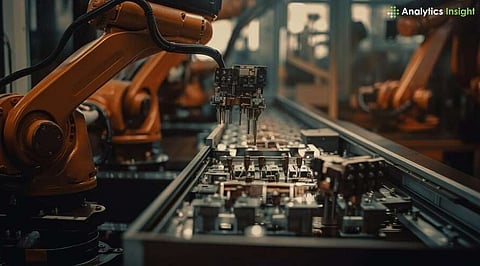
A smart factory is a manufacturing facility that uses AI, industrial IoT (IIoT), robotics, cloud computing, and real-time data analytics to automate processes, optimize production, improve quality, and reduce downtime.
Smart factories are transforming manufacturing by enabling predictive maintenance, AI-driven quality control, digital twins, and connected production systems that improve efficiency, flexibility, and decision-making across operations.
The core technologies include artificial intelligence (AI), industrial IoT (IIoT), robotics, digital twins, machine vision, cloud computing, edge computing, and advanced analytics for real-time production management.
Industries such as automotive, electronics, pharmaceuticals, aerospace, food and beverage, consumer goods, and industrial manufacturing benefit significantly from smart factories through higher productivity and better quality control.
Smart factories help manufacturers reduce costs, minimize production errors, improve sustainability, respond quickly to market demands, and build resilient supply chains, making them a key driver of Industry 4.0 and future manufacturing growth.
