.png)

What gray factories are and how they work
Role of AI, robotics, and IoT in automation
Benefits and challenges for manufacturers
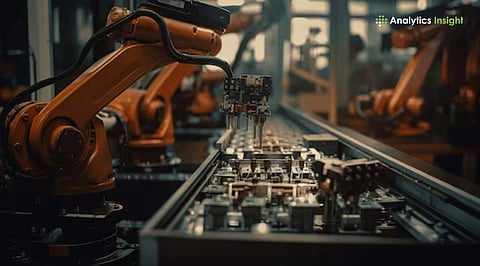
Gray factories refer to an advanced phase of industrial automation. These factories run with minimal lighting and almost no human intervention. The entire process is supported by highly sophisticated, intelligent machines, sensors, and software.
Manufacturers reduce manual labor to increase the efficiency in operations, accuracy, and speed of production. As of 2026, gray factories seem to be rising as the primary competitive strategy in the manufacturing industry.
Also Read: Leveraging SSRS and Big Data Analytics for Smarter Manufacturing Decisions
Gray factories are highly automated production setups that require little or no human supervision. They are also called lights-out factories because they operate with little to no lighting.
They employ robotic devices, artificial intelligence, cloud-based systems, and real-time analytics to manage manufacturing and production processes.
Companies save on running costs as they do not need to pay human workers, and can also save on power consumption, as there is no need for comforts like lighting or air conditioning.
In such factories, assembly and product packaging are done by industrial robots with the help of mechanisms for very accurate movement and sensitive handling of materials.
AI-based software tracks manufacturing processes, identifies faults, and proposes the most effective ways to work. This optimizes the workflow and reduces production time.
Sensors are used to monitor machine state, temperature, and product quality in real time. This helps maintain product quality while keeping production efficiency and speed high.
Cloud services are used as a repository of data from the manufacturing processes. With Edge used to process data in real time, issues or problems are flagged immediately. This also helps make time-bound, data-driven decisions.
Virtual reality smart factory models are used to simulate operations for better optimization and to make smarter decisions.
All these form a set of technologies that can turn a production facility into a self-governing factory.
Companies like Siemens offer intelligent automation solutions that combine machines, data, and software.
Such platforms enable companies to continuously monitor their processes and implement predictive control.
ABB is one of the leading manufacturers of robots that operate at very high speeds with great accuracy.
With their systems, companies can get their products onto the assembly line more consistently and with less waste.
Bosch is among the major suppliers of industrial sensors that can continuously monitor equipment condition.
These tools can signal malfunctions well before the equipment breaks down.
The AI systems can go through the whole production process and suggest new ways to make it more efficient.
Apart from this, they assist with quality inspection and market demand forecasting.
Cloud services make it possible for all factory data to be managed in one place and for the factory to be controlled remotely.
Machines do not get tired, so they work nonstop.
Lower energy consumption and wages mean making more money.
More accurate automated inspections can reduce errors caused by people.
Fewer people around means fewer chances of accidents.
Fast production changeovers are possible thanks to data-driven systems.
Automation systems come with a hefty bill.
Bringing different technologies together requires a high level of skill.
Connected devices are possible targets for hackers.
Employees will need to upgrade their skills to work digitally.
A technical glitch in a single part of the production can stop the whole production line.
Also Read: Top 10 AI Robotics Companies Leading Innovation in 2026
Gray factories have become the focal point of smart manufacturing models that emphasize real-time decision-making, resource optimization, and environmentally friendly production. Through the integration of automation and analytics, manufacturers can have better transparency and control over their operations.
This strategy is not only compatible with Industry 4. 0 standards but also supports the achievement of digital transformation goals.
In the next decade, gray factories are expected to shape changes in:
Customized mass production
Environmentally friendly manufacturing processes
Implementation of AI-powered supply chains
Development of autonomous logistics systems
Global interconnectedness through digital manufacturing networks
These innovations will be the industry game changers in terms of competitiveness.
Evaluate automation status quo
Devote finances to IoT and AI
Revamp old machines
Provide digital literacy training to staff
Establish collaborations with tech firms
A carefully planned itinerary will lead to less resistance.
Gray factories reflect the next stage in the evolution of smart manufacturing. By combining robotics, AI, IoT, and cloud systems, these factories can attain greater efficiency, higher product quality, and lower expenses.
Even though the execution of such endeavors requires significant capital investments and technical planning expertise, the resulting payoffs justify making gray factories a major strategic focus in 2026 and beyond.
1. What is a gray factory?
A gray factory is an advanced automated production plant that performs almost all processes without human intervention.
2. Are gray factories fully autonomous?
Generally, they are semiautonomous, with operators checking in remotely and providing on-site human supervision only occasionally.
3. Which industries use gray factories the most?
The leading sectors in implementing are the automobile, electronics, semiconductor, and precision manufacturing industries.
4. Are gray factories expensive to build?
Building a gray factory is definitely costly. The initial investment to set up the factory is high; however, long-term savings can offset it.
5. Do gray factories reduce jobs?
They eliminate manual labor roles but create more opportunities for highly skilled technicians and digital experts.
