.png)

Six verified wireless doorbells cover every home type, from rented apartments to independent villas
Each pick is compared on range, power source, storage cost, and smart integration, not marketing claims
Prices span from Rs 450 for a basic chime to Rs 16,999 for a premium smart video doorbell, with a clear trade-off noted for each
A doorbell used to have only one job earlier. It rang when someone was at the door, and that's it. Now, the same device can stream live video, send alerts to a phone, connect with smart home systems, and even lock or unlock the door. What used to be a small, cheap device is now tied to how a home handles security. Even so, a lot of buying guides still put basic wireless chimes and smart video doorbells on the same list, as if they were the same kind of product.
Price is not really where these products differ most. Signal range decides whether the doorbell still works properly in a bigger home, and the power source affects how easy it is to install and how much upkeep it needs later. Storage matters too, since it changes what ownership costs over time. Cloud storage usually means a monthly fee. Local storage is more of a one-time cost.
Smart integration can be small, just a notification when the bell rings, or bigger, tying into home automation and even electric locks. Wi-Fi signal near the door and a stable internet connection matter just as much as any of this. Since most doorbells rely on that connection to send alerts and let someone check in remotely.
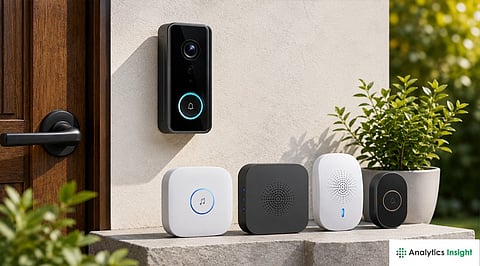
Every entry above solves a different problem: Some lean on cameras and smart alerts. Others exist purely to announce a visitor. The right pick depends on a home's layout more than on price.
This model focuses on picture quality. It's a 2K 5MP camera with a 160-degree field of view that captures visitors head to toe, and color night vision holds up well after dark. The IP64 rating handles monsoon exposure. Local SD card storage avoids any subscription, while an optional Tapo Care plan adds extended cloud history. The removable battery lasts up to 180 days per charge but still needs periodic recharging.
BUY NOW
Built for larger homes where Wi-Fi range is a real concern. AC power removes battery charging entirely, and dual-band Wi-Fi with an Ethernet port gives it a steadier connection than most battery-powered rivals. Its IP66 rating handles harsher outdoor exposure than IP64, and local storage scales up to 1TB without a subscription. The AC wiring that makes it reliable also makes it a poor fit for renters, who cannot run a permanent power line to the door.
BUY NOW
The budget entry point into video doorbells. Dropping to 1080p resolution and single-band Wi-Fi brings the price under Rs 6,500, while still delivering a built-in intruder alarm and a plug-and-play chime with 36 tunes. Footage shows less detail than the 2K models above, and extended cloud storage depends on a paid plan.
BUY NOW
Built for homes that want doorbell and lock control combined. A 7-inch indoor touch display shows a live 1080p feed with a 120-degree view, and the standout feature is direct control of a single electric lock, allowing a resident to verify a visitor and open the door without walking to it.
Storage stays local with no recurring fee, but the feed cannot be checked from outside the home network, and some users find the companion app less polished than dedicated doorbell apps.
BUY NOW
The strongest no-camera pick here. Panasonic's backing brings genuine service support, a rarity among unbranded alternatives in this price band. A 120-meter range covers most apartments and houses, and setup takes minutes with no drilling.
Forty-five melodies let one household's doorbell sound distinct from a neighbor's. What it lacks is any camera or way to see a visitor before opening the door.
Well suited to elderly residents or hearing-impaired households, and a solid choice for apartments where alerts matter more than cameras. A bright LED flash accompanies the chime, cutting through kitchen noise or catching attention when sound alone gets missed.
Fully plug-in and battery-powered, it moves easily between rentals without leaving marks on a wall. Like the Anchor pick, it carries no smart features: a plug-in receiver built for one job.
The category has split into two paths: simple chimes and connected systems doubling as security tools. The right choice depends on what a specific entrance needs.
Also Read: CCTV Camera vs Smart Doorbell: Which is Better?
A wireless doorbell doesn't have to be the expensive option to be the right one. It just has to suit the home it's going into. Most apartments do fine with a basic wireless chime. Bigger homes get more mileage out of video monitoring, stronger connectivity, and smart integrations. Think about what the space actually calls for, not how many features are on the box, and the purchase tends to age a lot better.
Also Read: Top 10 Smart Doorbells Compatible with Alexa and Google
Look for reliable wireless range, battery life, weather resistance, chime volume, easy installation, and smart features such as video monitoring, motion detection, and two-way audio if security is a priority.
Wireless doorbells are easier to install and ideal for renters or homes without existing wiring. Wired models provide continuous power, while battery-powered wireless options offer greater flexibility.
No. Basic wireless doorbells use radio frequency (RF) to connect the button and receiver without Wi-Fi. Smart video doorbells, however, require Wi-Fi for app access, notifications, and remote monitoring.
Battery life varies by model and usage. Standard wireless doorbells can last several months to over a year, while smart video doorbells typically require recharging every few months.
If you want added security, a smart video doorbell is a worthwhile investment. Features like live video, motion alerts, two-way communication, and visitor recording help monitor your home's entrance from anywhere.
