.png)

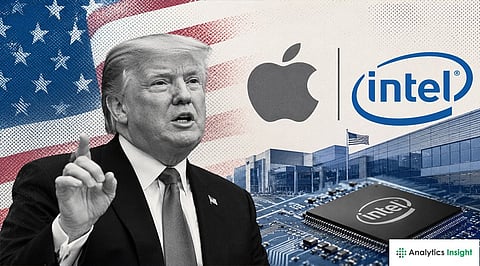
US President Donald Trump said Apple has agreed to work with Intel on chip design and manufacturing in the United States. He announced the partnership in a Truth Social post on Thursday, linking it to his administration’s drive to expand domestic semiconductor output.
Trump offered no contract terms, production schedule, chip models or factory locations. Apple and Intel had not confirmed the agreement when the announcement appeared. That lack of detail places doubt around the scope and timing of the proposed work.
Intel shares jumped between 6.5% and 9% in Thursday’s premarket session. Apple shares also edged higher. Investors reacted to the prospect of Intel securing business from a consumer electronics company.
“Apple has agreed to work with Intel to design and build its chips in America,” Trump wrote. Still, neither company issued a statement confirming whether the arrangement covers design, manufacturing, packaging or several operations.
Reports in May said Intel and Apple had reached a preliminary agreement after more than a year of talks. Under that reported plan, Intel would make some chips for Apple devices. The companies did not disclose which products could use them.
Meanwhile, Apple relies heavily on Taiwan Semiconductor Manufacturing Company for advanced processors used in iPhones, iPads and Mac computers. Adding Intel could give Apple another US-based option while demand for advanced production capacity rises across the artificial intelligence sector.
Intel has spent heavily to expand its contract manufacturing unit, but the business has struggled to attract enough large outside customers. An Apple order could provide steady demand and help Intel test its ability to serve a major device maker.
Nevertheless, the financial size of the possible agreement is unknown. Trump did not say when production would begin or whether Apple had committed to a minimum number of chips. The missing terms make the commercial value difficult to measure.
Intel moved its upgraded 18A-P manufacturing process into risk production. The company says the technology offers 9% higher performance at the same power level or 18% lower power use at the same speed compared with 18A.
Additionally, Intel says 18A-P works with existing 18A design rules, allowing customers to reuse intellectual property and development tools. That feature may shorten design work, though Intel has not said Apple will use 18A-P for the reported partnership.
Trump presented the Apple announcement as part of an effort to bring more chip design and production into the United States. He referred to Intel’s reported work with NVIDIA and Elon Musk’s TerraFab project.
The administration took a 10% stake in Intel last year and announced plans to invest about $10 billion in US factories. Trump later said the government’s holding had risen sharply in value, although market prices can change daily.
For Apple, working with Intel could reduce reliance on one supplier without ending its relationship with TSMC. TSMC operates leading production lines, and its capacity serves Apple, NVIDIA, Advanced Micro Devices, and other customers.
The announcement reflects Trump’s account of the agreement rather than matching statements from both companies. Further details from Apple or Intel would be needed to confirm the chips involved, production volumes, manufacturing sites, and launch dates.
Also Read: NVIDIA Targets Intel and AMD With New RTX Spark Processor for Windows Laptops
