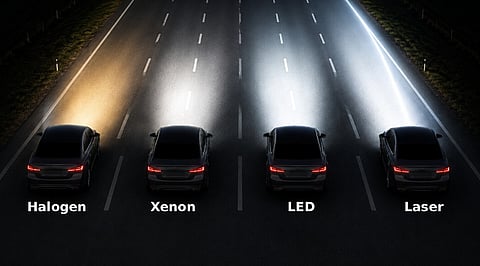
.png)

LED headlights offer the best mix of brightness, efficiency, and long lifespan.
Halogen headlights are the cheapest but have the shortest life and lowest brightness.
Laser headlights provide the longest beam but are mostly available in luxury vehicles.
Car headlights have changed dramatically over the years. Older cars mostly came with basic halogen bulbs. However, many new cars now use LED or even laser headlights. Headlights with improved design help drivers see the road clearly at night, during rain, and in fog. They also make it easier for other people on the road to notice a vehicle.
Every type of headlight works differently. Some cost less but do not last long, while others are bright, use less electricity, and last for many years. Knowing the difference helps buyers choose the right car and understand maintenance costs.
Halogen is the most commonly used and probably the oldest type of headlight. Most budget-friendly cars use them since the manufacturing and replacement costs are lower. These lights are equipped with a bio micro-thin filament in the glass bulb that produces light once electric current passes through it.
Typically, a halogen light can generate around 1,000-1,500 lumens of light. The beam emitted appears to be either white or warm yellow. While it is suitable for city roads, it does not produce enough light for dark highways.
A major flaw of halogen lights is their short lifespan. The average lifetime of a halogen bulb is 500-1,000 hours. Additionally, halogen lights usually generate heat and consume more power than modern types of lights. Despite the mentioned shortcomings, halogen lights are popular for their affordability.
Xenon headlights are also called HID, which stands for High-Intensity Discharge. These headlights do not have a filament but generate light through a small electric spark within a bulb filled with xenon gas.
This method gives much brighter light. A xenon headlight produces light of around 3,000 lumens, which is about twice as bright as many halogen bulbs. The white light also helps drivers see road signs, people, and animals more clearly at night.
Another advantage is lifespan. A xenon bulb usually works for 2,000 to 3,000 hours, much longer than a halogen bulb. However, xenon headlights are expensive. They also need a special part called a ballast to function properly. After turning the headlights on, it takes a few seconds for them to illuminate.
LEDs, or Light Emitting Diodes, are currently one of the most used types of headlights in newly manufactured cars. They rely on a small electrical component to produce light, which significantly decreases energy consumption.
A major advantage of an LED headlight is its long lifespan. Most of them can last for over 20,000 hours, reducing the need to replace headlights in the long run. Additionally, LED headlights provide full illumination as soon as they are lit. They emit pure white light, ensuring visibility even when it’s dark.
These lights are also quite popular among car manufacturers for their compact size, as small lights provide more room for designers' creativity. The only disadvantage is that they can be rather expensive. If the entire unit is damaged, the repair costs can be considerable.
Laser headlights are the latest type of car headlights. They are mostly found in expensive luxury cars. Despite the name, they do not shine laser beams onto the road. Instead, small laser units first create energy, and this energy then passes through a special material that changes it into bright white light.
Laser headlights can light up the road several hundred meters ahead. This makes night driving much safer, especially on highways. They also use significantly less amount of electricity and are compact. However, laser headlights can be expensive to manufacture and repair, limiting them to premium vehicles.
Also Read - Top Luxury SUVs Dominating Indian Roads Right Now
Halogen headlights are the cheapest option, but they are the least bright and have the shortest life.
Xenon headlights give much brighter light and last longer than halogen, but they cost more.
LED headlights offer the best mix of brightness, long life, and low power use. That is why most new cars now use LED lights.
Laser headlights give the best performance of all. They shine much farther than other headlights but are also the most expensive.
Car headlights today do much more than light up the road.
Many new vehicles now have Adaptive Driving Beam (ADB) technology. This system changes the high beam automatically. It keeps the road bright without shining strong light into the eyes of drivers coming from the opposite side.
Another new feature is Matrix LED technology. Instead of one large light, these headlights have many small LED sections. Each section can switch on or off by itself. This helps keep the road bright while reducing glare for other drivers.
Some luxury cars also have digital headlights. These can show warning signs, lane marks, or navigation directions directly on the road.
Car companies are also working on Micro-LED technology. Experts believe it will offer even better light, higher efficiency, and a longer life than today's LED systems.
The market for advanced automotive lighting keeps expanding yearly, with industry reports indicating that numerous automobile manufacturers are exchanging halogen lights for LED systems.
It is also anticipated that there will be a massive increase in the use of adaptive lights and laser lights over the course of the next ten years. The increased safety regulations, availability of electric vehicles, and better technology are the three influencing factors.
The use of halogen lights in economic cars continues to be widespread, while LED lights have become the norm in most new cars globally.
Also Read - Best Blue Light Screen Protectors for Eye Protection in 2026
Each headlight type has its distinct purpose. Halogen headlights are inexpensive and simple to change. Xenon headlights provide brighter light and have better longevity. LED headlights give the best combination of brightness, long life, and low power consumption, and have a lifespan of over 20,000 hours. Laser headlights produce the longest and most powerful beam, but are also the most expensive ones.
With the advancement in technology in the automobile industry, car headlights will become smarter over time. New technologies like Adaptive Driving Beam, Matrix LED, digital lighting, and Micro-LED will make night driving easier and safer.
1. Which headlight type is the brightest?
Laser headlights are the brightest and can light up the road several hundred meters ahead.
2. Why are LED headlights so popular?
LED headlights use less electricity, last more than 20,000 hours, and provide bright white light.
3. Are xenon headlights better than halogen?
Yes. Xenon headlights are brighter, last longer, and improve visibility at night.
4. Can halogen headlights be replaced with LED headlights?
Yes, but compatibility depends on the vehicle. Some cars may need additional parts or approved conversion kits.
5. What is Matrix LED technology?
Matrix LED headlights use many small LED sections that adjust automatically to reduce glare while keeping the road well lit.
