.png)

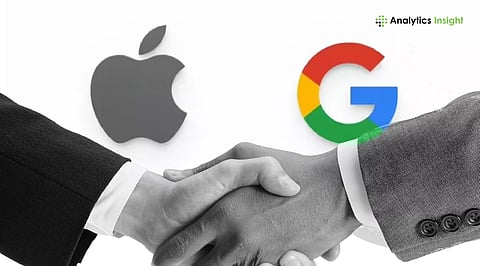
Apple is reshaping its AI roadmap by integrating Google’s advanced AI capabilities.
The collaboration balances speed, privacy, and performance in a fast-moving AI race.
It could redefine how AI features reach everyday users on Apple devices.
Apple is not a company that rushes into adopting new technologies. It takes time to refine and introduce polished experiences for users. The company has always ensured complete improvement of its cloud services and artificial intelligence.
However, Apple is now facing heavy challenges to compete against rapid innovation and advances in AI from companies like Google, Microsoft, and OpenAI.
This urgency explains why the tech giant turned to Google. The partnership signals a shift in Apple’s AI strategy to prioritize speed and capability while maintaining its core focus on user privacy and device integration.
Let’s take a look at the probable factors behind Apple’s strategy and how it may impact innovation.
Apple invested in large amounts for features such as Face ID, photo recognition, and on-device suggestions. However, large language models require massive datasets, specialized infrastructure, and years of iteration.
OpenAI, Google, and Meta are investing hundreds of billions of dollars in data centers, chips, and large-language-model training. At the same time, iPhone makers took a restrained approach with AI innovations. The iPhone maker has treated AI as a way to integrate into its products, not as a standalone business that requires endless infrastructure investment.
Also Read: Apple Loses Key Siri Strategist to Meta Amid Growing AI Rivalry
Apple has reshuffled leadership around Siri and AI. Siri has been placed under Mike Rockwell, who was responsible for launching the Vision Pro headset.
Apple's AI chief, John Giannandrea, announced his retirement earlier in December. His team was redistributed amid internal concerns regarding a lack of clear product direction. These changes point to Apple's effort to refocus its AI work.
The company’s biggest AI-related move will be the long-anticipated overhaul of Apple Siri. It is expected to arrive in the spring of 2026. The updated assistant is set to be more conversational and capable of completing multi-step tasks.
Apple is adopting Google's Gemini, which shows “an internal view that large language models may become commoditized and not worth the cost of large-scale proprietary development,” according to Macrumors.
Apple has been developing its own personal artificial intelligence models, but development has not progressed as quickly as Apple would have expected. In contrast, Google's Gemini models developed much faster than originally planned. These models are now used in conjunction with various search, Android, and workspace products. Apple faced the pressure of developing similar products at an accelerated pace.
Apple lacks experience in training and extensive deployment of large language models. It makes Gemini, which understands text, images, and context across tasks, more useful.
Apple could integrate Google’s models selectively, focusing its own efforts on interface design, on-device processing, and privacy safeguards. This hybrid approach will allow Apple to maintain its ecosystem control while benefiting from Google’s AI capabilities.
Think of Apple’s AI system as the front desk and Google’s model as a specialist consultant. Apple handles when, where, and how AI appears on your device. Google’s model steps in only when complex language understanding or generation is required.
Everyday users will enjoy features such as more capable conversational agents, photo organization capabilities, contextual assistance, and many more. Developers will benefit from AI integration within Apple by eliminating the requirement for third-party integrations.
The partnership introduces questions around long-term dependence and differentiation. The key questions remain:
Can Apple truly stand apart if core intelligence comes from a rival?
How will regulators view another major Apple-Google partnership?
Will Apple’s emphasis on privacy coexist with cloud-based AI models?
Also Read: Apple’s Open Secret? Employees Are Using AI Chatbots to Move Faster Amid Delays
Several tech companies are collaborating with another company on AI technology while continuing with their own internal innovations. Speed matters as much as ownership. Tech giants are choosing collaboration over isolation when timelines are tight.
Apple’s decision to work with Google reflects a more realistic view of modern AI development, where collaboration accelerates progress. Consumers no longer need to know which company was responsible for developing a particular AI solution, but only want to know if that specific solution will help them get their work done efficiently.
The real test will be how seamlessly AI fades into the Apple experience, doing more, demanding less, and staying largely invisible.
What role does Google play in Apple’s AI strategy?
Google provides advanced language model capabilities, while Apple controls how AI is integrated into its devices, focusing on user experience, privacy, and system-level optimization.
How will this partnership affect iPhone and iPad users?
Users can expect smarter AI features such as improved writing assistance, more capable voice interactions, and better contextual understanding across apps.
Which Google AI model is Apple using?
Apple is reportedly integrating Google’s Gemini family of AI models, known for their advanced multimodal and language capabilities.
Why couldn’t Apple build these AI features on its own?
Building large language models at scale requires enormous computational resources and datasets, making partnerships a faster and more efficient path amid intense competition.
What does this partnership say about the future of AI in big tech?
It signals a shift toward collaboration over isolation, showing that even the largest tech companies are combining strengths to stay competitive in the fast-moving AI landscape.
