.png)

Explores how AI assistants are transforming the in-car experience through conversational intelligence.
Compares AI partnerships between major automakers including GM, Mercedes-Benz, BMW, Tesla, Stellantis, and Lucid.
Examines the opportunities and challenges surrounding privacy, cloud connectivity, and the future of software-defined vehicles.
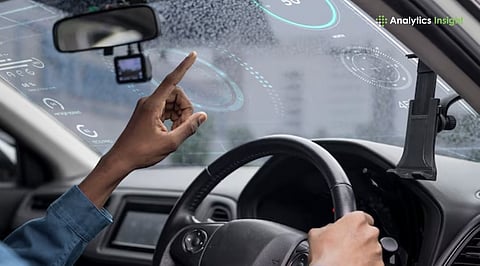
Voice assistants in cars have long been a frustrating experience rather than a convenient one. Car owners became adept at memorizing specific commands, repeating commands when misinterpreted, and ultimately turning to the touchscreen in despair. This era is coming to an end. Every single big car manufacturer has agreed with a major AI laboratory, switching from command systems to conversation-driven assistants based on large language models.
As noted by The Business Research Company, the in-car voice assistant industry is expected to be worth $3.27 billion in 2026 and to amount to $5.49 billion in 2029 with an annual rate of 13.9%. The growth of the industry is linked to the emergence of new capabilities of the car assistants and the rivalry between manufacturers over selecting their AI provider for the next decade.
This change carries significant commercial value in addition to technical merit. An engaging AI experience is fast emerging as a key differentiator affecting purchasing decisions, subscription plans, and ultimately brand loyalty, just like how the mobile phone ecosystem dictated consumer behavior about ten years ago. In the case of car manufacturers, the vehicle itself has evolved to become more than a mere means of transport; it is turning into yet another digital gadget vying for the driver’s attention.
The technical leap driving this transformation comes down to large language models replacing older rule-based voice systems. Previously, saying "find Italian food" might return a random, unfiltered list of restaurants with no real understanding of intent. Modern systems interpret nuance, prioritizing distance, ratings, or price even when the driver doesn't explicitly ask for it. This shift also enables multi-step, conversational requests that build on each other. A driver can now say something like "take me to the nearest coffee shop and text my mom I'll be late," then naturally follow up with "actually, make it one with outdoor seating," without restarting the interaction or repeating context already established.
Under the hood, this natural-language capability depends on a pipeline of distinct technologies working together. Automatic Speech Recognition converts spoken words into text, Natural Language Understanding interprets the meaning and intent behind that text, and the assistant then pulls from real-time data sources: maps, weather feeds, charging-station APIs, or a car's own sensor data before generating a response in plain language.
For electric vehicle owners specifically, this has translated into genuinely practical upgrades: a driver low on battery can simply ask whether there's a fast charger nearby that's still open, and the assistant can check live availability, pricing, and operating hours before recommending a route, all inside a single spoken exchange rather than a multi-app search.
Also Read: How to Use AI to Find the Perfect Car: Expert Buying Guide
In the past year, there have been several battles over AI within the car industry as opposed to the emergence of one clear standard. General Motors revealed that they were going to integrate Gemini from Google into Buick, Chevrolet, Cadillac, and GMC cars that use their "Google built-in" infotainment system, and there are almost four million such cars in the US alone, which makes this the biggest deployment of conversational AI.
Mercedes-Benz was among the first to embrace AI integration by incorporating ChatGPT into their MBUX Voice Assistant with the help of Microsoft Azure OpenAI Service, which could pull the answers to general knowledge questions with the Bing search engine and deliver them in natural language. BMW went another way by integrating Amazon's Alexa+ service into their Intelligent Personal Assistant in the new iX3 at CES 2026, after which it will become available in 40 models by 2027. However, Tesla decided to take another approach by integrating xAI's Grok into its vehicles, while Stellantis is partnering with French AI company Mistral for their next generation, and Lucid teamed up with SoundHound.
What's notable is how differently each automaker is approaching the same underlying problem. GM is leaning on its decades-old OnStar connectivity network to justify scaling Gemini to millions of vehicles at once, framing it as a bridge toward a fully proprietary, vehicle-specific AI trained on GM's own engineering data. BMW's pitch centers on continuity across a driver's broader digital life; a conversation started with Alexa+ at home can carry directly into the car without repeating context.
Mercedes, meanwhile, has doubled down on knowledge depth, positioning MBUX as capable of answering genuinely open-ended questions rather than only vehicle-related commands, thanks to its Bing-search-backed ChatGPT integration. None of these approaches has yet emerged as a clear industry standard, and it's likely automakers will continue experimenting with different AI partners rather than settling on one shared architecture in the near term.
Beyond answering trivia questions, these systems are increasingly built to handle genuinely useful, context-aware tasks. BMW's Alexa+ integration, for instance, can respond to a single sentence like "I'm feeling cold and would like pizza on the way home" by adjusting cabin temperature while simultaneously pulling up well-rated Italian restaurants along the route. It can also carry context across devices; a conversation about a ski trip started on an Alexa+ device at home can continue seamlessly once the driver gets in the car, simply by saying "take me to the place we just talked about."
Mercedes has focused on architecture rather than novelty, recently partnering with Liquid AI to run parts of its voice assistant on-device rather than relying entirely on the cloud, a meaningful upgrade for scenarios like asking for directions moments before reaching an intersection, where a cloud round-trip delay could mean a missed turn.
GM's vision extends this further, describing a future where drivers can ask a highly specific question about their vehicle, down to individual parts and systems, and receive a precise, accurate answer instead of a generic response pulled from a general-purpose model. That level of specificity requires an assistant fine-tuned on proprietary vehicle data rather than one built purely on public information, which is why GM has described its current Gemini rollout as an interim step ahead of a more specialized, OnStar-informed system planned for later release.
Beyond convenience features, some automakers are also using these assistants as a layer on top of driver-assistance functions, allowing spoken requests to adjust driving modes, trigger diagnostic checks, or surface maintenance alerts without the driver needing to navigate a menu system while in motion.
Despite the polish of these demos, the underlying technology carries real limitations that automakers are still working through. Large language models are prone to occasional hallucination, generating a confident but incorrect answer, which becomes a more serious concern when the response involves navigation or safety-relevant information rather than trivia.
Most current systems also depend heavily on cloud connectivity, introducing latency and creating potential blind spots in areas with poor signal, which is part of why companies like Mercedes are experimenting with on-device processing for time-sensitive requests. Data privacy is another growing concern, prompting automakers like GM to publicly commit to explicit opt-in consent and a policy against selling driver data, following prior industry criticism over connected-vehicle data practices.
Driver reception has also been mixed, and automakers are still gauging how much conversational depth people actually want behind the wheel versus how much simply adds friction. Some drivers have expressed reluctance about AI systems processing everyday conversations inside their vehicles at all, while others have raised concerns about wake-word design and whether an assistant might activate unintentionally during normal cabin conversation.
Automakers have responded by emphasizing that microphone activity is tied to explicit wake words or a physical steering-wheel button and that features remain optional rather than mandatory: core functions like navigation and climate control continue to work without linking any third-party AI account.
Also Read: How Generative AI Will Transform Cars from What Automakers Predict?
The current wave of chatbot-style assistants is widely seen as a stepping stone rather than the end state. GM has stated that its Gemini rollout is an interim step ahead of a proprietary, OnStar-trained assistant designed to have detailed knowledge of a vehicle's specific parts and systems. Automakers are also increasingly linking these conversational layers to advanced driver-assistance systems, using natural-language interaction as the front end for features like automated routing, predictive maintenance alerts, and deeper integration with autonomous driving systems.
As competition between Google, OpenAI, Amazon, xAI, and Mistral plays out across dashboards rather than smartphones, the modern car is increasingly being positioned not just as a mode of transport but as another connected device in a driver's daily digital ecosystem. This trajectory also lines up with the broader shift toward software-defined vehicles, where a car's capabilities are expected to improve continuously through over-the-air updates rather than requiring new hardware. BMW has explicitly tied its Alexa+ rollout to this strategy, while GM's cloud-based Gemini architecture allows Google and GM to add features after launch without a full vehicle software update.
For consumers, this likely means the AI assistant sitting in a car showroom demo today will look meaningfully different a year into ownership, a departure from how infotainment systems have traditionally worked, where capability was largely fixed at the point of sale. Whether this results in a genuinely safer, more useful driving companion, or simply a more sophisticated version of the same distraction concerns that have followed touchscreen infotainment for over a decade, is likely to become clearer as adoption scales beyond early pilot vehicles over the next two to three years.
Why this Matters
Artificial Intelligence is becoming a key differentiator in the automotive industry. As automakers compete through software, connected services, and intelligent assistants, AI is shaping purchasing decisions, improving driver experiences, enabling safer interactions, and accelerating the transition toward software-defined vehicles.
AI assistants are intelligent voice systems that use LLMs and natural language processing to help drivers interact with their vehicles. They can manage navigation, climate controls, entertainment, messaging, and vehicle information through natural conversations instead of fixed voice commands.
Traditional voice assistants relied on predefined commands and limited responses. Modern AI assistants understand conversational language, remember context, complete multi-step requests, and integrate with live data sources, making interactions faster, more intuitive, and significantly more useful for drivers.
Major automakers including General Motors, Mercedes-Benz, BMW, Tesla, Stellantis, and Lucid have partnered with companies such as Google, OpenAI, Amazon, xAI, Mistral AI, and SoundHound to develop advanced AI-powered in-car assistants.
AI assistants can provide navigation, recommend charging stations or restaurants, adjust climate settings, answer general questions, control infotainment systems, send messages, schedule destinations, perform vehicle diagnostics, and support predictive maintenance using conversational voice interactions.
By reducing the need to use touchscreens and physical controls, AI assistants allow drivers to complete tasks using natural speech. This creates a more convenient, personalized, and potentially safer driving experience while improving productivity during journeys.
