.png)

Earth's orbit is becoming increasingly crowded as thousands of new satellites are launched every year for internet, communication, and navigation services.
While these satellites make modern life easier, they also create bright streaks and radio interference that can disrupt important astronomical observations.
Scientists warn that without better planning, future telescopes may struggle to capture clear images of the universe, making major space discoveries much harder.
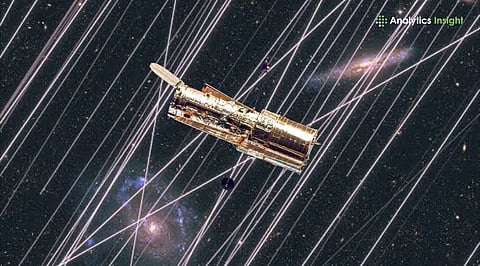
There was a time when looking at the night sky meant seeing only stars, planets, and the Milky Way. Today, that picture is slowly changing. More and more satellites are moving across Earth's orbit, leaving bright lines that often appear in telescope images.
This rise in the number of satellites is helping millions of people. Faster internet, better GPS, weather updates, and emergency communication all depend on satellites. These services have become part of daily life.
However, every new launch also adds another object to the sky; for people using telescopes, that creates a growing problem. Instead of getting a clear view of distant galaxies, many observatories now have to deal with unwanted light crossing their images.
Scientists are not against satellites. They simply want a balance where technology can grow without making it harder to explore the universe.
Space has become much busier than it was just a few years ago. Private companies and governments are sending large numbers of satellites into orbit to improve global communication.
The biggest reason is demand. People expect fast internet wherever they live. Ships at sea, airplanes, villages, and remote areas all depend on satellite networks. Businesses also need reliable communication, while weather agencies and emergency teams rely on satellites every day.
Launching satellites has also become less expensive. Modern rockets can carry many satellites on a single mission. This has encouraged companies to build large satellite networks rather than launch only a few. These projects bring many benefits. They connect places without mobile towers, improve navigation, help farmers monitor crops, and support rescue teams during disasters.
Still, there is another side to the story. Every satellite reflects sunlight. During the night, that light can pass directly across a telescope's view. The result is a bright streak that covers part of the picture. As more satellites enter orbit, these streaks appear more often.
Several companies are planning thousands of additional satellites over the next few years. Without careful planning, the sky could become even more crowded.
Also Read: Amazon to Acquire Globalstar in $11.57B Satellite Deal
Modern telescopes are built to study very faint objects that are billions of light-years away. They need a dark and quiet sky to do that work.
When a satellite passes in front of a telescope, it leaves a bright line across the image. Sometimes researchers can remove those marks with software. In many cases, however, valuable information is lost forever.
Radio telescopes face another problem. Many satellites transmit radio signals as they orbit Earth. These signals can interfere with the weak signals that scientists are trying to detect from deep space.
Future observatories could face even bigger challenges. New telescopes are expected to search for distant planets, study the first galaxies, and answer questions about how the universe formed. These projects depend on very clean observations.
Most experts do not believe telescopes will stop working. However, if the number of satellites continues to rise at the current rate, many observations could become slower, more difficult, and more expensive. Reports have already suggested that if the number of satellites in Earth's orbit exceeds 100,000, humanity may lose its ability to study the universe from the planet's surface.
To pacify the situation, scientists have suggested a few solutions. Some want satellites to use darker materials, so they reflect less sunlight. Others have suggested that satellite operators and observatories should work together and share flight information.
These measures may allow telescopes to avoid passing satellites while taking pictures. If the ideas work, they will reduce the problem to some extent, but can't completely resolve it, as long as the launches continue at the same pace.
Also Read: Top 10 Satellite Internet Services for Remote Areas
Why it Matters
The night sky belongs to everyone. If satellite traffic continues to increase without proper planning, future discoveries could become much harder. Protecting astronomy today is important to ensure that future scientists can explore space, answer new questions, and gain a better understanding of the universe.
Satellites have changed the way we live. They have improved weather forecasting, emergency services, communication, and navigation. So their importance will undoubtedly increase in the coming years. However, astronomy also matters to humankind's progress.
Every single discovery helps us learn more about planets, stars, black holes, and the history of the universe. So, the debate is never about choosing one over the other. It is more likely that a way can be found for both to exist without conflict.
With smarter satellite designs, better planning, and closer cooperation between companies and scientists, it is possible to protect the night sky and still build new technology. Today's decisions will tell how clearly future generations can look out into space.
What is satellite crowding?
Ans: Satellite crowding means many satellites are sharing Earth's orbit at the same time. As more satellites are launched, space becomes busier, making it harder for telescopes to capture clear images of the night sky.
Why do satellites affect astronomy?
Ans: Satellites reflect sunlight and create bright lines in telescope images. They can also produce radio signals that interfere with observations, making it more difficult for scientists to study distant objects in space.
Will telescopes become useless in the future?
Ans: No. Telescopes will continue to play a major role in astronomy. However, if the number of satellites keeps growing without better planning, many observations could become less accurate and take longer.
Why are companies launching so many satellites?
Ans: Most satellites support internet services, communication, navigation, weather monitoring, and scientific work. Lower launch costs have also made it easier to send large groups of satellites into orbit.
Can this problem be reduced?
Ans: Yes. Scientists believe darker satellite designs, better coordination between observatories and satellite operators, and responsible space policies can reduce the impact and help protect future astronomy.
