.png)

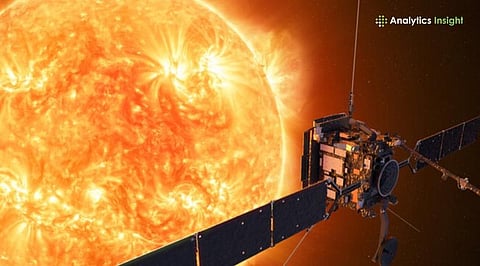
India's first solar observatory, Aditya-L1, played a key role in decoding the unusual behaviour of the strongest solar storm that struck Earth in May 2024. The discovery was made using the Gauribidanur radio telescope, operated by the Indian Institute of Astrophysics (IIA). It is supported by the Visible Emission Line Coronagraph (VELC) onboard Aditya-L1.
Scientists observed a CME-driven shock forming at a distance of approximately 130,000 kilometers above the Sun’s surface on 27 May 2024. The shock was traveling at nearly 1,700 kilometers per second.
According to Prof. R. Ramesh, Senior Professor at IIA and Principal Investigator of VELC, this is the closest distance from the Sun at which such a shock and its associated radio burst have been unambiguously detected.
The sunspot group linked to the May 27 event may have been the same region that produced the powerful “Mother’s Day” solar storm in May 2024. Due to the Sun’s rotation, the active region reappeared on the eastern edge of the Sun later that month.
Satellites and GPS systems are subject to substantial threats from solar flares. They cause interference in Earth's upper atmosphere, distort signals, and can damage electronic equipment. For centuries, scientists have disagreed as to where these shockwaves come from. While similar interplanetary shocks have been observed near Earth, identifying their “birth stage” near the Sun has remained challenging.
Also Read: India’s Largest Private Satellite: GalaxEye’s 160 kg Mission Drishti Heads to Space
According to a statement from ISRO, the solar storm, now known as "Gannon's storm," severely disturbed Earth's environment. It involved a series of giant explosions on the Sun. When these large CME bubbles collide with our planet, they can disrupt Earth's Magnetic Shield, causing damage to satellites, communications, and Power Grid Systems, as well as disrupting Global Positioning Systems (GPS).
"This discovery matters because it enhances our understanding of how solar storms evolve as they travel from the Sun to Earth. This demonstrates India's growing leadership in global space science. With Aditya-L1's contributions, India is now better prepared to understand and predict powerful solar storms," ISRO said in a statement.
The findings mark a significant step toward improving space weather forecasting and protecting modern technological infrastructure from solar threats.
