.png)

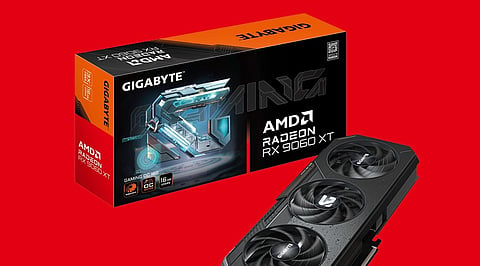
Graphics cards can feel like a wall of numbers and letters that mean nothing to most buyers. The AMD Radeon RX 9060 XT is a good example of a card built with real engineering ideas behind it, not just a spec sheet. Here is what sits inside it and what that means for anyone who sits down to game.
Every graphics card runs on an architecture, the design plan for how the chip works. The RX 9060 XT uses AMD's RDNA 4 design, a step up from the older RDNA 3 plan found in cards like the RX 7600. Think of it like a car engine getting a redesign: same basic job, more work done per cycle.
AMD built the RX 9060 XT around a chip called Navi 44, made on a 4-nanometer manufacturing process. A smaller process node packs more switches into the same space, which gives engineers room to improve efficiency. It does not, on its own, guarantee lower power draw; that still depends on how the whole chip is tuned.
The card carries 32 compute units, the processing blocks that handle every frame drawn on screen. RDNA 4 refines how these units are built, so the generation as a whole does more work for a similar unit count compared with RDNA 3.
Inside those units sit 2,048 stream processors. These handle lighting, shadows, textures, and color, painting every object a player sees on screen.
Ray tracing makes light, shadows, and reflections behave the way they do in the real world, instead of looking flat. It carries a real performance cost, and demanding ray-traced games can still slow this card down.
The RX 9060 XT carries 32 ray accelerators, AMD's third-generation design. A new second ray intersection engine inside each accelerator doubles throughput for two key calculations compared with the RX 7600 generation. That is a genuine architectural gain, though actual results still vary by game, settings, and resolution.
FSR 4 is AMD's upscaling technology. The GPU renders a scene at a lower resolution internally, then rebuilds it at full resolution using machine learning. The result looks close to native quality while running lighter on the hardware.
FSR 4 is AMD's first upscaling tool built around machine learning rather than older scaling math, and it runs exclusively on RDNA 4 cards.
FSR 4 needs somewhere to run its machine-learning math, and that is the job of the card's 64 second-generation AI accelerators. These are dedicated processing units built for AI calculations, separate from the general graphics pipeline, so AI-driven features do not steal performance from regular rendering.
They support newer data formats like FP8 and can reach up to 821 TOPS of AI performance, a figure that points toward AI-assisted rendering playing a larger part in future games.
The card pairs 128-bit GDDR6 memory with 32MB of Infinity Cache, a small, fast pool that stores frequently used graphics data close to the processing units. This cuts down trips to the main memory and helps bandwidth reach up to 320 GB/s.
Worth noting: this cache size matches the previous generation exactly. The bandwidth gain here comes from faster memory chips, not a larger cache.
Choosing between 8GB and 16GB matters beyond longevity. High-resolution textures and detailed environments consume memory directly, and once a game runs out of available memory, frame rates can drop even when the GPU itself has processing power to spare.
For 1080p gaming at moderate settings, 8GB holds up well. Heavier texture packs or 1440p play make 16GB the safer pick.
Also Read: AMD Launches Ryzen 7 CPUs, Radeon RX 9070 GRE at Computex 2026
The card runs on a single 8-pin power connector, keeping installation simple. Board power sits at 150W for the 8GB model and 160W for the 16GB model, modest enough for many existing mid-range power supplies. A full PCIe 5.0 x16 interface supports the current generation of motherboards and leaves room for later platforms.
Also Read: AMD Radeon RX 9070 XT vs. Nvidia GeForce RTX 5070 Ti
The RX 9060 XT shows how mid-range graphics cards are moving beyond raw processing power alone. Dedicated ray accelerators, AI accelerators, and a cache built for quick data access now work together rather than as separate boxes on a spec sheet. As game engines lean harder on AI-assisted rendering, cards designed around that balance from the start are the ones likely to age well.
1.Is the AMD Radeon RX 9060 XT good for 1440p gaming?
It handles 1440p well in most titles, especially with FSR 4 upscaling turned on. Heavier, ray-traced games at 1440p may need settings adjustments to hold a steady frame rate.
2.What is the difference between the 8GB and 16GB models?
Both use the same 32 compute units and core design. The only difference is memory capacity, which affects how well the card handles high-resolution textures and memory-heavy games over time.
3.Does the RX 9060 XT support ray tracing?
Yes. It includes 32 third-generation ray accelerators built specifically for ray tracing calculations, a clear step up from the previous generation.
4.What is FSR 4, and does this card support it?
FSR 4 is AMD's machine-learning upscaling technology. The RX 9060 XT supports it directly through its 64 second-generation AI accelerators, which handle the required calculations.
5.How much power does the RX 9060 XT need?
The 8GB model is rated at 150W, and the 16GB model at 160W. Both run on a single 8-pin power connector, so most existing mid-range power supplies can handle the card without an upgrade.