.png)

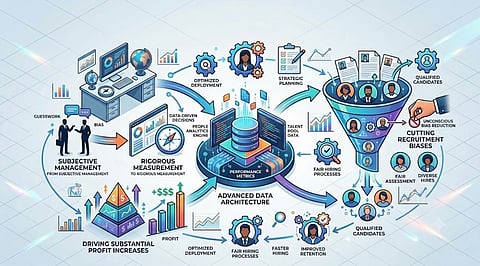
As corporate planning shifts from subjective management to rigorous measurement, advanced data architecture is driving substantial profit increases and cutting recruitment biases.
The infrastructure of human resources has undergone a fundamental redesign over the past decade. The traditional reliance on intuitive hiring and subjective management has been replaced by a rigorous, statistical approach to organizational design. Human resources departments now operate as central intelligence hubs, analyzing vast datasets to anticipate workforce trends, measure funnel velocity, and optimize talent allocation. This shift represents a broader recognition that labor is an optimization challenge best managed through quantitative measurement and strategic analysis. Metrics such as cost-per-hire, compensation benchmarking, and organizational footprint analysis are no longer supplementary; they are the primary drivers of corporate planning.
The necessity of this data-centric approach is clear across major enterprises as they scale their global operations. SHRM research indicates that 71% of HR executives whose organizations use people analytics say it is essential to their HR strategy. Organizations rely on these analytical frameworks to dissect performance patterns, identify operational bottlenecks, and align their human capital with their broader operational objectives. Without a centralized analytics function, executives risk making critical structural decisions based on fragmented or entirely anecdotal information.
This evolution extends beyond simply counting headcount or tracking administrative functions. CIPD factsheet defines strategic workforce planning as the process of balancing labor supply against demand, analyzing the current workforce, identifying future needs, and implementing solutions to help organizations accomplish their mission and strategic plan. By evaluating both the quantitative and qualitative aspects of the workforce, companies can preemptively address skills gaps before they disrupt commercial output. The ability to model future workforce dynamics against projected business growth defines the modern standard for talent strategy.
The financial implications of deploying sophisticated talent acquisition systems are substantial and well-documented. McKinsey research demonstrates that companies using data and advanced analytics to inform their talent decisions realize up to a 30 percent increase in profits through hiring focus alone. These systems enable organizations to evaluate candidate pipelines mathematically, reducing the subjective variables that frequently lead to costly hiring errors. Consequently, human resources teams are heavily investing in robust data architecture.
Kwan Chun Clinton Ngan knows this challenge firsthand. A people analytics professional with more than ten years of experience across HR data and workforce intelligence roles in Asia, Europe, and the United States, he has built his career translating complex workforce data into C suite decisions. At Meta, he served as the sole owner of offer health analytics across a workforce of approximately 75,000 employees and developed the organization’s first standardized metric for evaluating recruiting effectiveness at scale. “The true function of a workforce intelligence system goes beyond simple measurement. It provides a reliable, objective foundation for organizational growth, replacing subjective bias with mathematical clarity,” Ngan explains.
This analytical philosophy is essential when managing data infrastructure at global scale. Operating in an environment of this magnitude requires a departure from manual reporting and disconnected spreadsheets. Instead, it demands automated dashboards and unified metric definitions to ensure that vice presidents and chief executives receive accurate, standardized information for structural and resource allocation decisions.
Maintaining organizational effectiveness requires an exact understanding of employee sentiment and its relation to long-term operational health. According to Gallup, employee engagement and strengths-based development are two of the strongest predictors of team performance, retention, and profitability. “By treating employee sentiment as actionable data, organizations can align their structural policies with the actual realities of their workforce,” Ngan observes.
When organizations treat sentiment as structured data rather than anecdotal feedback, it becomes a direct input to policy - shaping decisions on everything from remote work arrangements to office infrastructure.
The speed of data processing and reporting is equally critical to maintaining a competitive human resources strategy. TMI report notes that effectively implementing people analytics can cut biases and boost recruiting efficiency by 80% while simultaneously lowering attrition by 50%. “By automating core analytical workflows, human resources teams can shift their focus from manual data assembly to strategic intervention and high-level evaluation,” Ngan emphasizes.
This principle guided his approach to revamping major recruiting reports for specific, high-priority populations such as Engineering and Artificial Intelligence teams. Ngan leveraged artificial intelligence and process automation to reduce executive-level reporting time by over 90 percent. This structural overhaul condensed a three-day engineering reporting process into a 45-minute task, and transformed a weekly team allocation report into a single-day operation. By redesigning the end-to-end production process, the reporting mechanisms became vastly more efficient and resistant to human error. The infrastructure behind these gains wasn't off-the-shelf - Ngan built the underlying data pipelines and dashboards from scratch, including a competitor intelligence mapping framework that became the organization-wide standard for reconciling offer data across People Analytics and Compensation teams, addressing a data integrity problem that remains one of the most persistent structural challenges facing the people analytics industry at scale.
Anticipating workforce turnover is another area where advanced data models provide a distinct advantage over traditional observation. MDPI study demonstrated that integrating explainable AI techniques into attrition modeling significantly enhances the ability to make robust, accurate, and actionable employee attrition predictions. “Predictive frameworks allow leadership to address retention proactively rather than reactively, giving decision-makers a standardized measure to evaluate organizational risks,” Ngan notes.
At organizations operating at global scale, this type of ongoing attrition analysis gives leadership the intelligence needed to adjust retention strategies before critical talent is lost to competitors.
Ultimately, the primary goal of these analytical systems is to identify and secure individuals who will drive outsized value for the business. McKinsey research shows that individuals who are top performers in highly critical roles deliver 800 percent more productivity than average performers in the same role. “When you establish empirical data on offer health and funnel activity, you ensure that the organization consistently secures the high-impact talent necessary for technical and specialized functions,” Ngan states.
Organizations that build this capability into their talent infrastructure gain a measurable edge - not only in securing high-performers, but in retaining them and deploying them where they create the most value.
The shift toward people analytics is no longer an emerging trend but the new baseline for competitive workforce management. Organizations that continue to rely on intuition over infrastructure will find themselves at a structural disadvantage, unable to move at the speed modern talent markets demand. Those that invest in the analytical frameworks, automation capabilities, and predictive models outlined here will be better positioned to attract and retain the right people and deploy them more effectively. The future of human resources is not purely human but human and analytical in equal measure, with data serving as the connective tissue between organizational strategy and workforce execution. For enterprises operating at scale, this combination is no longer optional, but the foundation for sustainable growth.
