.png)

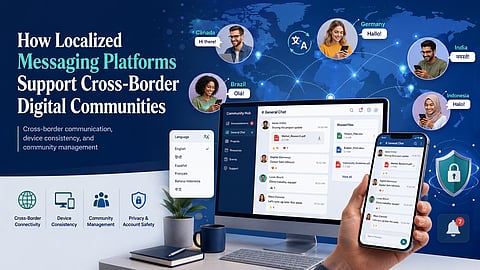
Digital communities increasingly bring together people who live in different countries, speak different languages, and use different devices. A single group may include students, business owners, remote workers, and families across Asia. Although they may share the same interests, they do not always share the same technical habits.
An English-language interface alone is often not enough. A platform may be globally accessible yet still feel difficult when menus, notifications, support pages, and download instructions are not adapted to local users.
Localization therefore goes beyond translation. It also includes how users discover the correct application, register an account, receive notifications, switch between desktop and mobile devices, and manage shared content. When these elements work together, a messaging platform can reduce friction and help cross-border communities communicate more consistently.
Cross-border communities often include users with different levels of technical confidence. Some members are comfortable installing desktop software, while others rely almost entirely on mobile apps.
Language barriers can affect participation at several stages. A user may hesitate to join if the registration page is unclear, misunderstand a channel description, or ignore an important announcement because the wording is unfamiliar. Small points of confusion can reduce engagement.
Localized communication improves accessibility by presenting essential information in a form users can understand quickly. Clear menus, recognizable labels, and understandable help instructions make it easier for non-technical users to complete basic tasks without depending on an administrator.
This is one reason some Chinese-speaking users search for resources related to 土豆聊天软件 when evaluating communication options. The search reflects a wider need for guidance that matches the user's language environment.
For community managers, localization can also reduce repetitive support requests. When members understand how to join channels, mute notifications, find shared files, and update account settings, administrators can focus on managing the community itself.
Translation usually focuses on replacing words in one language with words in another. Localization is broader. It considers whether the entire user experience makes sense in a specific region, language, and device environment.
A localized platform should present dates and times in a familiar format. File names, search labels, notification text, and account-recovery instructions should be understandable to the intended audience. Help documentation should use the same terminology as the app interface so users do not see one term in a guide and another in the application.
True localization also considers operational expectations. Users in different regions may prefer different registration flows or notification patterns.
Consistency across operating systems is equally important. If the mobile interface uses one Chinese label while the desktop version uses another, users may believe the features are unrelated. Standardized terminology reduces confusion and makes tutorials easier to follow.
Localization should therefore be treated as a product and workflow decision, not merely a language setting.
Mobile devices are usually the fastest way to read messages, respond to updates, and participate in short conversations. Desktop computers are better suited to long discussions, document editing, file organization, and tasks that require multiple windows.
Cross-border communities often need both. A member may receive an announcement on a phone during a commute, then open the related files on a Windows computer later. Another may begin a discussion on desktop and continue it on mobile.
Problems appear when device experiences are not aligned. Notifications may arrive on one device but not another. A downloaded file may be easy to find on desktop but difficult to locate on mobile. A user may read a message on a phone but miss the related task after switching devices.
A well-designed workflow should therefore account for device switching. Members should know where important files are stored, which channels require immediate attention, and how notifications behave across devices. The purpose of multi-device access is not simply convenience; it is continuity.
Localization is most effective when combined with clear information architecture. Even a translated interface becomes difficult to use if every discussion, file, and announcement appears in the same channel.
A practical community structure usually separates official announcements, general discussion, topic-specific channels, shared files, and member support. Important updates should be pinned or stored in a predictable location. Repeated questions can be answered through a short multilingual guide.
File naming should also be standardized. Without a consistent system, members may upload several copies of the same document with small changes. A simple format using the project name, date, and version number can reduce duplication.
Administrators should distinguish between temporary chat and long-term information. Casual discussion can remain in chat history, while policies, onboarding instructions, and final documents should be stored in a stable location. This makes essential information easier to find.
Cross-border communities can involve many users, changing membership, and multiple device logins. These conditions make account security and access management essential.
Members should regularly review active login sessions and remove devices they no longer use. Verification codes should never be shared in public channels, forwarded to unknown contacts, or entered into unofficial forms. Account-recovery information should be kept current so users do not lose access when changing phones or numbers.
Invite links also require careful handling. Publicly shared links can attract spam accounts or unintended members. Communities should control invitations, replace exposed links, and review new accounts.
Administrator privileges should be limited to people who genuinely need them. Giving too many members full control increases the risk of accidental changes, deleted content, or unauthorized invitations. Trusted administrators can manage settings while moderators handle daily discussions.
Security guidance should also be localized. Users are more likely to follow account-protection instructions when the wording is clear and available in a familiar language.
Users should evaluate a messaging platform based on more than interface language. A localized experience should make the entire adoption process easier to understand.
First, users should check whether the platform clearly identifies supported versions for Windows, macOS, Android, iOS, or other systems. Download instructions should explain which version fits each device.
Second, users should verify the download source. A clear official website, recognized app store listing, or consistent publisher identity reduces installation risk. Users should avoid pages with misleading buttons, excessive redirects, or unclear file names.
Third, they should examine whether Chinese menus, help pages, privacy explanations, and account-recovery guidance are available. A translated homepage alone does not mean the rest of the product is properly localized.
When researching options, some users may look for 土豆app下载 information to compare mobile access and Chinese-language guidance. The important step is to evaluate the source carefully, confirm the intended platform, and avoid assuming that every page using a familiar product term is official.
A reliable localized experience should help users understand what they are downloading, how to install it, and how to manage the account afterward.
A successful community does not depend only on the platform. It also depends on repeatable operating rules.
Channel names should follow a consistent pattern so members understand their purpose immediately. Separate prefixes can identify announcements, regional discussions, projects, and support. Multilingual descriptions can clarify each channel's purpose.
File rules should be equally clear. Members should know where final documents are stored, how versions are named, and who is responsible for updates. Important files should not depend on one person's device.
Notification policies can reduce overload. Communities may reserve urgent alerts for deadlines, security issues, or major updates, while routine discussion remains muted or optional. This prevents notification fatigue.
Administrators should periodically remove inactive accounts, review invite links, and check whether regional or language-specific channels are still useful. Members should also review active login devices and update recovery information.
A short onboarding guide can explain channel structure, file locations, notification expectations, and security practices. A localized, updated guide helps new members become productive quickly.
The value of a localized messaging platform extends far beyond translated menus. Effective localization helps users register, identify the correct application, understand notifications, switch between devices, find shared files, and protect their accounts.
For cross-border digital communities, these details influence participation and trust. Members are more likely to stay active when the communication environment feels understandable and predictable.
Long-term success comes from combining localization with consistent device access, clear channel organization, sensible permissions, secure account practices, and documented workflows. A messaging platform may provide the technical foundation, but communities create stability by using that foundation in a structured and inclusive way.
