.png)

If you've spent any time shooting with traditional FPV drones, you know the workflow tradeoff. You commit to a framing decision in flight. Whatever you didn't capture in the moment is gone. If you want a different angle, you have to fly again. If you want both a horizontal YouTube cut and a vertical TikTok cut from the same scene, you fly twice.
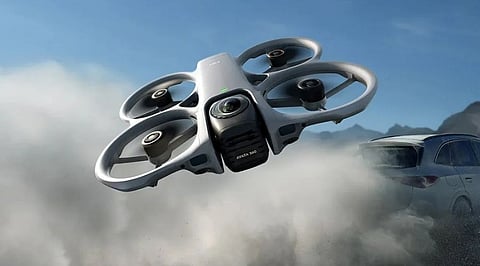
The DJI Avata 360 changes that workflow. Launched on March 26, 2026, it's DJI's first 360-degree drone and only the second 360 drone available on the consumer market. The headline feature isn't a spec. It's a different way of thinking about how aerial footage gets captured and used.
This review is for creators considering the DJI Avata 360 and trying to figure out whether the 360-degree workflow actually delivers on its promise or whether it's a novelty that doesn't change much in practice.
The basics matter, so here are the specs that actually do work in real shooting:
Dual 1/1.1-inch CMOS sensors that capture the full sphere around the drone in a single pass
8K/60fps HDR capture at 180 Mbps for source footage with the resolution headroom to reframe aggressively in post
Whoop-style propeller guards that make the drone safe for tight indoor spaces and close-proximity shooting that traditional FPV drones can't safely enter
O4+ transmission for stable signal even at extended ranges and through interference
Single Lens mode that supports traditional 4K/60fps for standard footage when you don't need the 360 workflow
The propeller guards alone open up shooting environments that have historically been off-limits for aerial work. Wedding venues, warehouses, indoor sports facilities, retail spaces, and any tight environment where a standard drone would damage either itself or its surroundings is now accessible.
The headline isn't the dual sensors. It's what they enable in the edit.
Traditional drone footage is composed in flight. You aim the camera, you fly the path, you commit. The Avata 360 reverses that workflow. You fly the path. The camera captures everything around it. You compose in post.
GyroFrame in the DJI Fly app is the tool that makes this work. After landing, creators can pull any frame from the 360 sphere and adjust angles, focal points, and orientation. The same flight produces a wide cinematic horizontal frame, a vertical TikTok cut centered on a subject, a top-down reveal, or any combination of these without flying again.
For working creators, this is the most meaningful shift in drone workflow since GPS stabilization made consumer drones flyable for non-pilots. The single-pass capture solves a problem that has cost creators time and battery life for years.
Worth being clear about: the 8K/60fps source capture is the recording resolution. The final flat video export in most workflows lands at 4K rather than 8K. The extra resolution gets consumed by the reframing process, since pulling a specific framing out of a 360 sphere uses up the source resolution headroom.
This isn't a flaw. It's how 360 capture works structurally. The 8K source exists specifically so that the 4K final output has the quality headroom to look clean after the reframing. Expecting 8K final output from a 360 drone is the wrong expectation.
For creators evaluating the Avata 360 against traditional 8K-capable drones, the honest comparison is on 4K final output quality and post-production flexibility, not on raw source numbers. On those terms, the Avata 360 is competing on its actual strengths.
The use cases emerging from early Avata 360 footage demonstrate what the workflow enables in practice.
Solo adventure creators are extracting multiple angles from one pass. A single flight over a mountain trail produces a wide establishing shot, a tight subject-tracking shot of the rider, an overhead reveal, and a vertical short-form cut. Previously, this required either multiple flights or multiple drones.
Wedding videographers are reframing single flights for different deliverable cuts. The ceremony reveals that the highlight reel, the venue establishing shot for the wedding website, and the vertical Instagram cut for the couple's stories all come from the same aerial pass. The time savings on a typical wedding shoot day are substantial.
Athletes and sports creators are staying center-frame in post even when they drift mid-flight. Traditional FPV requires the pilot to anticipate where the subject will be. The 360 capture means the subject can be repositioned in the frame after the fact, which is particularly useful for unpredictable action shots.
Content creators producing for multiple platforms are getting both a YouTube-wide and a TikTok vertical from a single flight. This is the simplest argument for the workflow shift and the one that resonates most clearly with multi-platform creators.
The "invisible drone" modifier is the more advanced application. Skilled reframing inside the GyroFrame workflow can effectively remove the aircraft from the perspective entirely, creating shots that look like they were captured by an impossible camera position.
Reviewer response to the Avata 360 has been notably enthusiastic. Tom's Guide called it one of the best drones on the market outright. The "creative director in the sky" framing has resonated with creators who want more editing flexibility without flying twice, and that framing accurately captures what the drone actually does in the workflow.
The consistent thread across reviews is that the Avata 360 doesn't replace traditional drones for every use case. It opens a new category of use cases that didn't exist before, and for the creators whose work fits those use cases, it changes how they shoot.
The Avata 360 isn't a replacement for the DJI Drone lineup. It's a compliment to it. For traditional aerial work where you know the framing you want in flight and don't need post-production flexibility, the Mini 5 Pro or Mavic 4 Pro remain the right tools. For tight-space shooting, single-flight multi-output workflows, and creators producing content for multiple platforms from the same source, the Avata 360 fills a category gap.
If your work involves shooting the same scene for multiple deliverables, working in tight or indoor environments, or capturing unpredictable subjects where you can't lock framing in flight, this is the drone that solves problems your current gear doesn't.
When buying a drone in this price category, where you buy matters. Look for an authorized US retailer that:
Ships from US-held stock in domestic warehouses
Includes the full official DJI manufacturer warranty on every unit
Has US-based customer support reachable by phone and email
Delivers within a few business days, not weeks from overseas
DJI is an authorized US reseller stocking the Avata 360 with domestic shipping and the full manufacturer warranty included. For a drone introducing a new shooting workflow, having local support and warranty coverage matters more than usual since you'll likely have questions as you learn the platform.
The DJI Avata 360 is the most interesting new drone DJI has launched in years, not because of any single spec but because of what the 360-degree capture enables in the edit. For creators who shoot for multiple platforms, work in tight spaces, or want the freedom to reframe shots after landing, this is genuinely new territory in consumer aerial work.
The 8K source to 4K output reality is worth understanding before purchase, but it's not a limitation. It's how 360 capture works. On the dimensions that actually matter (4K final output quality, post-production flexibility, single-pass multi-output workflows), the Avata 360 delivers what reviewers have been calling one of the best drones currently available.
For creators ready to change how they think about aerial workflow, this is the drone worth considering.
Check the DJI Avata 360 product page for current pricing and availability.
