.png)

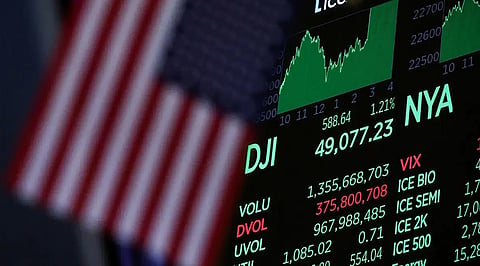
US stocks traded unevenly on Wednesday as investors tracked rising oil prices, weaker chip shares, and a busy earnings schedule. The Dow Jones Industrial Average gained about 0.5%, while the S&P 500 stayed near the flatline. The NASDAQ Composite fell approximately 0.3%.
Alphabet, Tesla, IBM, ServiceNow and Texas Instruments will report quarterly results after the closing bell. Their updates may provide new details on artificial intelligence spending, cloud demand and corporate technology budgets.
Alphabet and Tesla will become the first members of the ‘Magnificent Seven’ group to report second-quarter results this week. Investors will focus on revenue growth, capital spending and plans for the rest of 2026.
Alphabet shares traded near the $346 level before the report. The company faces questions about its AI strategy after delaying the launch of a model tied to its development plans.
Tesla’s results will also draw attention as the company spends heavily on new projects. Investors will watch its cash flow, operating costs and capital expenditure.
Sam Stovall, chief investment strategist at CFRA Research, said investors may take a ‘wait-and-see attitude’ before making larger market moves. He added that spending levels will play a central role in the response to Alphabet and Tesla’s reports.
Oil prices climbed as the United States carried out an eleventh straight round of strikes against Iran. Brent crude gained about 3% and traded above $93 per barrel after briefly moving above $95. West Texas Intermediate rose above $86 per barrel.
US Secretary of State Marco Rubio said Washington would continue protecting shipping through the Strait of Hormuz. He also said Iran was ‘not serious’ about negotiations.
“If they’re serious, we’re serious,” Rubio said. “If they’re not, then we will do what is necessary to protect our interests and also the interests of our allies.”
Higher energy prices increased concerns about inflation and interest rates. Traders fear that higher transport and production costs could push consumer prices higher.
Federal funds futures showed traders assigning a strong chance that the Federal Reserve will hold rates steady at its next meeting. However, markets continued to price a possible rate increase later in 2026.
Technology stocks recorded the weakest sector performance during morning trading. Semiconductor shares struggled after several volatile sessions reduced demand for riskier assets.
The Philadelphia Semiconductor Index traded near unchanged levels. The index had closed lower in five of the previous ten sessions. Texas Instruments also fell slightly before releasing its quarterly results.
Investors will examine chip demand, order growth, and management forecasts during the current earnings season. AI infrastructure spending has supported semiconductor valuations, but recent price swings have slowed the NASDAQ’s momentum.
Materials and utilities moved higher and limited broader market losses. Strength in industrial and materials shares also supported the Dow.
Market breadth stayed positive. Advancing stocks outnumbered declining stocks on both the New York Stock Exchange and the NASDAQ, even as the main technology index moved lower.
Super Micro Computer shares surged more than 20% after the AI server maker issued a strong business update. The company said it secured more than $60 billion in new fourth-quarter orders.
Super Micro also expects its gross margin to exceed its previous forecast. The update renewed demand for the stock after concerns about margins and competition had pressured its recent performance.
AT&T shares gained about 3% after the telecom company added more wireless subscribers than analysts expected during the second quarter. The company also reported better-than-expected quarterly earnings.
Meanwhile, GE Vernova shares dropped after its second-quarter report. The company posted $11.1 billion in revenue and raised its 2026 financial guidance, but the stock fell as earnings missed market expectations.
GE Vernova reported an 88% rise in total orders to $24.2 billion. Its data center orders exceeded $5 billion during the first half of the year, more than double its full-year total in 2025.
Shares of generic drugmakers also declined after President Donald Trump announced plans for future tariffs on imported generic medicines. The policy calls for a 100% tariff in August 2028, followed by a 200% rate one year later.
With oil prices rising and Big Tech earnings approaching, markets remain focused on the next major catalyst for direction.
Join our WhatsApp Channel to get the latest news, exclusives and videos on WhatsApp
_____________
Disclaimer: Analytics Insight does not provide financial advice or guidance on cryptocurrencies and stocks. Also note that the cryptocurrencies mentioned/listed on the website could potentially be risky, i.e. designed to induce you to invest financial resources that may be lost forever and not be recoverable once investments are made. This article is provided for informational purposes and does not constitute investment advice. You are responsible for conducting your own research (DYOR) before making any investments. Read more about the financial risks involved here.
