.png)

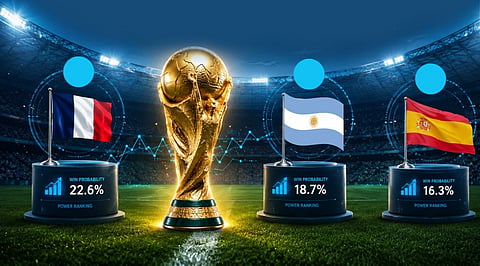
With the 2026 FIFA World Cup now into its knockout rounds, the eye test and the numbers are finally starting to agree. Betting markets, prediction models, and advanced ratings systems like Silver Bulletin's PELE model have all converged on a similar picture: a handful of teams have separated themselves from the pack, both statistically and on the pitch. Here's a data-driven breakdown of the three strongest contenders left standing — and why the analytics back them.
Across nearly every data source, France sits at the top. What makes their case compelling isn't just reputation — it's performance quality. France reached the quarterfinals without conceding a single goal in either knockout match, a defensive record that stands out in an expanded 48-team tournament where fatigue and squad depth typically start to show. Their odds moved from +500 at the start of the tournament to as short as +175/+180 by the quarterfinal stage, one of the sharpest market shifts of the competition.
The underlying numbers support the shift. In their round of 32 win over Sweden, France produced a dominant attacking performance, and their quarterfinal display against Morocco included 22 shots, nine on target — the kind of shot-volume and shot-quality profile that predictive models weight heavily when projecting knockout success. Squad depth is the other structural advantage: France can rotate elite-level players at nearly every position without a meaningful drop-off, which matters more in a longer, more physically demanding tournament format.
Why the data likes them: elite expected-goals output, a defense that hasn't been breached in the knockouts, and a deep enough squad to absorb injuries or suspensions without losing quality.
Argentina presents an interesting case study in the gap between market sentiment and pure model output. The reigning World Cup and Copa América champions have improved dramatically in the betting markets — from roughly +950 at the start of the tournament to around +400 by the quarterfinals — driven largely by tournament experience, a settled defensive structure, and Messi's continued individual brilliance (he entered the quarterfinals as the tournament's leading scorer at age 39).
However, data-driven models are more cautious than the betting markets here. Advanced rating systems have flagged that Argentina's underlying performance metrics haven't matched their results — back-to-back 3-2 knockout wins, including a dramatic late comeback against Egypt, actually caused some model-based ratings to decline even as Argentina advanced, because the underlying match control and shot data didn't fully support the scorelines. That combination — proven knockout pedigree and a defense anchored by Emiliano Martínez, but statistically shakier performances than the results suggest — makes Argentina a fascinating contender: dangerous precisely because they know how to win ugly, even when the models aren't fully convinced.
Why the data likes (and questions) them: elite goalkeeping and knockout experience, but underlying match metrics suggest more vulnerability than their results indicate — a classic "clutch vs. sustainable" tension in predictive modeling.
Spain entered the tournament as a co-favorite with France and, despite an early stumble (a shock 0-0 draw with Cape Verde), has steadily rebuilt its case through the knockout rounds, including eliminating Portugal. Betting markets have Spain as a solid second or third choice, and the analytical case for them rests on the same pillars as France: two capable options at nearly every position, elite attacking talent, and recent tournament pedigree as reigning European champions.
What separates Spain analytically is efficiency. Rather than relying on overwhelming shot volume, Spain's model-friendly profile comes from possession control and conversion quality — squeezing high-value chances out of matches rather than needing high shot counts to win. That's historically been a durable trait across deep World Cup runs, since it tends to hold up against a variety of opponent styles, from possession-heavy sides to disciplined counter-attacking defenses like Morocco's.
Why the data likes them: balanced squad depth, elite individual attacking talent, and a possession-efficiency profile that travels well against different tactical setups.
What the models and markets agree on is that this remains an unusually open World Cup by historical standards. The expanded 48-team format has widened the field of realistic contenders and increased the volatility of individual results, which is part of why teams like Norway, Morocco, Belgium, and England remain live threats rather than afterthoughts. But when you filter for the combination of underlying performance data, squad depth, and tournament experience, France, Argentina, and Spain remain the three teams the numbers keep pointing back to as the final rounds approach.
If you want to watch the finish of this tournament play out in person, you can check available world cup 2026 final tickets to see the contenders battle it out on the biggest stage in football.
Odds and statistics referenced are current as of early July 2026 and subject to change as the knockout rounds progress.
