.png)

A peer-reviewed study on food waste found that drawer-style freezers hide items more easily than shelf-style ones, changing how people shop and cook.
A matched retail comparison showed a French door model priced $600 higher than an equivalent side-by-side, despite offering less capacity.
The right choice depends less on kitchen size and more on one habit: how often frozen food gets forgotten and wasted.
Most buyers think they are picking a door style. What they are actually picking is a daily habit: what stays visible in the fridge, what quietly gets buried and forgotten, how much of the groceries actually gets used before spoiling, and whether the extra cost buys real value. Most comparisons stop at ‘more fresh-food space’ versus ‘more freezer capacity,’ which barely scratches the surface of what is actually different.
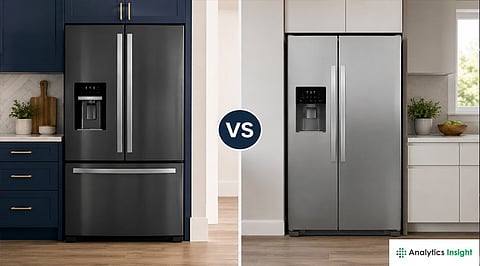
A French door refrigerator combines a full-width refrigerator compartment with a pull-out freezer drawer below. A side-by-side split divides both sections vertically instead. This single structural choice shapes storage, accessibility, pricing, and long-term ownership more than most buying guides let on.
Two findings stand out from observation. First, the layout that makes French door freezers convenient to load is the same one that makes items easiest to lose. Second, in at least one documented case, the price gap between styles had nothing to do with capacity or features. It came down to the doors.
Side-by-side freezers use vertical shelves, viewed straight on, similar to scanning a stocked pantry shelf. French door freezers work differently. They're drawers, viewed from above, and depth makes visibility harder.
A peer-reviewed study on refrigeration and food waste interviewed households about this exact pattern. Drawer storage, meant to protect food, often ends up concealing it instead. People adapt by keeping items they'll use soon near the front, while smaller bagged items settle at the bottom and get forgotten.
That study wasn't built specifically around French door models. It covered crisper and freezer drawers more broadly. Still, the mechanism it documents applies directly to bottom freezer drawers, and it isn't a marketing claim dressed up as research.
Owners back this up in plain language. French door users often describe digging through a drawer, uncertain what's buried beneath stacked vegetables and old meal-prep containers. Side-by-side owners rarely mention this problem. A freezer at eye level doesn't need excavating.
One caveat matters here. This is a documented tendency, not proof that French door households waste more food overall. No study has directly compared freezer waste across the two layouts. What the evidence does support is narrower but still useful: drawer storage makes items easier to lose track of, and that has real consequences for anyone who freezes meals in batches or buys frozen staples in bulk.
The standard explanation for French doors' higher price is added features: better shelving, humidity control, and in-door dispensers. Sometimes that holds up. It doesn't always. A same-brand, same-width, same-finish comparison makes the gap easy to see.
One retailer's matched pair told the story clearly: a 36-inch Whirlpool side-by-side in black stainless, 28 cubic feet, priced at $2,199. The French door version, the same brand, same width, and same finish, offered less capacity at 25 cubic feet and cost $2,799.
The only real difference was the door and drawer configuration. In this comparison, the premium appears driven more by the door configuration than by additional storage capacity. Similar pricing patterns are common across the market, though features still influence pricing between individual models.
Also Read: Bottom Freezer vs Top Freezer Refrigerators: Which is Better?
French doors earn their reputation honestly in one area: full-width shelves fit platters, sheet pans, and bulky produce that a side-by-side's narrower columns can't accommodate. Fresh food also sits at eye level rather than near the floor, a real advantage for households that cook in volume or host often.
Side-by-side's advantage isn't just a lower price tag. The same full-height, shelf-based structure that keeps costs down also solves the visibility problem that French doors struggle with. Narrower compartments are a genuine limitation for wide items, but they come with an organizational upside that rarely gets credit: nothing sits more than one shelf-depth from view.
The decision ultimately comes down to a habit rather than a kitchen layout: how often food goes into a freezer and gets forgotten. Households that batch-cook or buy frozen staples in bulk should weigh the drawer-visibility research seriously. Households that entertain often or need wide-shelf capacity have a legitimate case for French doors, price gap and all.
Also Read: Best Samsung Refrigerators with Digital Inverter Technology in 2026
The real difference between these two layouts is not measured in cubic feet. It shows up in daily decisions: how easily ingredients get found and how often frozen food actually gets eaten instead of forgotten at the bottom of a drawer. Once that connection between layout and daily habit is clear, the right choice stops feeling like a coin flip between two showroom doors and starts feeling obvious.
Neither is universally better. French door refrigerators offer wider fresh-food storage and a modern design, while side-by-side models provide easier freezer access, better organization, and are often more affordable.
Energy efficiency depends on the model and energy rating. Many modern French door and side-by-side refrigerators are designed to minimize power consumption, so always compare their energy efficiency labels before buying.
French door refrigerators typically require less door swing space because each upper door is narrower. However, the best choice depends on your kitchen layout, available clearance, and overall appliance dimensions.
Yes, side-by-side refrigerators make it easier to organize and access frozen foods with full-height shelves and compartments. They are ideal for households that frequently use the freezer.
Consider your food storage habits, available kitchen space, budget, energy efficiency, freezer usage, and preferred layout. Choosing the right design depends on how you use your refrigerator every day.
