.png)

Artificial intelligence is rapidly changing the identity verification systems. They can detect fraud and automate decisions at scale. At this point, organizations rely on AI systems with millions of data points. These systems reduce operational costs and accelerate customer onboarding. However, as automation expands, the consequences of errors are becoming more significant, especially in domains like financial services, compliance, and digital trust.
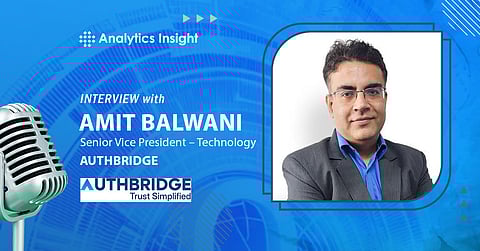
Analytics Insight’s latest podcast episode examines how human oversight has evolved from a safety requirement to a fundamental design element. Amit Balwani, Senior Vice President of Technology at AuthBridge, shares how organizations can strike the right balance between the speed of automation and human judgment while maintaining transparency, accountability, and reliability in decision-making.
Ans: AuthBridge has been a category leader and pioneer in background verification, and a reputable organization for the past twenty-plus years. So AuthBridge operates at the intersection of trust, identity, and intelligence. We specialize in end-to-end identity verification, spanning KYC, KYB, employee background screening, fraud detection, and continuous monitoring.
As SVP of Technology, my role is to translate this trust mandate into scalable, AI-first platforms while balancing innovation with reliability. In simple terms, I ensure that while we move fast, we don't break trust.
Ans: AI without humans, as it stands today, is like a high-speed train without signals. So it is fast, but one wrong turn can be catastrophic for the enterprise. So we are seeing a shift where human-in-the-loop is no longer just a brake pedal, but it's part of the steering system itself.
Especially in our domain, trust and identity, a false positive or a false negative is not just an error; it is either fraud slipping through or a genuine customer being blocked. So human-in-the-loop ensures contextual judgment where data alone falls short. So the narrative has changed. It's not AI versus human; it's AI with humans by design.
Ans: The right balance comes from risk-tiering the decisions. So if it's a low-risk, high-volume decision, we can go with fully automated AI engines and workflows. If it's medium risk, it has to be AI-led, with human validation triggers. If it's a high-risk use case, it has to be human-led, although it could be AI-assisted. So that's what we follow in our organization, and it has reaped us a lot of fruit. We often use a confidence score approach as well. If the model's confidence exceeds a threshold, it flows straight through. If it falls into a gray zone, a human steps in.
Ans: The first one is risk impact, whether it's financial, reputational, or legal. The second one is the explainability requirement, and the third one is error tolerance. So, for example, if it's a password reset use case, it could be purely AI-driven. If it's a loan approval or fraud flags, it could be a hybrid because the stakes are high. So if a decision can materially affect someone's life or livelihood, humans should have the final say. So that's my take on it.
Ans: What we believe is that explainability is not just about why the model decided, it's also about who validated the decision and how. So, human-in-the-loop creates an audit trail of reasoning. The first point we consider is that AI currently provides probabilistic output. The second point is that humans add contextual judgment. Then, the third step we follow is for the system to log both of these actions.
Now, this layered decision-making improves traceability. So regulators don't just want a black-box answer; they want a narrative. In fact, frameworks such as the GDPR and emerging AI regulations emphasize the right to explanation. Human-in-the-loop helps translate algorithmic outputs into human-understandable reasoning.
To know more about the discussion, listen to the full podcast.
