.png)

The way software gets built is changing faster than most people realize. For decades, the process followed a familiar rhythm, gather requirements, design the architecture, write the code, run tests, deploy. It was linear, human-driven, and deeply dependent on technical expertise at every stage. That model is now being disrupted at its core.
The concept of a dark factory, a fully automated production setup that runs without constant human intervention has long been associated with advanced manufacturing. Now, that same principle is being applied to software development, where AI systems are beginning to handle the entire build cycle with minimal human input.
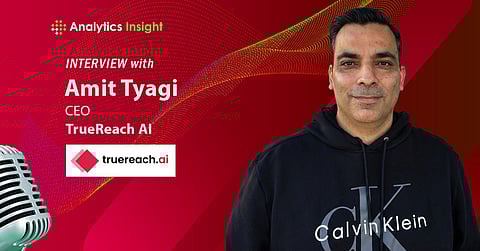
In a recent episode of the Analytics Insight podcast, host Priya Dialani sat down with Amit Tyagi, CEO of TrueReach AI, to explore what this transformation actually looks like in practice, what it demands from developers and leaders, and where the human role fits in a world increasingly driven by autonomous systems.
TrueReach AI was founded on a straightforward but ambitious premise to make software creation as autonomous as possible. The journey began in mid-2022. Amit Tyagi, fresh off a startup exit that had been acquired by ANAROCK, was deliberating on where to invest the next decade of his career.
A chance encounter with someone who had worked on early large language model development at AWS in Seattle changed his direction entirely. Even before ChatGPT had entered the public consciousness, Tyagi and his co-founders saw the transformative potential of LLMs. TrueReach AI was incorporated in November 2022, two weeks before ChatGPT launched.
From the beginning, the team identified two core challenges that would need to be solved for LLMs to have real economic value. The first was reliability since LLMs are probabilistic by nature. Hence, producing a consistently accurate output is not guaranteed. The second was the nature of human-machine interaction. So, how do you design a system that draws the best from both human and artificial intelligence, while compensating for the weaknesses of each?
The team chose software development as their proving ground with those problems in focus. They did it partly because outcomes can be objectively verified and partly because software underpins virtually every industry in the world. By July 2024, TrueReach AI had delivered its first complete, end-to-end solution. It is a working system with an IoT layer, server backend, and frontend, built well before the term ‘vibe coding had even been coined. Since then, the platform has evolved into a fully operational dark factory for software.
The analogy to manufacturing is surprisingly direct. For example, Toyota's dark factories accept a design specification and produce finished vehicles through an automated process, including quality checks. Similarly, TrueReach AI's platform accepts a software requirement and handles everything from that point forward.
Once a business analyst inputs what needs to be built, the system takes over. It generates high-level and low-level design specifications. It also maps out the user interface and data flows. The TrueReach AI system will create a sprint plan with properly sequenced tasks and sub-tasks, and then proceeds to write the code. This spans frontend, backend, mobile applications, third-party integrations, and even brownfield scenarios where new functionality must work alongside existing systems. Testing, including regression testing, happens autonomously. Deployment to cloud environments like AWS or Azure is handled without manual steps.
At the end of the line, a quality assurance professional reviews the working solution, much like a final inspection at the end of a manufacturing line. That is the only human touchpoint in what is otherwise a fully autonomous pipeline. This approach has already been revealed in production. For instance, a major Indian apparel brand deployed a solution built by TrueReach AI's dark factory that went on to process over a hundred million dollars in orders.
The short answer is yes but that shift is not new, and it is not something to fear. Tyagi draws a direct parallel to the evolution of programming languages. Early in his career, he wrote in assembly language for performance-critical applications. Nobody does that today, yet the underlying logic still executes at the machine level. The move from assembly to C, from C to Java, from Java to modern frameworks, each step represented a new layer of abstraction that freed developers from low-level concerns and redirected their energy toward higher-order thinking.
Generative AI is simply the next layer. Instead of translating logic into a programming language, developers are increasingly describing what they want and letting the system determine how to build it. Tyagi's prediction goes further. He believes that within three years, programming languages themselves may largely disappear. They would be replaced by AI that writes directly in assembly or machine-optimized code. It would also be more efficient, both in cost and computational power, than anything humans would write in a high-level language.
What this means for developers is a huge shift in what skills matter most. The startups that succeeded or failed over the last two decades rarely did so because of code quality. Their success dependent on how well they understood their customers and identified the right problem to solve. That ability, market intuition, customer empathy, product judgment becomes more valuable in a world where execution is increasingly automated.
The analogy to design tools is useful here too. Before generative AI, someone who knew how to use Adobe's suite well could outperform a more talented designer who lacked that technical fluency. Today, the tool dependency has collapsed. What matters is the design eye, not the tool proficiency. The same shift is coming to software.
This is one of the most pressing challenges in the current transition. Tyagi believes most of the industry has not yet solved this issue adequately. The statistics reflect the problem. While developers report higher productivity and greater job satisfaction when using AI coding assistants, the vast majority do not fully trust that the output is functionally correct. The traditional solution, having experienced engineers review every line of code simply does not scale when code is being produced at machine speed.
The bottleneck has already shifted. Research indicates that even as engineers produce code faster, teams are not shipping faster. This is because the constraint has moved to specification, design, and quality assurance. The only viable long-term solution, in Tyagi's view, is for AI to both generate and validate its own output.
Although this introduces another layer of complexity. If the system generating the code is probabilistic, and the system reviewing the code is also probabilistic, how do you achieve deterministic reliability? This is TrueReach AI's primary intellectual property. It is a mechanism that makes both code generation and test case creation deterministic. When the system produces code, it is correct. When it generates test cases through a separate process, those are also correct. That combination is what makes autonomous software development viable for enterprise-grade, mission-critical applications.
In the interim, accountability remains with the human team. The CTO or delivery lead is not responsible for writing the code, but they are responsible for the solution. The obligation shifts from line-by-line review to end-to-end validation. Hence, ensuring that the deployed system handles edge cases, performs under load, and meets the real needs of the business.
This concern is genuine, and even prominent figures in the AI space have publicly acknowledged experiencing it firsthand. Tyagi offers an instructive parallel from aviation. As autopilot systems have become more capable, pilots fly manually less and less. The danger is not during routine operations, it is during the rare moments when automation fails. Those are precisely the situations that demand the sharpest human judgment and manual skill, yet they tend to arrive with no warning, after long periods of disuse.
The airline industry's response has been deliberate. Pilots are periodically required to hand-fly aircraft to make sure the underlying skill remains sharp when it is genuinely needed. Something similar may be warranted for software developers. Even as enterprise development becomes more automated, there is value in maintaining the habit of writing code manually. It can be done through side projects, personal experiments, or structured practice environments. Whether most developers will take that advice is another question. However, for those who want to preserve their technical depth during what could be a five-to-ten-year transition period, intentional practice is likely the only real safeguard.
The long-term picture that Tyagi describes is one where the dark factory model extends well beyond software. TrueReach AI has built an autonomous factory for software development. At the same time, others are building equivalent systems for marketing, operations, finance, and other business functions. When those capabilities exist across an organization simultaneously, the implications for how companies are structured become profound.
What once required a team of hundreds could potentially be handled by a small group of people directing multiple AI-powered systems. Human beings, in this model, are not replaced, they are repositioned. Their value lies in decisions, what to build, why it matters, who it serves, and what tradeoffs are acceptable. The AI handles execution.
In that sense, the developer of tomorrow looks less like someone who writes code. They would look more like someone who thinks clearly about problems, understands markets, and knows how to direct intelligent systems toward meaningful outcomes. The coding craft, once the core of the profession, becomes one input among many, and eventually, perhaps not a requirement at all.
The transition will be uncomfortable for many. It demands new skills, new mindsets, and a willingness to relinquish the familiar. However, for those who make the shift, the scope of what becomes achievable is genuinely extraordinary.
Listen to the full discussion on the Analytics Insight Podcast.
