.png)

As artificial intelligence becomes deeply embedded across enterprises, organizations are facing a new generation of cybersecurity challenges. The rapid growth of cloud platforms, autonomous systems, and AI-powered applications has expanded the attack surface beyond traditional users and devices. Today, businesses must manage not only human identities but also machine identities, applications, and AI agents.
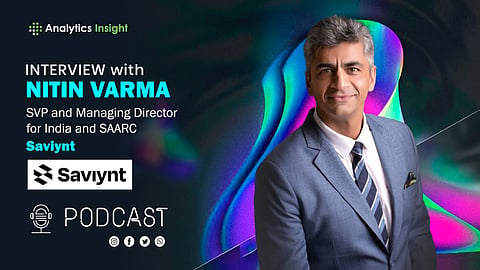
In this episode of the Analytics Insight Podcast, Priya Dialani speaks with Nitin Varma, SVP and Managing Director for India and SAARC at Saviynt. The conversation explores the evolving identity security landscape, the rise of non-human identities, malware-free attacks, and how organizations can establish stronger governance across increasingly complex digital ecosystems.
Ans: Saviynt, when you look at Priya, it's fundamentally an identity security and governance platform company that specializes in governing who can act inside your enterprises and who can get access to enterprise systems, applications, and data, and what makes Saviynt particularly relevant today, talking to various CISOs and business leaders in the Indian market.
Since you asked me about the specialization, there's no one specialization that I can just call about Saviyant, but I would rather put it in this way that Saviynt's core specialization sits at the intersection of identity governance and administration, privilege access management, application access governance, and non-human and AI identity security.
Ans: I think there are two factors influencing cybersecurity. One, I think AI is transforming cybersecurity by becoming embedded, automating tasks, and making systems more intelligent. Second, I think AI is also introduced as a new identity risk.
When I talk about the security landscape shifting in the AI era, let me look at it through the lens of customers, regulators, and partners, because they are the ones who really matter to us today, right? When you talk to customers, regulators, or partners today, Priya, right, they don't just want technology that works. They want to trust that it's secure, it's compliant, and it's accountable.
Ans: I think it has always existed in the past for, I think, many, many, many decades now, right? But what has really changed in this AI era is the scale, speed, and nature of those identities. What I mean by that here is that, traditionally, when you look at identity risk, it was largely human-centric. The employees like you and me, the partners, and maybe the customers at times, these identities were very deterministic.
These identities often don't go through governance, right? They have excessive privilege, which I think makes them the most vulnerable pieces in an enterprise, and they are poorly tracked. So what it means here is that the attack surface has expanded massively out here.
Ans: Now, because organizations are realizing that identity governance must evolve from traditional access management to a continuous security control plane, something that can manage identity across humans, machines, applications, and now the autonomous AI agents as well. A platform that can unify visibility, number one, governance, and real-time policy enforcement across this expanding identity landscape. This actually is becoming the foundation of enterprise cybersecurity today. Now, this is where I personally believe that Savyint is actually making that relevance and impact in the identity industry by standing at the forefront of identity security transformation in this AI era.
Ans: A couple of things that I personally believe, and I'm trying to keep it short, the organization basically needs to do. I think, from an identity standpoint, they need a unified control plane. Why? One, to discover the identities, wherever it is, whether it's in platforms like you know, the multi-cloud setup, or maybe platforms like Vertex or Bedrock, AWS Bedrock, so on and so forth.
It's very important to discover the identities. The human, non-human, and the various kinds of identity that an enterprise might have. So one, I think with a unified control plane, it's easier for us to discover, register those identities, and most importantly, monitor those identities in real time across these diverse environments, whether it's legacy, whether it's on-prem, whether it's cloud, whether it's platforms like Bedrock, ServiceNow, so on and so forth.
To know more, listen to the full podcast.
