.png)

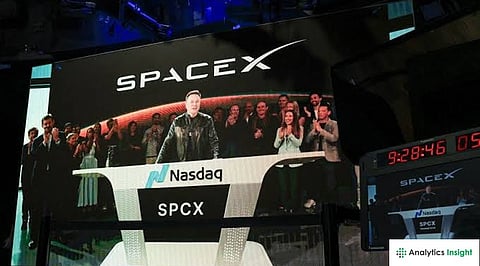
SpaceX entered the NASDAQ 100 on Tuesday, July 7, 2026, only 15 trading days after its public market debut. The fast addition follows NASDAQ’s revised entry rules for large new listings.
The rocket and satellite company priced its IPO at $135 per share on June 12 and raised $75 billion, the largest IPO on record. The stock now gives millions of NASDAQ 100 fund investors automatic exposure to SpaceX through index-linked ETFs and mutual funds.
SpaceX’s NASDAQ 100 entry forces index-tracking funds to add the stock to their portfolios. These products include ETFs and mutual funds tied to the benchmark, including funds linked to the Invesco QQQ complex.
Reuters reported that J.P. Morgan estimated the inclusion could generate about $4.3 billion in passive inflows. The buying is tied to index rules rather than a fresh view on the company’s business. That means fund managers must adjust holdings to match the new benchmark.
However, SpaceX’s starting weight will not match its headline market value. The company has a market value above $2 trillion, but only about 5% of its shares trade freely. NASDAQ uses free-float market value in its index math, which keeps the initial weight near 1% to 1.3%.
SpaceX shares surged after the IPO, with reports placing the post-listing high near $225.64. The stock later pulled back sharply and traded near the $160 area before its NASDAQ 100 entry. Even after that drop, the shares stayed above the $135 IPO price and the $150 opening price.
The short trading record adds another layer of risk for funds and retail investors. Avery Marquez of Renaissance Capital said, “IPOs are inherently volatile, and especially in those early weeks.” The remark points to doubt around the stock’s near-term trading path as investors weigh index demand against post-IPO selling pressure.
Meanwhile, the NASDAQ 100 has already shown more volatility than the S&P 500 this year. The Cboe NASDAQ 100 Volatility Index rose about 43% through Thursday, compared with an 8% rise for the Cboe Volatility Index tied to the S&P 500. SpaceX’s small float may add to sharp price swings when large orders hit the market.
SpaceX has joined the NASDAQ 100, but it is not expected to enter the S&P 500 soon. S&P Dow Jones Indices did not revise its rules for SpaceX, leaving the company subject to a one-year listing requirement and profitability standards.
That gap matters for passive demand. NASDAQ 100 inclusion brings buying from index products now, while S&P 500 inclusion would create a separate wave of demand at a later date. At this stage, SpaceX investors are watching NASDAQ rebalancing, trading volume, and stock supply.
Lockup expirations also sit on the market’s calendar. Early investors and employees hold shares that may become eligible for sale in stages.
Louis Navellier of Navellier & Associates said he would consider buying SpaceX after insiders sell some shares and once the company appears ready to report a profitable quarter. His comment points to the main doubt around the stock beyond the index move: public market results must now support the valuation.
Also Read: Tesla's First-Ever Close Above $420 Revives Meme Trading and Draws Retail Buyers
