.png)

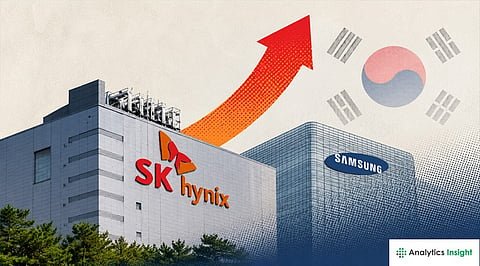
SK Hynix overtook Samsung Electronics on Monday to become South Korea’s most valuable listed company. The shift followed a sharp rise in SK Hynix shares, driven by demand for high-bandwidth memory chips used in AI systems.
The company now leads the global HBM market and supplies major customers such as Nvidia and Google. Its market value rose above Samsung’s and Micron’s after shares jumped 5.6% on the day.
SK Hynix closed at a market capitalization of 2,080.4 trillion won, or $1.35 trillion. Samsung’s stock fell 0.14%, leaving its market value at 2,066.7 trillion won, excluding preferred shares. Samsung said any valuation should include preferred shares. Including those shares, Samsung’s market value stood at 2,246.4 trillion won at the close.
AI has changed the semiconductor industry. It has turned specialized memory chips into core parts of systems that power ChatGPT and other advanced models.
SK Hynix focused on memory chips, while Samsung also makes logic chips and consumer electronics. That focus gave SK Hynix a strong position as AI spending grew. Analysts said customized AI memory changed industry economics. They also said it helped SK Hynix secure market leadership in HBM.
HBM chips stack vertically and deliver faster performance with lower power use. They connect tightly with AI processors, which raises barriers to entry and gives suppliers more pricing power.
By 2025, SK Hynix held 61% of the global HBM market. Samsung held 17%, while Micron held 21%.
SK Hynix began as Hynix Semiconductor and nearly collapsed in 2002. At the time, Micron almost bought the company, but the deal fell through. The company stayed under creditor control for nearly a decade. Its shares later sank to 135 won in 2003, which left it widely seen as a penny stock.
The company then moved through the memory industry’s boom-and-bust cycle. In 2023, it posted an annual operating loss of 7.73 trillion won. It recovered in 2024 as AI investment accelerated across Microsoft, Google, and Meta. SK Hynix reported an annual operating profit of 23.5 trillion won, its record at the time.
Read More: Samsung One UI 8.5 Update Triggers Screen Line Issue on Galaxy S23 Devices
Analysts now say Samsung’s DRAM lead could also come under pressure. Bank of America estimated SK Hynix’s monthly DRAM output at about 589,000 wafers this year, versus Samsung’s 691,000 wafers.
SK Hynix plans to expand DRAM output by about 38% between 2025 and 2028. Samsung’s output growth should reach about 17.5% over the same period. Reuters also reported that SK Hynix is choosing Nasdaq for its planned U.S. listing. The move would broaden its investor base and lift its global profile.
SK Hynix’s rise reflects how AI demand has changed the memory chip market. Strong HBM sales, record profits, and growing DRAM output helped it pass Samsung in listed value. The shift shows how specialized AI chips now shape semiconductor leadership.
