.png)

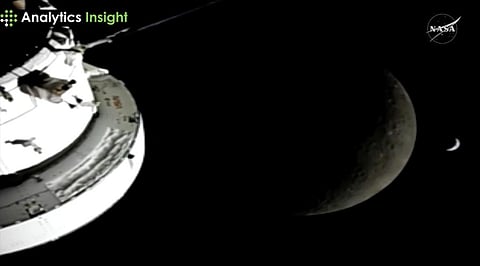
NASA’s Artemis II crew is heading back to Earth after completing a lunar flyby that set a new record for the farthest distance any human has traveled from the planet. During the mission, the Orion spacecraft passed the previous Apollo 13 mark and carried four astronauts around the Moon for the first crewed lunar flyby since 1972.
NASA said Orion passed the previous record on Monday as the spacecraft reached about 252,752 miles from Earth. The earlier mark of 248,655 miles was set by Apollo 13 in April 1970. The milestone came during the most closely watched stage of the Artemis II mission, a seven-hour flyby around the Moon.
The mission crew includes NASA astronauts Reid Wiseman, Victor Glover, and Christina Koch, along with Canadian astronaut Jeremy Hansen. NASA said the spacecraft entered the Moon’s sphere of influence early Monday, when lunar gravity became stronger than Earth’s pull on Orion. The spacecraft later moved behind the Moon and lost contact with Earth for about 40 minutes, which had been expected as part of the flight path.
After communications resumed, Christina Koch told mission control, “It’s so great to hear the Earth again.” The mission then continued with Orion moving to within a few thousand miles of the lunar surface before lunar gravity bent its path back toward Earth.
During the flyby, the astronauts were tasked with documenting the lunar surface using cameras, sketches, and spoken observations. NASA said the crew viewed parts of the Moon’s far side that human eyes had not seen before. The agency also released an image showing the Orientale basin, adding that “this mission marks the first time the entire basin has been seen with human eyes.”
Jeremy Hansen described the view from the spacecraft, saying, “It is blowing my mind what you can see with the naked eye from the moon right now. It is just unbelievable.” Koch also described an emotional moment while looking closely at the lunar surface, saying, “Something just drew me in suddenly to the lunar landscape and it became real.”
The crew also saw a total solar eclipse from Orion’s position as the Moon blocked the Sun. Victor Glover said, “It is amazing the brightness where the sunset is still bright and you still have a distinct Earth shine.” NASA said the eclipse also allowed teams to observe how Orion’s systems performed during a period without direct sunlight.
Artemis II is the first crewed mission to travel around the Moon since Apollo 17 in 1972. It is also the first time a woman and a person of color have flown around the Moon. Christina Koch became the first woman to do so, while Victor Glover became the first person of color on a lunar flyby mission.
President Donald Trump called the crew after the flyby and congratulated them on the mission. During the exchange, Commander Reid Wiseman said, “We saw sights that no human has ever seen, not even Apollo, and that was amazing for us.” The crew also asked NASA to name two lunar craters “Integrity,” after their spacecraft, and “Carroll,” in memory of Wiseman’s late wife.
The mission remains a test flight for future Artemis launches. NASA plans to use data from Orion’s power, thermal, and communications systems as it prepares for later missions aimed at returning astronauts to the lunar surface. The crew is now traveling back to Earth, with a splashdown planned in the Pacific Ocean after several more days of checks and experiments.
Also Read: SpaceX Delays 2026 Mars Mission, Shifts Starship Focus to NASA Moon Landing
