.png)

Aviation stocks experienced a decline on 2 March 2026 as tensions in the Middle East rose. This pushed the prices of crude oil higher and resulted in flight disruptions.
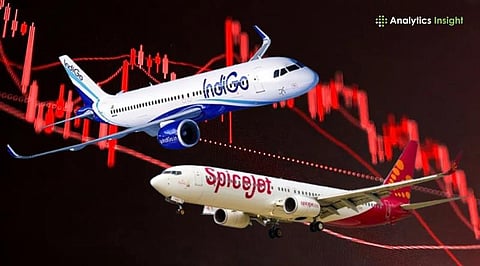
InterGlobe Aviation (IndiGo) shares dropped over 5% in early trading, while SpiceJet saw a nearly 4% decline as investors became concerned over the rising costs of fuel.
The rise in Brent crude prices after the US-Israel-Iran conflict has increased concerns about airline costs.
Aviation turbine fuel (ATF) accounts for roughly 30-45% of operating expenses for carriers, which makes their profitability depend on oil price changes.
Brokerage estimates suggest that for IndiGo, every $5 increase in Brent crude would decrease their earnings per share (EPS) by about 13%, depending on stable currency levels.
Most of the West Asian airspace has become unusable due to the ongoing geopolitical conflict. The effects can also be seen in India, with Indian airlines canceling and changing their international flight operations.
The Indian airlines cancelled nearly 179 flights, including 86 flights by Air India, 72 flights by IndiGo, 13 flights by SpiceJet, and 8 flights by Akasa Air, as of midnight on 1 March 2026.
Long-haul flights from North America and Europe are having to fly through different transit points. This causes an increase in both flight durations and fuel burn.
The implementation of these changes will increase operating expenses for the business while creating challenges for both aircraft usage and flight timetable management.
The Directorate General of Civil Aviation (DGCA) has issued a safety advisory directing airlines to avoid 11 countries in the conflict-affected region until March 2, 2026.
IndiGo shares opened at Rs. 4,460.90 on the BSE before recovering partially toward Rs. 4,664.95 intraday.
Analysts identify the Rs. 4,500 zone as a critical near-term support level. A sustained break below this could expose the stock to further downside toward Rs. 4,200, while resistance is seen near Rs. 4,800.
SpiceJet opened at Rs. 15.31, touching a low of Rs. 14.91 and a high of Rs. 15.60. The stock remains in a broader downtrend, with Rs. 12 seen as the next major support and Rs. 16.5 as immediate resistance.
Also Read: Barclays Warns Brent Could Hit $100 After US-Israel Strikes on Iran
With crude prices firming and airspace closures affecting operations, the aviation sector faces a challenging near-term environment. While airlines may attempt to pass on part of the cost increase through higher fares, sustained geopolitical uncertainty could continue to weigh on profitability and investor sentiment.
