.png)

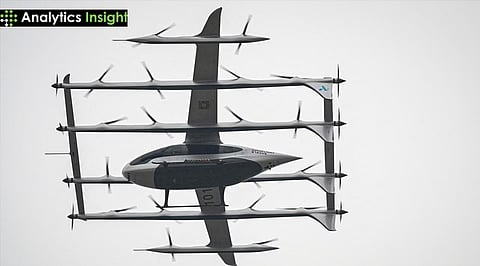
China has made a strong move toward the future of air travel. AutoFlight, a Shanghai-based aviation company, has unveiled Matrix, the world’s largest flying car. The launch shows China’s growing ambition to lead the low-altitude economy. This sector focuses on short-distance flights using electric aircraft.
AutoFlight revealed Matrix after a successful flight test in Kunshan, near Shanghai. The company noted that Matrix is the largest electric vertical take-off and landing aircraft built so far. The flying car weighs nearly 5 tons. It has a wingspan of 20 metres. The aircraft is 17.1 metres long and 3.3 metres high. These numbers make it much larger than most flying cars in development today.
Matrix has two versions. One supports passenger travel, while the other focuses on heavy cargo transport. The passenger model can carry up to 10 people. Most eVTOL aircraft currently carry only 4 to 6 passengers. This higher capacity gives AutoFlight a strong position in the market.
AutoFlight receives backing from CATL, the world’s largest electric vehicle battery maker. CATL holds a large stake in the company. It also supports battery research and development. This support helps improve flight range, safety, and carrying capacity. Battery strength plays a key role in flying car performance.
China is pushing hard to develop the low-altitude economy. The government is setting clear rules for aircraft design, air traffic control, safety systems, and infrastructure. Officials plan to introduce basic standards by 2027. More than 300 detailed standards could arrive by 2030. These rules aim to prepare cities for flying cars and cargo aircraft.
AutoFlight first focused on cargo aircraft. Its earlier model, CarryAll, already gained full certification in China. It received approval for design, production, and airworthiness. CarryAll also completed a long cargo flight between two Chinese cities. The aircraft flew 160 kilometres in about one hour. This flight proved its real-world use.
Passenger travel is now the company’s main focus. About 70 percent of AutoFlight’s total orders come from passenger aircraft. Certification for passenger flights is still in progress, and company leaders expect approval within one to two years. However, orders are already being accepted for future delivery.
Experts believe 2026 will be an important year for flying cars in China. Several companies plan to start deliveries soon. China could also see its first paid passenger flights. New infrastructure, like landing pads and charging stations, will support this growth.
AutoFlight also plans to expand outside China. Demand is strong in regions with weak transport networks. Island nations and mountainous areas show high potential for cargo and passenger flights. The company sees Northeast Asia, Southeast Asia, and the Middle East as key markets.
In the long term, flying car travel could cost as much as premium ride services on the ground. Large-scale use may still take a few years. Still, the Matrix launch shows clear progress. China is moving quickly from ideas to real flying machines.
Also Read: India’s Largest Private Satellite: GalaxEye’s 160 kg Mission Drishti Heads to Space
