.png)

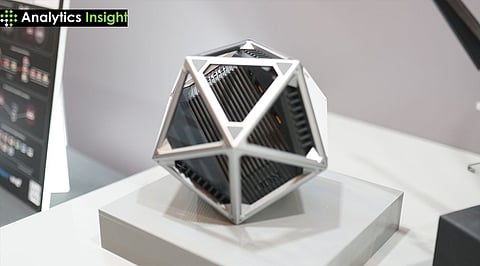
The CES 2026 has officially introduced a new era for global networking. Taking center stage, Asus revealed the ROG NeoCore, a striking icosahedron-shaped router that marks the first real-world use of Wi-Fi 8 technology. This launch signals a shift from the speed-focused era of Wi-Fi 7 to a reliability-centric future.
Using its unique twenty-sided geometric design to improve signal stability, the NeoCore model delivers better performance with steady connectivity, reshaping how seamless home integration and next-generation professional networking are today.
The Asus Wi-Fi 8 router, built on the IEEE 802.11bn standard, prioritizes intelligent spectrum coordination over peak speeds to eliminate interference in dense urban homes. Asus VP Tenlong Deng noted the goal is to achieve smarter, seamless collaboration between AI assistants and electronic devices.
This shift is powered by Asus AI Network Engine features, which can dynamically optimize bandwidths for critical tasks. Focusing on communication efficiency rather than just raw data rates, the technology ensures stable, ‘wired-grade’ reliability for modern, gadget-heavy environments.
At its recent event, Asus showcased the ROG NeoCore achieving a groundbreaking Wi-Fi 8 performance. Real-world tests revealed double the mid-range throughput and wider IoT coverage. Ideal for gaming and cloud computing, it delivered a 6x reduction in P99 latency.
The router’s functional twenty-sided design optimizes internal antenna placement to minimize self-interference while stabilizing multi-device traffic flows. These high-speed geometric models are scheduled for release in the second half of 2026, marking a massive leap in wireless efficiency and aesthetic hardware engineering.
Compared to the previous versions, Wi-Fi 8 delivers a ‘quality of life’ upgrade rather than a simple bandwidth boost. While Wi-Fi 7 introduced the 320MHz channel and 4K-QAM, it was often seen struggling with stability in busy environments.
The Asus Wi-Fi 8 router addresses these ‘dead spots’ with coordinated spatial reuse, allowing access points to communicate together and reduce interference across dense network spaces.
Also Read: CES 2026: First RGB‑Stripe QD‑OLEDs from MSI & Asus Can Finally Fix Text Fringing-text-fringing
These upgrades make the ROG NeoCore a strong option for apartment complexes or when managing large smart home device networks. Its integrated Asus AI Engine helps future-proof the hardware for upcoming artificial intelligence-based applications.
Based on current product cycles, this early adoption offers a more reliable internet experience to finally match the high-speed fiber connections available across most Indian metros.
