.png)

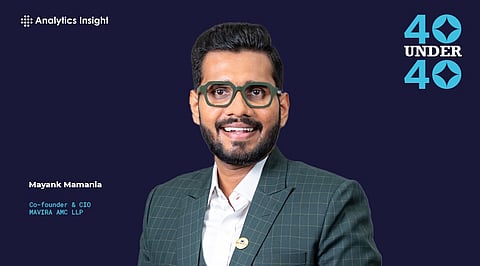
In the investment world, capital follows conviction. And in a market increasingly crowded with funds chasing the same large, well-covered names, conviction often lies in the spaces others overlook. For Mayank Mamania, Chief Investment Officer and Co-Founder of MAVIRA AMC LLP, that space is the ₹200–2,000 crore market-cap segment — a niche that sits squarely between the world of private equity and the universe of large AUM funds, and one that very few institutional investors are structurally built to operate in. Most large AUM funds in India, constrained by their own scale, focus on companies above ₹5,000 crore; private equity plays earlier, in unlisted territory. The middle — small caps, micro caps, SMEs, and high-quality unlisted businesses approaching the public markets — is where structural mispricings persist longest, and where India's next generation of compounders is quietly being built.
It is in this vacuum that MAVIRA AMC LLP has built its identity. Today the AMC manages over ₹520 crore in assets, serving family offices, corporates, and high-net-worth investors. But behind the scale lies a more deliberate story — of independent thinking, of identifying opportunities before they become consensus, and of building an institution capable of compounding wealth across decades.
After qualifying as a Chartered Accountant, Mayank stood at a crossroads familiar to many in finance the safer trajectory of a CA practice on one side, the uncertain path of full-time investing on the other. Markets, after all, test conviction in ways few professions do.
What turned that crossroads into a beginning rather than a lingering question was the trust of two men who would become his partners. Soon after qualifying, Mayank joined Mr. Vijesh Shah and Mr. Raja Shah, and together the three of them formed “MAVIRA” a name derived from the first syllables of their names: MA (Mayank), VI (Vijesh), and RA (Raja). From that moment onwards, the partnership has been the quiet backbone of everything the firm has built. Mayank describes Mr. Vijesh Shah and Mr. Raja Shah not in the language of capital or titles, but of character — men of integrity, balance, and quiet conviction, who have offered counsel during difficult market phases and held the line on values during moments when shortcuts would have been easier. Their faith in handing him the responsibility of leading MAVIRA as its CIO, and their steadiness through every cycle since, is something he says he does not take lightly on any single day.
If the partnership gave the firm its foundation, it was his uncle and mentor CA Jayant Mamania who first introduced him to investing. From him, Mayank learned the fundamentals from the ground up — but the lesson that has stayed with him most stubbornly, he says, is also the simplest: as a fund manager, focusing on returns is everything. Process, philosophy, and patience all matter, but they matter because they ultimately compound into returns for the investor. He offers the credit humbly, but it is a framing he says has shaped his discipline ever since.
One of the defining aspects of Mayank's career has been an ability to identify emerging opportunities before they become widely recognised. He has been particularly drawn to businesses sitting on top of structural tailwinds — companies benefiting from technological disruption, evolving consumer behaviour, and the long-tail implications of innovation. By developing a deep understanding of business models, industry structures, and management quality, he has consistently built conviction in companies ahead of broader market acceptance.
The clearest illustration of this is the fund's investment in the KP Group of Companies, where MAVIRA delivered approximately a 50x return. The position was built early, when the renewable energy and clean infrastructure thesis was still maturing in Indian markets, and was held with the kind of patience that small and mid-cap investing genuinely demands. It is the sort of outcome that does not come from chasing momentum; it comes from understanding a business and the industry around it long before the rest of the market catches up.
Mayank's understanding of why the ₹200–2,000 crore segment exists as a structural opportunity did not arrive as a thesis on a whiteboard. It built up over years of watching what actually happens to growth-oriented companies at their inflection point.
What he kept seeing was a peculiar bottleneck. These were businesses with proven models, real customers, and visible runway — companies that needed what he describes as essential growth capital: funding to scale operations, add capacity, enter new geographies, or invest in technology. But Indian debt markets, he observed, were largely unwilling to lend beyond the collateral on the table. And when credit was extended beyond that point, it came at rates and on repayment schedules that would quietly suffocate the very growth the capital was meant to fund.
Naturally, these companies turned to equity. And it was here that the second hiccup appeared — one that, even today, has stubbornly refused to close. Large AUM funds carry a structurally valid concern about micro and small caps: liquidity is thinner, governance is less standardised, and concentration risks are real. Those concerns are not unreasonable. But addressing them through the kind of deep, on-ground research these businesses demand is difficult to justify when the position size moves the needle very little for a large fund. Private equity, meanwhile, tends to be looking for exits at exactly this stage of a company's life, not fresh entries. The growth-stage company ends up caught between a debt market that won't fund it and an equity market that isn't built to.
The consequence has been a sustained vacuum in the middle of Indian capital markets — and one of the few segments in Indian equities where valuations have stayed genuinely reasonable even as the businesses underneath them have continued to compound. It is this gap, observed first and then deliberately addressed, that MAVIRA was built to occupy.
That observation gradually reshaped how MAVIRA approached the opportunity. For years, the fund had invested primarily in the listed space, and the discipline built up there — understanding business models, industry structures, and management quality at the ₹200–2,000 crore band — turned out to be directly transferable. Many of the most attractively valued opportunities were sitting in the unlisted version of the very same universe, in the same kinds of businesses, 6-18 months before they reached the public markets. The companies were familiar; only the stage had changed.
This recognition shaped a structured investment thesis built around both listed and unlisted equity, and eventually drove the most important institutional decision in the firm's history: the transition from personalised portfolio advisory services to a pooled wealth management vehicle, and the restructuring of the fund into a Category III Alternative Investment Fund.
The shift was not cosmetic. As an institutional vehicle, MAVIRA could now participate in the entire growth cycle of a company — entering early in the unlisted phase, infusing fresh equity at various stages as the business matured, and continuing to hold through the listed life of the company. Few mid-sized funds in India are structurally set up to do this. It is, in many ways, the operational expression of the firm's belief that great compounding stories are not captured in a single trade they are captured by being present across stages.
The confidence to make that institutional leap, Mayank readily acknowledges, was significantly shaped by his closest associates in investing — Sudhir Bheda and Rupesh Soni. Through countless investment discussions, exchange of ideas, and exposure to a wider network of entrepreneurs, business leaders, and seasoned investors, they helped him see that the next leap was not in picking better stocks, but in building a better institution around the process. It was, in his telling, the moment the conversation shifted from being a successful investor to being a credible steward of other people's hard earned capital.
For all the structural conviction and institutional progress, there were stretches in this journey when the markets themselves offered no validation. The disorientation of the COVID period was the sharpest of these returns turned unreliable, the future of public markets looked genuinely uncertain, and conviction had to substitute for visibility for months on end. It was through this phase that the steady presence of his father, his family, and his wife became the quiet bedrock he leaned on. His father's early belief in the path he had chosen, and his family's unwavering support through the long stretches when nothing in the market seemed to confirm the choice, became foundational to everything that came afterwards. Mayank speaks of those phases without drama, but acknowledges that no investment career survives them on intellect alone.
The premise of the firm has always been forward-looking, and the emergence of artificial intelligence has only sharpened that orientation. MAVIRA has been actively integrating AI into its internal processes — particularly research and due diligence — allowing the team to analyse larger datasets, identify patterns more efficiently, and spend more time on the parts of investing that cannot be automated: judgement, conviction, and conversations with founders.
The more important consequence of AI, however, is the new investment universe it is creating. Demand for data centres, semiconductor ecosystems, digital networks, cloud infrastructure, and AI-enabled business models is reshaping the playing field across sectors. Much of the next decade of value creation here will play out in companies that are today still small — exactly the kind of high-tailwind, inflection-stage businesses MAVIRA has spent years learning how to identify and back.
India stands at a generational inflection point — financialisation of household savings, deepening capital markets, a vibrant entrepreneurial ecosystem, and the clear ambition of becoming the world's third-largest economy. For investors prepared to look beyond the obvious, the structural backdrop is rare.
Mayank's vision for the next five years is not merely to grow AUM, but to position MAVIRA among India's top 5 firms in terms of returns and one of the most respected alternative investment institutions — strong on governance, deep on research, anchored by a culture of meritocracy, and disciplined enough to keep doing what very few funds do: invest with conviction in the middle, where India's next decade of wealth is most likely to be created.
Capital, after all, follows conviction. And conviction, when paired with the right people, the right structure, and the right segment, tends to compound for a very long time.
