.png)

Dual-band mesh systems provide reliable coverage and performance for most modern households affordably.
Tri-band mesh routers offer dedicated backhaul channels for faster speeds across larger homes.
Wi-Fi 7 mesh systems deliver future-ready connectivity with improved efficiency and higher throughput.
A fast internet connection is only as good as the Wi-Fi network distributing it throughout your home. Whether you're streaming movies in 4K, attending video meetings, gaming online, or managing dozens of smart devices, weak signals and dead zones can quickly become frustrating.
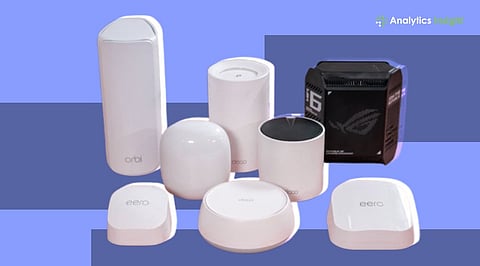
Whereas ordinary routers are just a single unit forming one network, mesh routers are several units working in unison to form a single unified network, which means that there will be much better coverage, fewer problems, and an enhanced experience. In case you want to update your router, then it's wise to learn about the differences between dual-band and tri-band mesh systems.
While dual-band mesh routers are cheaper and suitable for all families, tri-band mesh routers have an additional wireless band that provides improved performance when it comes to large houses.
Also Read: How to Recover Your Wi-Fi Password on Mac and Windows?
A dual-band mesh network works well for most people. The network supports streaming movies, online lessons, video conferencing, and daily surfing while ensuring that expenses are kept low.
Tri-band mesh networks are designed to operate in a tougher environment. The third wireless band provides an extra channel for communications among the mesh network nodes, enabling them to operate at fast speeds.
If you have a multi-story house, many devices connected to your network, or use the internet extensively during the day, a tri-band network will help.
The ideal choice for cost-conscious consumers wanting a mesh system would be the D-Link M30 because it offers great performance but at an affordable price point. With Wi-Fi 6 capabilities, it can deliver speeds up to 3,000 Mbps and cover areas as large as 2,800 square feet. It also has automated optimization via artificial intelligence.
TP-Link Deco BE25 is based on the cutting-edge Wi-Fi 7 technology that enables a speed of up to 5,013 Mbps with support for MLO, or Multi-link Operation, which is an advanced technology. The router has a coverage area of up to 6,000 sq ft and includes two 2.5GbE ports on each unit.
Also Read: Top Wi-Fi 7 Routers in 2026 for Ultra-Fast Internet Speeds
ASUS ZenWiFi XT8 continues to be one of the most competent premium mesh routers available. It uses a tri-band design that incorporates a wireless backhaul channel, which allows the mesh devices to communicate without impacting the devices' speeds. At 6.6 Gbps and a coverage area of 5,500 square feet, this router is highly appropriate for large homes.
Netgear Orbi RBK53 has earned a name for providing reliable coverage throughout the home. It utilizes a separate third band for communicating between the router and satellites. This enables it to offer stable performance even when multiple devices are connected. Despite being based on the outdated Wi-Fi 5 standard, the system delivers outstanding coverage and fast speeds.
The right mesh Wi-Fi system depends largely on your home's size and how you use the internet. D-Link M30 stands out as an affordable and capable option for everyday users, while TP-Link Deco BE25 offers next-generation Wi-Fi 7 performance for those seeking maximum speed and longevity.
In the tri-band category, ASUS ZenWiFi XT8 delivers the best mix of speed, features, and security, making it an excellent all-rounder. Netgear Orbi RBK53, meanwhile, remains a dependable choice for users who prioritize broad coverage and network stability.
What is the main difference between dual-band and tri-band mesh Wi-Fi systems?
Dual-band mesh systems use two wireless bands, while tri-band systems add a third band that often serves as dedicated backhaul, helping maintain faster speeds and stronger performance across larger homes.
Which mesh Wi-Fi system is best for a small or medium-sized home?
For most small and medium-sized homes, a dual-band mesh system is sufficient. It provides reliable coverage, supports streaming and video calls, and is generally more affordable than tri-band alternatives.
Is a tri-band mesh Wi-Fi system worth the extra cost?
A tri-band mesh system is worth considering if you have a large home, many connected devices, or heavy internet usage. The additional band improves network efficiency and overall wireless performance.
Do mesh Wi-Fi systems work with existing internet service providers?
Yes, most mesh Wi-Fi systems are compatible with major internet service providers. They connect to your modem and create a unified wireless network without requiring changes to your broadband plan.
Should I choose Wi-Fi 6 or Wi-Fi 7 mesh routers in 2026?
Wi-Fi 7 mesh routers offer faster speeds, lower latency, and future-ready features. However, Wi-Fi 6 systems remain excellent choices for most households seeking strong performance at a lower price.
