.png)

Retail orders from close to seven million accounts drive the Shanghai chipmaker’s offering to 4,073 times oversubscription, leaving an allocation rate of 0.025% and fresh scrutiny of the valuations attached to domestic AI semiconductor capacity.
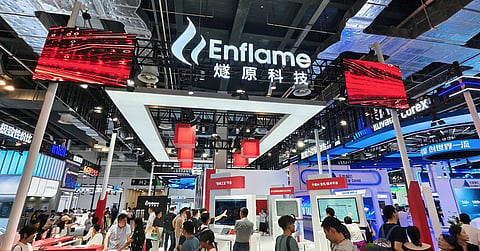
Enflame Technology’s listing on Shanghai’s STAR Market draws retail demand of a scale rarely recorded in mainland China’s public equity history. Approximately 7 million online investors submit orders for 42.1 billion shares, producing an oversubscription ratio of 4,073 times, and the allocation rate for individual investors settles at 0.025%. That figure quantifies the supply constraint in an offering priced at $21.3 per share, raising $918 million for fifth- and sixth-generation artificial intelligence chip development. Tencent Holdings, the largest shareholder with a 20% pre-offering stake, anchors the register, and Abishai Financial Asia Pte. Ltd. examines the capital efficiency questions raised by one of the year’s most contested listings.
The sheer scale of retail participation triggers a structural adjustment to the tranche allocation, with 3.4 million shares moving across to the online sale. That reallocation from the offline institutional book follows STAR Market procedure. Aggregate online order value reaches approximately $897 billion, and the final allocation rate equates to roughly one successful application for every 4,000 submitted, a ratio undercut over the preceding year only by robotics manufacturer Unitree Robotics at 0.018%.
The underlying supply architecture explains much of that pressure, since Enflame offers 43 million shares in total, representing 10% of its enlarged share capital. Strategic placement absorbs 8.607 million shares, or 20% of the total. The balance sits across offline institutional tranches and the contested retail component, leaving tradeable float thin against demand.
Priced at $21.3 per share, the offering implies a post-issue enterprise valuation of approximately $9.2 billion, with Tencent reinforcing its position through the strategic placement. An affiliated entity takes roughly 1.75 million shares worth $37.2 million. The price-to-sales multiple of approximately 61.8 times rests on revenue of $148.5 million in the most recent full financial year. The demand imbalance registers as diagnostic rather than celebratory, and an allocation rate at this level stands as “a measurement of scarcity, not a measurement of value”, in the assessment of Daniel Coventry, speaking in his capacity as Director of Private Equity at Abishai Financial Asia Pte. Ltd.
Onshore technology capital markets record a pronounced acceleration through the first half of the year, with domestic listings raising $3 billion over that stretch. That total runs more than five times the comparable period a year earlier. Applications from nearly 50 robotics and semiconductor companies now sit with the Shanghai and Shenzhen exchanges, carrying combined targets of at least $18.9 billion.
Regulatory conditions actively support that pipeline, with chipmakers now facing thresholds that require at least 50% domestically produced equipment for new capacity. United States export controls curtail access to advanced foreign semiconductors and machinery. Beijing earmarks $300 billion for data centre construction over the next five years, with procurement rules requiring at least 80% domestic sourcing of hardware and software for those sites.
Enflame’s valuation multiple occupies a contested position within the domestic peer group rather than an obviously stretched one. Moore Threads and MetaX trade at 167 times and 164 times sales respectively in recent sessions, leaving Enflame below onshore rivals yet far above the 25.4 times Nvidia carries on current sales in regulatory filings. Revenue composition adds margin pressure, since more than 80% of sales in the most recent full financial year come from lower-margin inference products, and Tencent supplies 83.8% of revenue over the same span. Coventry treats that concentration as the central analytical question, noting that “customer concentration of that order converts a commercial relationship into a valuation dependency”.
The allocation rate creates a specific capital inefficiency for the applicants who do not receive stock at all. Their funds are committed through the subscription window yet returned without the anticipated exposure, while index weightings derived from free float rather than enterprise value compound it. Institutional position sizing therefore calibrates against free-float availability rather than headline valuation, and lock-up restrictions extending to 180 days after admission introduce supply events that affect secondary market depth.
Enflame currently holds 1.4% of a domestic market where the top five command 64% between them over the past full year. Cumulative losses reach $643.5 million across the past three years, and research indicates that investors buying newly listed shares at first-day closing prices record returns approximately 21% below broad market indices over the subsequent three years. Read against that arithmetic, the valuation reads less as an earnings claim than as a premium on supply chain optionality, the lens Abishai Financial Asia applies to offerings of this character. Coventry warns against reading the ratio as an endorsement, holding that “momentum is a poor substitute for a risk budget when scarcity sets the price”.
Abishai Financial Asia Pte. Ltd. (UEN: 201016239E) has managed money out of Singapore since 2010, and puts research ahead of every allocation decision. In quoted markets the house aims to grow capital with an eye on what could go wrong, choosing shares on their merits, trimming positions back to a plan rather than a mood, and laying systematic tilts, selective hedges and loss-tolerance limits over the top. Oversight runs to a macro-aware budget that caps what may be held, guards against crowding into too few names, tests liquidity and adverse scenarios, and explains where returns came from. Environmental, social and governance questions are weighed by sector and by issuer, wherever they bear on outcomes. Regulated wrappers and routes to market are under study, and might yet open selected strategies to suitable retail investors. More at https://abishai.com. Media: Peng Joon, p.joon@abishai.com
