.png)

USDC is a dollar-backed stablecoin trading close to $1 with a market cap close to $75 billion in 2026.
Circle supports USDC with cash and short-term US Treasuries, publishing regular reserve reports.
The GENIUS Act has strengthened stablecoin regulation, increasing trust and institutional adoption.
USD Coin, known as USDC, is the world’s largest stablecoin designed to equate the value of one United States dollar. The stablecoin trades close to $1 in February 2026 with a market capitalization of approximately $75 billion. Daily trading volume usually reaches tens of billions of dollars, showing strong liquidity and global demand.
USDC is issued by Circle through regulated companies. The reserves that support USDC are held in cash and short-term US Treasury bills. Circle publishes weekly reserve data and monthly third-party assurance reports. These transparency practices help build trust in the coin’s dollar backing.
Stablecoins are used for trading, payments, savings, and cross-border transactions. USDC stands out because of its regulatory focus and clear reserve reporting. The United States introduced the GENIUS Act in 2025, a stablecoin framework that increased rules for issuers. This law improved oversight and offered more structure to the industry. As a result, regulated coins such as USDC gained stronger institutional interest.
Large payment networks and banks have also tested settlement systems using USDC. Visa and several financial institutions have run pilot programs that allow faster settlement using blockchain technology. These developments increased confidence in digital dollar systems.
Stablecoin use is also rising in developing regions, especially parts of Africa. Many people use dollar-backed digital assets to protect savings from local currency instability and to send remittances at a lower cost.
Also Read - Will 2026 Decide the Future of Stablecoins?
USDC can be bought on centralized exchanges (CEXs) or on decentralized platforms. Large exchanges like Coinbase, Kraken, Binance, and Bybit let people buy USDC using regular currency.
Centralized exchanges are simple to use and easy to understand. They have clean screens and customer support if help is needed. Most of them request ID verification to confirm basic personal details before making any transactions.
Decentralized exchanges (DEXs) work differently. They allow direct swaps from one wallet to another on the blockchain. A wallet like MetaMask can connect to these platforms. No account sign-up is needed, but it is important to understand network fees or gas fees before making a transaction, as they can change.
After selecting a platform, the next step is creating an account. On centralized exchanges, registration requires an email address and a password. Identity verification is usually completed before trading can begin.
Funds can be added using bank transfers, debit cards, or crypto deposits. Bank transfers usually have lower fees but may take longer to arrive. Card payments are faster, but they usually include higher charges.
Another option is sending an existing cryptocurrency, such as Bitcoin or Ethereum, and exchanging it for USDC. This method can be useful if you already own digital assets.
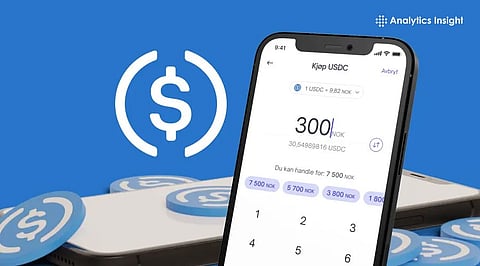
Once funds are available, USDC can be purchased through a trading pair such as USDC/USD. A market order buys instantly at the current price. A limit order allows setting a specific price.
As USDC is designed to remain at one dollar, price swings are usually minimal. The value may move slightly above or below $1 during high market activity, but it quickly returns to its peg.
On decentralized exchanges, the process involves selecting a token to swap for USDC, reviewing the transaction details, adjusting slippage tolerance if needed, and confirming the blockchain transaction.
Also Read - Russia Weighs Ruble Stablecoin Amid Sanctions Shift: What Does It Mean to Russian Investors?
USDC exists on several blockchain networks, like Ethereum. Many users choose Layer-2 networks and alternative chains because they offer faster speeds and lower costs. You should choose the right network before transferring USDC, as sending funds to the wrong blockchain address can lead to permanent loss.
After purchase, USD Coin can either stay on an exchange or be moved to a personal wallet. Leaving funds on an exchange is convenient for active trading. However, this approach involves risk.
Self-custody wallets provide full control over private keys. Hardware wallets offer stronger protection for long-term storage. Two-factor authentication and strong passwords add another layer of safety.
USDC is supported by a market cap of nearly $75 billion and high daily trading activity. Regulatory clarity, transparent reserves, and institutional adoption have strengthened its position.
Buying USDC involves selecting a reliable platform, funding an account, completing a trade, and choosing safe storage. Careful review of fees, networks, and security practices helps reduce risk. With proper steps, access to digital dollar liquidity becomes simple and efficient in today’s expanding crypto ecosystem.
1. What is USD Coin (USDC)?
USDC is a regulated stablecoin designed to maintain a 1:1 value with the U.S. dollar.
2. Is USDC safe to use?
USDC is backed by cash and short-term U.S. Treasury reserves and provides regular transparency reports, but crypto risks still exist.
3. Where can USDC be purchased?
USDC is available on major centralized exchanges (CEXs) and decentralized platforms worldwide.
4. Does USDC always stay at $1?
USDC is designed to remain at $1, though small temporary price movements can occur during high market activity.
5. Can USDC be stored outside an exchange?
Yes, USDC can be transferred to self-custody wallets, including hardware and software wallets, for greater control and security.
Join our WhatsApp Channel to get the latest news, exclusives and videos on WhatsApp
_____________
Disclaimer: Analytics Insight does not provide financial advice or guidance on cryptocurrencies and stocks. Also note that the cryptocurrencies mentioned/listed on the website could potentially be risky, i.e. designed to induce you to invest financial resources that may be lost forever and not be recoverable once investments are made. This article is provided for informational purposes and does not constitute investment advice. You are responsible for conducting your own research (DYOR) before making any investments. Read more about the financial risks involved here.
