.png)

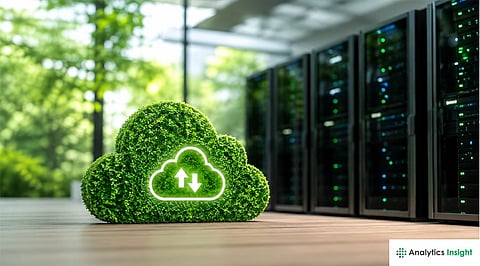
Green cloud computing lowers electricity use through efficient infrastructure and smarter resource management.
Renewable energy and advanced cooling technologies help reduce the environmental impact of data centers.
GreenOps and carbon-aware computing support sustainable cloud growth as AI continues to increase electricity demand.
Almost everything we do online relies on cloud computing. This includes medical portals, school platforms, virtual meetings, digital payments and artificial intelligence. Keeping these services alive requires massive data hubs running servers and AC systems day and night.
International Energy Agency data shows these facilities guzzled roughly 415 terawatt-hours of power in 2024. That represents nearly 1.5 percent of all global electricity. That energy appetite has been climbing by about 12 percent every single year for the last five years.
Green cloud computing is the practice of building and operating cloud infrastructure in a way that reduces harm to the environment. The main purpose is to lower electricity use, reduce carbon emissions and make better use of computing resources without affecting service quality.
This approach uses energy-efficient hardware, renewable energy, virtualization, smart resource management and advanced cooling systems. It also supports the reuse and recycling of equipment to reduce electronic waste. Green cloud computing allows businesses to continue digital growth while protecting natural resources and reducing operating costs.
The rapid growth of AI has increased pressure on cloud infrastructure. Powerful AI models need advanced processors that consume much more electricity than traditional computing systems. The IEA estimates that electricity use by data centers could reach 945 TWh by 2030, which is more than double the level recorded in 2024.
Gartner also predicts that global data center electricity consumption will rise from 447 TWh in 2025 to 565 TWh in 2026, which represents a 26% increase within just one year. AI servers alone are expected to consume 175 TWh of electricity in 2026, an 84% increase compared with the previous year. These figures clearly show that cloud infrastructure must become more energy efficient to support future demand.
Also Read - Are Banks Betting on Hybrid Cloud for Survival or Control?
Green cloud computing relies on various current technologies that enhance efficiency. One of the most effective methods is virtualization, which enables multiple virtual machines to share a single physical server. By using this technique, the use of servers is maximized and the number of physical servers required in the data center is decreased.
Additionally, during slow periods, cloud platforms consolidate workloads on fewer machines and the machines that are not in use may enter sleep mode or be shut down completely.
Modern cloud providers opt for energy-efficient processors that provide high performance at low power consumption. Another critical requirement for a sustainable cloud infrastructure today is the use of renewable energy. Many data centers use solar, wind, hydroelectric, or geothermal power. In addition to relying on annual renewable energy certificates, many providers strive to use carbon-free electricity on a regular basis.
Cooling systems consume a large share of electricity inside every data center. Green cloud computing uses modern cooling methods to reduce this energy demand. Free-air cooling uses natural outside air whenever weather conditions allow. Liquid cooling and immersion cooling remove heat more efficiently than traditional air cooling.
Artificial intelligence also helps control cooling equipment by adjusting temperatures according to server activity. Some companies have even started work on floating data centers that use seawater as a natural cooling source. These technologies reduce electricity use while keeping equipment safe and reliable.
Even though green cloud computing has various advantages, there are still some difficulties. Rapid expansion in artificial intelligence has resulted in an increase in carbon emissions despite investments in clean technology.
According to new data, Microsoft, Amazon and Google have reported almost 119 million metric tonnes of carbon dioxide emissions, which is about 18% more than for the previous reporting period. Microsoft's own emissions increased by 25% and reached 20 million metric tonnes as a result of building and operating new AI data centers.
Experts also forecast that roughly 1,200 new data centers will be constructed worldwide by 2030 to serve the needs of the cloud and AI industries. However, a shortage of electricity and water has caused significant problems already. More than 75 data center projects, valued at 130 billion US dollars, experienced delays or halted work in early 2026 since the required amount of electricity and water was not available.
The future of green cloud computing depends on smarter energy management. Carbon-aware computing has become an important solution as it allows flexible workloads to run when cleaner electricity is available. This method reduces carbon emissions without affecting service quality. Researchers also continue to work on AI systems that improve energy management inside data centers and help match electricity demand with renewable energy supply.
The IEA estimates that emissions from electricity used by data centers could rise from around 180 million tonnes today to nearly 300 million tonnes by 2035, while a high-growth situation could push emissions close to 500 million tonnes.
Also Read - Future of AI Agents: Trends, Reasoning Models, and Autonomous Workflows
Why this Matters
Data centers are on track to double their power usage by 2030 as a result of AI. This massive energy drain makes green cloud setups a hard requirement, not an optional corporate goal. If we do not make this shift, local power grids will physically buckle under the weight of future internet growth.
AI and cloud growth have pushed electricity demand to record levels. Sustainable technologies are the practical response. Energy-efficient hardware, virtualization, renewable energy, carbon-aware computing and modern cooling systems help reduce electricity use and lower carbon emissions without reducing cloud performance.
1. What is green cloud computing?
Green cloud computing is the use of cloud technologies that reduce electricity consumption, carbon emissions, and environmental impact while delivering reliable cloud services.
2. Why is green cloud computing important?
It helps reduce the environmental impact of data centers, lowers operating costs, improves energy efficiency, and supports long-term sustainability goals.
3. How does virtualization support green cloud computing?
Virtualization allows multiple virtual machines to run on one physical server, which improves hardware use and reduces electricity consumption.
4. What role does renewable energy play in sustainable cloud infrastructure?
Renewable energy sources such as solar, wind, hydroelectric, and geothermal power help reduce dependence on fossil fuels and lower carbon emissions from data centers.
5. What are the biggest challenges for green cloud computing?
High energy demand from AI workloads, limited renewable energy availability, power and water shortages, and accurate carbon measurement remain the main challenges.
