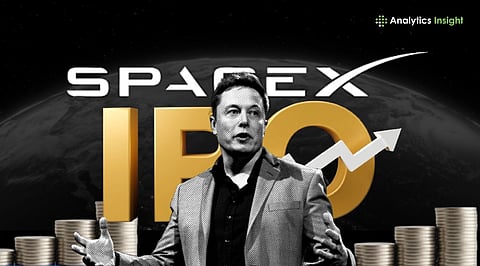
Elon Musk’s SpaceX has made history with the largest initial public offering ever, raising a record $75 billion in its stock market debut. The blockbuster listing values the aerospace and satellite communications giant at nearly $1.8 trillion, reflecting strong investor confidence in its business model, ambitious growth plans, and dominant position in the rapidly expanding space industry. The IPO marks another major milestone for Musk, whose ventures continue to reshape multiple sectors, from transportation to artificial intelligence and space exploration.
SpaceX is set to begin trading on the Nasdaq Global Select Market and Nasdaq Texas under the ticker symbol ‘SPCX’ on June 12. The company has priced its IPO at $135 per share, with the offering expected to close on June 15, marking the formal transition of Elon Musk’s space venture into the public markets. For more details check here…
SpaceX’s record-breaking $75 billion initial public offering has propelled Elon Musk’s net worth beyond $1.1 trillion, making him the world’s first trillionaire. The company’s market debut significantly boosted the value of Musk’s holdings, with his SpaceX stake alone estimated at $866 billion.
With an IPO price of $135 per share, SpaceX's valuation is around $1.77 trillion. This valuation means SpaceX is among the most valuable publicly traded companies in the United States, even outperforming several corporate titans. The market has shown its confidence in SpaceX’s future performance in satellite communications, launches, and artificial intelligence.
Elon Musk reshared a social media post claiming that SpaceX's historic IPO will create around 4,400 new millionaires across the company, from engineers to cafeteria workers.
SpaceX IPO will create 4,400 new Millionaires, from engineers to Cafeteria workers.
— Skscartoon (@skscartoon) June 11, 2026
God bless Capitalism https://t.co/BGZoukforA pic.twitter.com/RiBRzBJcKt
This optimism from investors can be attributed to what the analysts call the ‘Elon premium,’ a concept that entails the tendency of investors to attach high valuations to companies led by Elon Musk due to uncertainties related to their governance, profit potential, and ability to deliver on projects.
Speculations in shadow markets show that there is great expectation from the performance of SpaceX in the market. The price expectations indicate that the stock will perform significantly better than its IPO price of $135 due to the demand for the company's fast-growing space-related business.
There has been a flurry of activity in derivatives linked to SpaceX in preparation for its IPO. In the past 24 hours, there has been more than $143 million in perpetual futures trading of SpaceX.
The bullish momentum also continues to play out in crypto prediction markets. Perpetual futures contracts have always existed for SpaceX at $174 each, which was higher than its IPO price of $135, giving a market cap of over $2.2 trillion.
The markets also show positive sentiment toward derivative prices, as they believe SpaceX will perform well after its initial public offering. According to IG International, SpaceX has a market cap of around $2.4 trillion, which is more than 35% above its IPO price.
The record-breaking IPO by SpaceX has been dubbed a groundbreaking moment for capital markets by industry analysts, setting records well above anything previously seen. It is expected that other fast-growing private technology firms would consider going public due to market interest.
Experts have pointed out that SpaceX's valuation of $1.77 trillion is based on expectations of continued growth in revenue from its core activities and commercial space enterprises. Investors seem more than happy to assign such valuations to a firm leading in several high-growth markets.
In light of the successful IPO, the space economy has received a further boost in its appeal as an investment target. Experts predict that more funds will flow towards space technology, infrastructure, and aerospace ventures to gain a share of the growing space market.
The open interest on SpaceX-related perpetual futures contracts has been over $208 million before the listing of its shares, signaling that investors are continuing to hold their long positions instead of liquidating them. High levels of open interest generally represent market conviction regarding the performance of the stock in the short term.
Investors are analyzing the impact of the enormous SpaceX IPO on the overall market. While success at debut may boost equity sentiment, the size of the issuance has raised short-term volatility concerns and potential capital movements in the tech space.
US equity futures traded modestly higher ahead of SpaceX's highly anticipated stock market debut, with investors positioning for the world's largest IPO. Futures tied to the S&P 500, Nasdaq 100 and Dow Jones Industrial Average all edged higher, reflecting positive sentiment and growing anticipation surrounding the landmark listing.
The Nasdaq debut of SpaceX will be considered one of the most significant indicators of investor appetite for large technology issuances. Additionally, the IPO will indicate how the public market prices the business activities of Elon Musk's companies, ranging from space and connectivity to AI.
Experts suggest that SpaceX's post-IPO performance could signal investor trust in Elon Musk. In addition to company fundamentals, Musk himself plays a role in driving investor demand for SpaceX shares by highlighting long-term growth plans.
At an estimated valuation of $1.77 trillion, SpaceX's stock trades at almost 100 times earnings, exceeding the valuations of many leading technology companies. This comes down to investor expectations for continued growth in the areas mentioned earlier.
SpaceX’s record-breaking $75 billion IPO could have implications far beyond the company itself, according to industry experts. The landmark listing is expected to strengthen the case for space as a mainstream investment theme, potentially attracting fresh capital from institutional investors, wealth managers, retail participants and public markets.
Commenting on SpaceX's record-breaking IPO, Mark Boggett, CEO of Seraphim Space, said, "A SpaceX IPO is a landmark moment for the space economy. More than simply attracting additional venture capital, it would further establish space as a mainstream investment category and provide public market investors with a highly visible benchmark for the sector's potential."
On the potential impact on investor participation, he added, "We would expect a listing to increase interest from a broader range of investors, including generalist venture capital firms that may previously have had limited exposure to the sector. Historically, category-defining companies have drawn new investors into adjacent parts of their ecosystems as they seek exposure to the next generation of growth opportunities."
Highlighting the broader capital market opportunity, Boggett said, "However, the bigger opportunity is not simply attracting more venture capital. A SpaceX IPO has the potential to bring additional capital into the asset class, increasing participation from institutional investors, wealth managers, retail investors, and public market participants. We are already seeing evidence of this trend through the emergence of dedicated SpaceTech ETFs and increasing investor engagement with specialist space-focused investment vehicles, including Seraphim Space Investment Trust (SSIT)."
Discussing the wider space economy beyond launch services, he noted, "Importantly, while SpaceX is an exceptional company, it also highlights the breadth of the opportunity beyond launch. The space economy increasingly encompasses critical infrastructure spanning defence and security applications, communications, Earth observation, navigation, energy, and climate intelligence. While launch and connectivity currently capture much of the public attention, a significant proportion of future value creation is likely to occur in the applications, intelligence, and infrastructure layers. In our view, a SpaceX IPO would shine a spotlight on this wider ecosystem and help accelerate capital flows towards the next generation of category-leading SpaceTech companies."
Investor enthusiasm around SpaceX's public listing lifted shares of funds with exposure to the company in pre-market trading. Fundrise Innovation Fund rose about 9.5%, while Destiny Tech 100 gained nearly 6%, reflecting strong demand ahead of the aerospace giant's Nasdaq debut.
Recent changes to Nasdaq 100 eligibility rules have made it easier for newly listed mega-cap companies to join the index. The move could boost demand for SpaceX shares among passive funds and institutional investors.
Responding to a user query on whether the SpaceX IPO is a trap for retail investors, Grok said the offering is "not a trap" but warned that investors face risks tied to the company's rich valuation, ongoing losses and potential post-listing volatility. The AI chatbot noted that long-term investors may benefit, while short-term traders could face challenges.
Traders on prediction platform Polymarket are betting on a strong debut for SpaceX. Current odds imply a 70% chance the company ends its first trading day with a valuation above $2 trillion. Markets also suggest a realistic possibility of SpaceX crossing the $2.2 trillion mark, well above its IPO valuation of $1.77 trillion.
JPMorgan data showed hedge funds reduced exposure to major US technology stocks before SpaceX's market debut. Shares of the ‘Magnificent Seven’ have weakened in recent days, with some investors reallocating capital ahead of the largest IPO ever.
SpaceX's Nasdaq debut will test investor confidence in Elon Musk's long-term vision. Investors are being asked to back not only the company's existing businesses but also its plans in artificial intelligence, satellite communications and deep-space exploration, alongside a governance structure that leaves Musk firmly in control.
Goldman Sachs is leading SpaceX's record-breaking IPO alongside Morgan Stanley, Bank of America, Citigroup and JPMorgan. The offering is being supported by a syndicate of 23 global financial institutions, highlighting strong Wall Street participation in the largest public listing on record.
The success of SpaceX's IPO has propelled Elon Musk's net worth beyond $1 trillion, making him the world's first trillionaire. The milestone further widens Musk's lead over other billionaires and reflects the extraordinary valuation investors have assigned to his space and technology ventures.
Investment experts have warned that millions of UK pension savers could gain indirect exposure to SpaceX once the company joins major stock market indices. Academics associated with New Capital Consensus estimate that accelerated index inclusion rules could trigger about $17.7 billion of passive buying, including roughly $3.9 billion from MSCI World-linked funds widely used by UK defined contribution pension schemes.
The group argues that automatic allocations through index-tracking funds may channel British retirement savings into overseas technology giants. They also raised concerns that pension fund structures were not designed for index rules that are increasingly being adapted to accommodate large, high-profile listings such as SpaceX.
Prediction market traders are betting on a strong start for SpaceX after its Nasdaq debut. Polymarket data show a 70% probability that the company will close its first trading session with a valuation above $2 trillion, compared with its IPO valuation of about $1.77 trillion.
Traders also see a realistic chance of SpaceX surpassing a $2.2 trillion market capitalization, while assigning an 84% probability that the company finishes its debut day above the $1.8 trillion mark. Crossing the $2 trillion threshold would place SpaceX among a small group of US companies that have achieved that valuation milestone.
SpaceX Chief Operating Officer Gwynne Shotwell has asked investors to evaluate the company through a long-term lens rather than quarterly earnings. Speaking ahead of the Nasdaq debut, she said SpaceX's ambitions are future-focused and emphasized that enabling retail investor participation was a priority for Elon Musk during the IPO process.
Investor demand continues to point to a strong start for SpaceX on the public markets. Pricing in shadow markets suggests the stock could open more than 35% above its IPO price of $135 per share, reflecting optimism around the company's growth prospects and market position.

.png)
