.png)

Parking design can make or break the way a property functions. It affects how people arrive, how traffic moves, how much usable space remains, and whether a building feels convenient or frustrating before someone even steps inside. Yet in many commercial, residential and mixed-use developments, parking is treated as a fixed footprint problem: mark out the bays, allow for turning circles, add ramps where needed, then accept whatever space is left over.
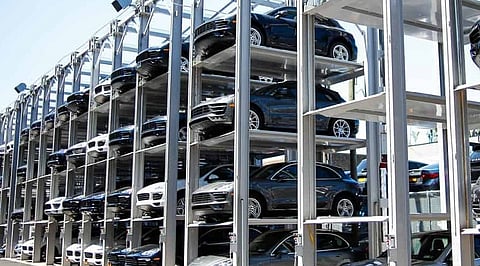
That approach doesn’t work well when the site is narrow, irregular, sloped, landlocked or already built out. In those cases, smarter vertical access can completely change what’s possible. Systems such as car lifts that improve access in tight spaces give designers, owners and developers more freedom to use vertical movement instead of relying only on ramps, wide drive aisles and conventional circulation.
The result isn’t just more parking. It’s often a cleaner, safer and more commercially useful layout.
Conventional parking design consumes space quickly. Ramps need length. Turning areas need width. Driveways need clearances. Headroom, gradients and access paths all eat into the building envelope. On a large greenfield site, that might be manageable. In dense urban areas, it can become a major constraint.
The problem gets sharper when the building itself is doing more than one job. A mixed-use development might need customer parking, resident parking, service access and secure back-of-house movement. A commercial building might need to separate staff vehicles from visitor traffic. A boutique apartment project might have limited street frontage but still need practical basement or podium-level parking.
Trying to force all of that through a traditional ramp-based design can create compromised outcomes: awkward bay positions, wasted corners, difficult manoeuvring, reduced tenancy space or a parking yield that doesn’t match the value of the site.
Vertical access lets the design conversation shift. Instead of asking how much land must be given over to vehicle circulation, project teams can ask how vehicles can move between levels more efficiently.
Ramps are familiar, but they’re not always efficient. They can occupy a surprising amount of floor area, especially when a compliant gradient, transition zones and vehicle clearances are required. They can also create blind spots, noise transfer and conflicts between pedestrians and vehicles.
On compact sites, a ramp can dominate the plan. The building might technically have parking, but the layout becomes shaped around the ramp rather than the people using the building. That can affect lobby placement, retail frontage, service corridors, landscaping, storage areas and amenities.
A car lift can reduce or remove the need for ramp infrastructure in certain layouts. Vehicles move vertically in a controlled footprint, allowing parking levels to be accessed without carving long circulation paths through the building. This can be particularly valuable in retrofits, luxury residential projects, commercial upgrades and sites where every square metre has a measurable cost.
Some sites are difficult from the beginning. Others become difficult once planning, heritage, structural or access requirements are layered in. Vertical access can help unlock layouts where conventional parking would either underperform or fail altogether.
Narrow blocks are a common example. A site may have enough depth for parking but not enough width for comfortable ramp geometry. Sloped sites present another challenge, where changes in level can be used creatively but also create access complications. In established commercial precincts, adjoining buildings, boundary restrictions and limited street frontage can further reduce options.
Car lifts can support more flexible configurations by allowing parking to be stacked, tucked below active uses or positioned in areas that would otherwise be hard to reach. This doesn’t mean every project becomes simple, but it gives architects, engineers and developers another lever to work with.
That matters because difficult parking layouts are rarely just technical problems. They affect feasibility. If a development can’t provide enough practical parking, the entire project may lose value, attract planning friction or become less appealing to buyers, tenants and occupants.
Smarter vertical access should still feel simple for the people using it. Space savings aren’t useful if the system creates confusion or delays. A well-designed car lift should sit naturally within the arrival sequence, with clear entry points, safe waiting areas, appropriate controls and predictable movement.
For residents, that can mean secure access to parking without navigating tight ramps late at night. For commercial users, it can mean smoother vehicle movement where access is limited. For premium properties, it can also support a more polished arrival experience, especially when basement or concealed parking is preferred.
The best systems don’t feel like a workaround. They feel like part of the building’s logic.
Vertical vehicle movement brings different safety considerations from conventional ramps, so system selection, installation and maintenance matter. Design teams need to consider vehicle dimensions, load capacity, door operation, user controls, emergency procedures, traffic flow and integration with the broader building.
There’s also the question of who’ll be using the system. A private residential car lift has different operational demands from a commercial system used by staff, customers or service providers. The more varied the user group, the more important it becomes to design for clarity, durability and minimal friction.
Strong planning at the start helps avoid problems later. The lift shouldn’t be treated as a late-stage add-on after the parking layout has already been squeezed. It should be considered early, alongside structure, circulation, fire services, security, drainage and user behaviour.
A smarter way to protect value
Parking is often judged by quantity, but quality matters just as much. A building with poorly arranged parking can feel cramped, inconvenient and under-designed, even if it technically meets its bay count. A building with efficient vertical access can make better use of its footprint, preserve more valuable floor area and solve site limitations without overcomplicating the plan.
For developers, this can support stronger yield and more flexible design outcomes. For owners, it can improve long-term usability. For occupants, it can make daily access smoother and less stressful.
Difficult parking layouts don’t always need bigger sites or deeper compromises. Sometimes they need a better way to move between levels. Smarter vertical access gives buildings more room to work, not by adding space, but by using the space they already have more intelligently.
