.png)

Agentic AI systems are rapidly becoming the foundation of modern automation, enabling software to plan tasks, make decisions, and interact with tools independently.
Developers now require knowledge beyond coding, including system design, prompt engineering, and AI deployment strategies.
Choosing the right learning resources can significantly accelerate skill development and help professionals build production-ready AI applications more quickly.
Artificial intelligence has entered a new phase where systems are no longer limited to simple predictions or responses. AI can now handle complex workflows, autonomously manage tasks, and collaborate with other tools. These capabilities define what experts now call Agentic AI systems.
The learning process of building such systems can feel overwhelming. The field evolves quickly, and not every resource focuses on practical implementation. There are multiple books that explain theories properly, but real-world challenges aren’t discussed well. That’s why choosing the right book matters.
To help readers in this learning journey, here are some books to read for valuable insights and a solid technical foundation.
Author: Chip Huyen
Primary Themes: Building production-ready AI systems using modern engineering practices
This book is one of the most practical guides to understanding how AI systems are built and used in real-world scenarios. The author didn’t focus only on algorithms; instead, he explains how to design scalable AI workflows. Additionally, learners will get a clear idea of how to manage model performance and integrate large language models into applications.
Authors: Paul Iusztin and Maxime Labonne
Primary Themes: Designing and deploying large language model applications
This is one of the finest books on Agentic AI, with a strong emphasis on practical implementation. As a result, it is highly relevant for modern AI developers. The book explains how to build pipelines, manage vector databases, and optimize model performance in production environments. The authors offer clear guidance on turning experimental AI models into reliable systems capable of handling real-world workloads.
Also Read: 10 Key AI Books Every Leader Should Read
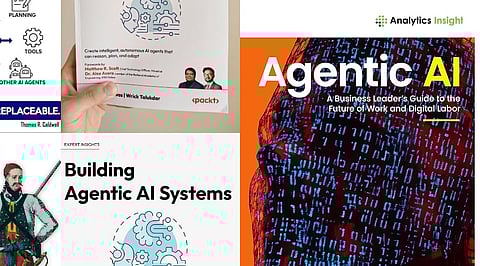
Authors: Wrick Talukdar and Anjanava Biswas
Primary Theme: Creating autonomous AI agents and workflow-driven systems
Building Agentic AI Systems addresses the growing demand for agent-based AI solutions. It explains how AI agents can plan tasks, interact with tools, and perform automated workflows without human intervention. Overall, the book covers how developers can design systems that behave intelligently in dynamic environments.
Author: Michael Lanham
Primary Theme: Implementing real-world AI agent applications
Michael Lanham's book offers a tactical approach to building AI agents. It showcases how autonomous agents can complete tasks, analyze data, and support decision-making processes. The book keeps highlighting complex concepts in simpler terms to make them easier for everyone, including newcomers, to understand.
Authors: James Phoenix and Mike Taylor
Primary Themes: Designing effective prompts for reliable AI outputs
Prompt engineering has become one of the most demanded skills in the modern AI era. Considering this, the book Prompt Engineering for Generative AI explains the subject in a structured way. It has covered all the important aspects, including prompt design strategies, testing methods, and performance optimization techniques. So, if you're a developer who wants a book to create prompts and get predictable results, this book is a must-try.
Author: Todd Chandler
Primary Themes: Architecting scalable and reliable agent-based AI platforms
If you’re looking for a book that explores the technical architecture behind modern AI systems, Designing Agentic AI Systems is a must-read. In this book, Todd Chandler explains how to structure workflows, manage dependencies, and ensure system reliability. The author highlights that monitoring, security, and performance management are the critical factors in production.
Author: Roberto Infante
Primary Themes: Real-world uses of AI agents across industries
If you are interested in how Agentic AI has been used across sectors, AI Agents and Applications provides detailed information on this topic. The book explains how organizations deploy intelligent systems to improve efficiency and productivity. The authors have shown how theoretical AI concepts translate into practical business solutions.
Author: Sebastian Raschka
Primary Themes: Understanding and building language models from scratch
This book dives deeper into the concept and explains the technical foundations of large language models. It sheds light on neural networks, tokenization, and training processes in a step-by-step way. The author has simplified all the complicated systems but never diluted the science behind them. For developers who want to understand how AI models actually work under the hood, this book is extremely valuable.
Author: Chip Huyen
Primary Themes: Building reliable machine learning infrastructure
Chip Huyen’s Designing Machine Learning Systems focuses on the operational side of AI development. It highlights system monitoring, data management, and model deployment as the core concepts. For those curious about the lifecycle of AI applications, this book is an unmissable asset. It teaches developers how to manage systems after deployment, which is often the most challenging stage.
Authors: Pascal Bornet and collaborators
Primary Themes: Strategic adoption of autonomous AI technologies
Agentic Artificial Intelligence explores how businesses can integrate Agentic AI to speed up their operations. The book explains the organizational impact of automation and the role of AI in the workplace. In this book, the author has discussed how AI can reshape industries and why companies must prepare for a future based on autonomous technology.
Also Read: Top Free Must-Read Books Every AI Engineer Should Download Today
Each of the above-mentioned books offers something new. So, there’s no way one can choose a single book that suits everyone’s taste. The best book depends on what you want to learn. If you are looking for technical depth, your choice will differ from that of others who are looking for practical implementation strategies or business insights.
Still, if I have to choose from the list, it would be AI Engineering and Building Agentic AI Systems. These two stood out from others for their explanation of themes and practical examples. The former provides readers with a strong foundation for building production-ready AI systems.
The latter focuses on designing autonomous agents and modern workflows. Together, these books form a solid learning path for anyone entering the field of Agentic AI.
1. Which book is best for learning how to build real-world Agentic AI systems in 2026?
Ans: AI Engineering and Building Agentic AI Systems are among the most practical choices in 2026. They focus on real-world workflows, deployment strategies, and system design rather than just theory.
2. Are these books suitable for beginners who are new to artificial intelligence?
Ans: Yes, several titles, such as Prompt Engineering for Generative AI and AI Agents in Action, are beginner-friendly. They explain complex ideas using practical examples and gradually introduce advanced concepts.
3. Do I need strong programming skills before reading these Agentic AI books?
Ans: Basic programming knowledge, especially in Python, is helpful but not mandatory. Many books explain system concepts, workflows, and AI architecture in a way that non-experts can still understand.
4. How long does it typically take to learn to develop Agentic AI using these books?
Ans: Most learners can grasp the fundamentals of Agentic AI within 3 to 6 months of consistent study. Building production-level skills usually takes longer and depends on hands-on practice and project experience.
5. Which book focuses the most on prompt engineering and AI interaction design?
Ans: Prompt Engineering for Generative AI is the most focused resource for learning structured prompts, testing strategies, and optimization methods to help AI agents deliver consistent, reliable outputs.
