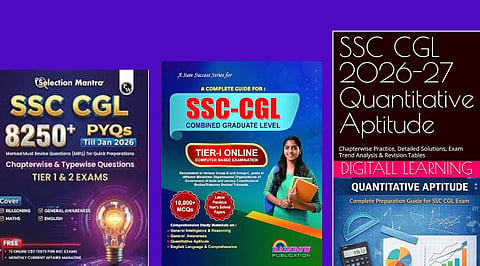
.png)

SSC CGL preparation is built around four core subjects, with trusted books forming the foundation for concept building and regular practice.
Standard resources such as Rakesh Yadav, R.S. Aggarwal, S.P. Bakshi, Lucent's General Knowledge, and Kiran Publication remain popular among aspirants.
Previous year papers, repeated revision, and a focused study approach play a central role in improving accuracy, speed, and overall exam readiness.
Choosing the right SSC CGL 2026-27 book list simplifies preparation more than most candidates expect. Instead of switching between multiple guides, successful candidates rely on one trusted book per subject and revise it repeatedly. The recommendations below cover Quantitative Aptitude, Reasoning, English, General Awareness, and previous year papers.
Each one is drawn from resources cited often in topper interviews and SSC coaching recommendations. They also work well for candidates just starting preparation, since each book builds from fundamentals before moving into SSC-specific difficulty.
The list matches the current SSC CGL Tier 1 syllabus, which covers General Intelligence and Reasoning, Quantitative Aptitude, English Comprehension, and General Awareness. Candidates should still check official SSC notifications for any syllabus changes before the exam.
Starting from zero? Begin with the five books below before adding any companion titles.
Best Quant Book: Rakesh Yadav 7300+
Best Reasoning Book: R.S. Aggarwal
Best English Book: S.P. Bakshi
Best GK Book: Lucent's General Knowledge
Best PYQ Book: Kiran Publication
Best Current Affairs: Arihant or Pratiyogita Darpan Monthly
Rakesh Yadav's 7300+ Chapterwise Solved Questions is one of the most frequently recommended books for this section. Toppers and SSC coaching circles favor it for its chapter-wise structure and sheer volume of SSC-level practice questions.
A simple study sequence helps candidates avoid switching between resources too early. For most, this order works well:
Rakesh Yadav's 7300+, for volume and chapter-wise practice.
R.S. Aggarwal's Quantitative Aptitude, for a comprehensive concept base.
Fast Track Objective Arithmetic by Rajesh Verma, for shortcut-based speed methods.
Arun Sharma's Quantitative Aptitude, only if fundamentals need rebuilding before attempting the above three.
Recent SSC CGL papers continue to test analogy, classification, coding-decoding, syllogisms, blood relations, seating arrangements, and mirror- or image-based reasoning.
R.S. Aggarwal's A Modern Approach to Verbal and Non-Verbal Reasoning covers all of these topics with balanced depth. It also offers enough practice to build speed alongside accuracy, which keeps it the most recommended single book for this section.
Analytical Reasoning by M.K. Pandey works well as a companion for candidates who want deeper puzzle-based and analytical practice, a category that has grown more common in recent papers.
Kiran's Reasoning compilation pairs well with either book for additional practice drawn directly from past SSC question patterns.
S.P. Bakshi's Objective General English covers the widest range of tested areas, including cloze test, error detection, reading comprehension, and synonym-antonym practice. It remains the most recommended English resource for SSC CGL beginners and repeat candidates alike.
Wren and Martin's English Grammar serves as the foundational reference for candidates who need to rebuild grammar basics before attempting objective practice.
Neetu Singh's English for General Competitions suits candidates who prefer an exam-focused format over a traditional grammar textbook. Word Power Made Easy fills the vocabulary gap none of the core books covers in depth.
Lucent's General Knowledge is the standard resource for this section. It covers history, geography, polity, economics, and science in a format built for repeated revision.
Many successful candidates revise Lucent's General Knowledge several times over the preparation cycle, since static GK depends more on repeated revision than first-time reading.
Recent SSC CGL papers combine static GK with current affairs. Lucent's works best alongside a monthly current affairs compilation from Pratiyogita Darpan or Arihant, rather than on its own. Kiran's General Awareness previous-year compilation adds targeted practice on the kind of factual questions SSC has actually asked in past papers.
Previous year papers are not optional. They reveal recurring question styles, topic weightage, and real difficulty level better than any standalone practice book. Many toppers solve several years of SSC CGL papers before attempting full-length mocks.
Kiran Publication's chapter-wise previous year compilation is the most commonly used resource for this purpose. It organizes past questions by topic rather than by year, which makes targeted revision faster.
Several of these titles, including R.S. Aggarwal, Rakesh Yadav, and Lucent's, also support Tier 2 preparation, since Tier 2 Paper I draws on the same core subjects at a slightly greater difficulty.
Also Read: Best Books for CTOs to Improve Leadership and Technology Strategy
One trusted book per subject, revised multiple times, builds more exam readiness than several books read once each. Quantitative aptitude and reasoning benefits from solving the full book once, then revisiting only the difficult questions two or three times.
English grammar needs three to four revisions before rules become automatic under time pressure. Lucent's GK rewards repeated revision more than any other book on this list, since General Awareness depends heavily on recall speed rather than reasoning.
Also Read: Top DSA Books Every Programmer Should Read in 2026
The books on this list build the foundation, not the outcome. What separates candidates who clear SSC CGL from those who attempt it again and again is usually a narrow, well-revised set of resources. Steady, unhurried progress through them tends to matter more than the search for a better book along the way.
1. Which is the best book for SSC CGL 2026 Quantitative Aptitude
Rakesh Yadav's 7300+ Chapterwise Solved Questions is one of the most recommended books for SSC CGL Quantitative Aptitude due to its extensive practice questions. Beginners can also use R.S. Aggarwal or Arun Sharma to strengthen concepts before solving advanced questions.
2. Is Lucent General Knowledge enough for SSC CGL General Awareness?
Lucent's General Knowledge is considered one of the best books for static GK, covering History, Geography, Polity, Economics, and Science. However, candidates should also follow monthly current affairs magazines or reliable current affairs sources for complete preparation.
3. Which English book is best for SSC CGL preparation?
S.P. Bakshi's Objective General English is widely recommended for SSC CGL because it covers grammar, vocabulary, comprehension, and objective practice. Candidates looking to improve grammar basics can also refer to Wren & Martin.
4. Are previous year question papers important for SSC CGL 2026?
Yes. Previous year papers help candidates understand the exam pattern, question types, topic weightage, and difficulty level. Solving them regularly also improves speed, accuracy, and time management.
5. How many books are enough for SSC CGL preparation?
Most successful candidates rely on one trusted book for each subject, along with previous year papers and current affairs material. Revising a limited set of quality resources multiple times is generally more effective than studying from many different books.
