.png)

A carefully selected reading list helps candidates build strong foundations in probability, statistics, derivatives, programming, and financial market concepts before advanced learning.
Interview-focused books strengthen analytical thinking, improve quantitative problem-solving skills, and prepare readers for technical hiring processes across leading financial firms.
A structured reading schedule allows learners to progress steadily from fundamentals to advanced quantitative finance topics while developing practical coding and research skills.
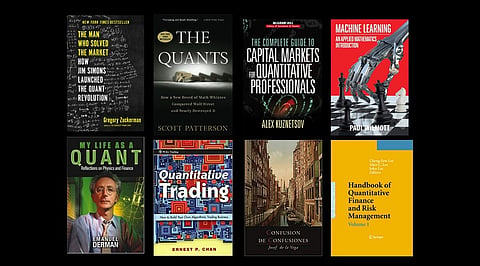
Quant finance hiring keeps getting tougher every year. Firms want candidates who understand probability, coding, and market structure at the same time. Reading the right books will not guarantee a job offer, but it builds the type of thinking that interviewers actually test for. Here is a practical reading list for anyone preparing for quant research, trading, or risk roles in 2027.
Online courses and video lectures are everywhere now. Still, books offer something short videos cannot: depth, structure, and worked-out logic that forces slow thinking. Quant interviews often revolve around problems that were first explained clearly in a handful of classic texts. Candidates who skip these books usually end up relearning the same ideas the hard way, through failed interviews.
Also Read: Best Technical Writing Books for Professionals in 2026
Before jumping into stochastic calculus or trading strategies, every candidate needs strong basics in probability, statistics, and market structure.
‘A First Course in Probability’ by Sheldon Ross – Covers combinatorics, random variables, and distributions with clear examples. This is the starting point for almost every quant interview guide.
‘Options, Futures, and Other Derivatives’ by John Hull – The standard reference for derivatives pricing. Nearly every trading desk expects candidates to know this book well.
‘Heard on The Street’ by Timothy Falcon Crack – A collection of real interview questions asked by banks and hedge funds, with detailed solutions.
Once the basics are clear, candidates should move toward the mathematics that drives actual pricing models and risk systems.
‘Stochastic Calculus for Finance’ (Volumes I and II) by Steven Shreve – A rigorous, step-by-step introduction to the mathematics behind option pricing.
‘Statistical Inference’ by Casella and Berger – Builds a strong statistical toolkit, useful for research-heavy roles.
‘The Concepts and Practice of Mathematical Finance’ by Mark Joshi – Bridges theory and practical pricing, written by someone who has worked on trading floors himself.
Modern quant roles ask for coding fluency alongside mathematics. Python and C++ dominate this space, and a few books stand above the rest.
‘Python for Data Analysis’ by Wes McKinney – Written by the creator of pandas, this book teaches data manipulation skills used daily in quant research.
‘C++ Design Patterns and Derivatives Pricing’ by Mark Joshi – Shows how object-oriented design connects with real pricing engines.
‘Advances in Financial Machine Learning’ by Marcos López de Prado – A sharp, opinionated guide to building machine learning models for markets, popular with systematic trading firms.
Technical knowledge alone rarely wins an offer. Candidates also need to practice the exact style of questions asked in interviews.
‘Quant Job Interview Questions and Answers’ by Mark Joshi, Nick Denson, and Andrew Downes – A widely used guide covering brainteasers, probability puzzles, and finance-specific questions.
‘Frequently Asked Questions in Quantitative Finance’ by Paul Wilmott – Written in a conversational tone, this book clears up common confusions around derivatives and models.
‘Green Book: Quantitative Finance Interviews’ by Xinfeng Zhou – Focused purely on interview problems, with worked solutions and hints.
Experienced candidates aiming for senior research or portfolio roles should look at these titles.
‘Active Portfolio Management’ by Grinold and Kahn – A detailed guide to building and managing systematic strategies.
‘Algorithmic Trading’ by Ernest Chan – Practical advice on building, testing, and running trading systems.
‘The Volatility Surface’ by Jim Gatheral – A focused study of volatility modeling, useful for anyone targeting options desks.
A common mistake candidates make is trying to read every book on a list at once. A better approach is to build a plan across a few months.
Spend the first month on probability, statistics, and derivatives basics.
Month 2: Transition into stochastic calculus and programming, solving problems in addition to reading.
Month 3: Use this entire month for interview-style books, answering questions under time pressure.
Only try more advanced or niche titles after you have a solid grasp of the basics.
Quant finance is a fast-moving and ever-changing field, with more and more focus on machine learning and alternative data. Still, the core fundamentals covered in these books have held up for more than 20 years. Candidates who are aiming at the 2027 hiring cycle should see this list as a starting point and then supplement it with recent research papers and market-specific readings as they go along. A good knowledge of the fundamentals, combined with lots of practice, will give any candidate a big competitive advantage in a very competitive hiring environment.
Also Read: Leadership Experts' Top 10 Book Picks for Career Growth and Success
1. Which are the best quant finance books for beginners in 2027?
Beginners should start with ‘A First Course in Probability’, ‘Options, Futures, and Other Derivatives’, and ‘Python for Data Analysis.’ These books explain core concepts that support advanced quantitative finance learning and interview preparation.
2. Which books help prepare for quant finance interviews?
‘Heard on The Street,’ ‘Green Book: Quantitative Finance Interviews,’ and ‘Quant Job Interview Questions and Answers’ focus on probability, logical reasoning, mathematics, and technical interview questions commonly asked by financial firms.
3. Why is Python important for quant finance careers?
Python supports data analysis, financial modelling, automation, algorithmic trading, and machine learning. Learning Python through dedicated finance books helps candidates apply quantitative concepts using practical programming techniques valued across the industry.
4. Should candidates study advanced quant finance books first?
Starting with advanced books often creates learning gaps. Building knowledge through probability, statistics, derivatives, and programming first makes complex mathematical finance topics easier to understand and apply effectively.
5. How long does it take to complete a quant finance reading plan?
A focused three-month plan covering fundamentals, programming, and interview preparation provides a practical starting point. Advanced titles and research papers can be added gradually as technical knowledge and confidence continue to grow
