.png)

Overview
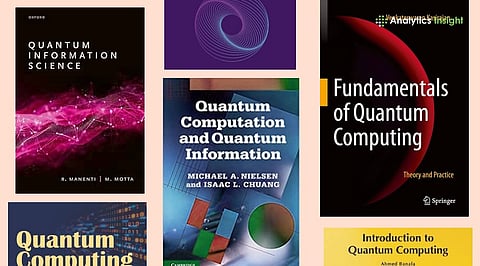
This curated collection features beginner-to-advanced books covering quantum computing fundamentals, programming techniques, cryptography, machine learning, and industry developments.
Readers can select titles based on experience level, professional goals, and preferred learning style, from conceptual introductions to rigorous technical references.
Together, these recommended books provide a practical roadmap for understanding quantum information, emerging technologies, and real-world quantum computing applications across industries.
Quantum computing is shifting from scientific laboratories to the commercial sector. There is substantial investment in this technology by educational institutions and government organizations, and new software tools are also making quantum computing easy to program. As more people develop an interest in the subject, there are many books available on the market to guide people through theory and practice.
These include books that discuss fundamental principles without requiring any mathematical knowledge, as well as books dedicated to programming, algorithms, cybersecurity, or machine learning. This list contains 10 of the most helpful books available on the topic.
From beginner guides to advanced technical references, these books explain quantum computing clearly and practically.
Also Read: Best Quantum Computing Predictions for the Next Decade
Difficulty: Beginner
This book is probably one of the easiest books to begin with. Chris Bernhardt uses simple English to explain concepts like qubits, superposition, and entanglement. The mathematics involved in the book is kept to an elementary level to make it easy for even beginners to comprehend. It would be useful to both students and businessmen, and everybody else interested in the concept of quantum computing.
Difficulty: Beginner to Intermediate
This book is authored by Robert Sutor, an ex-IBM employee. This book develops knowledge gradually, starting from classical computation, proceeding to quantum mechanics, circuits, and algorithms. The recent edition of this book also discusses the aspects of quantum machine learning and quantum computation. People with some technical knowledge will find this book more relevant.
Difficulty: Intermediate
Jack Hidary blends theoretical knowledge with hands-on programming. This book teaches the reader about Google’s Cirq software and delves into issues such as quantum computer hardware, optimization algorithms, and real-life uses. It is suitable for programmers, engineers, and anyone else wishing to learn more about quantum computing.
Difficulty: Intermediate
The central theme of this book is learning through code. The reader gets to design quantum circuits, experiment with quantum teleportation, the Quantum Fourier Transform, and Shor’s algorithm through real-world scenarios. Any individual who knows how to program can benefit from this book to learn quantum computing.
Difficulty: Advanced
This book on quantum computing is targeted at the university level. The book discusses quantum computing concepts using a computer science approach and explains topics such as quantum circuits, algorithms, and quantum information with rigorous mathematics.
Difficulty: Beginner to Intermediate
Thomas Wong compares classical and quantum computing throughout the book, helping readers understand how the two systems differ. Exercises and worked examples make it suitable for classroom learning as well as self-study. Its recent publication also reflects many developments in the field.
Difficulty: Beginner to Intermediate
Readers who prefer learning by doing may enjoy this guide. Using Python and IBM's Qiskit platform, Robert Loredo explains circuit design, quantum algorithms, and cloud-based quantum computers through practical coding exercises. The book works well for developers who want to write and test quantum programs.
Difficulty: Advanced
The book highlights the relationship between quantum computing and artificial intelligence. The book discusses topics such as quantum neural networks, feature spaces and machine learning algorithms. This book will appeal to those who have an understanding of both machine learning and quantum mechanics.
Difficulty: Advanced
Quantum computers have the capacity to break today’s cryptography algorithms. This book will describe cryptography techniques that are resistant to quantum attacks and also discuss post-quantum concepts. This book is suitable for cybersecurity practitioners and researchers interested in the emerging area of quantum computing.
Difficulty: Intermediate to Advanced
This is an open-access guide that addresses almost all aspects of the industry of quantum technologies. Computing, communications, sensors, hardware, software, startups, and public policy issues are addressed in more than 1,500 pages. Instead of being read cover to cover, the guide functions as a reference for those interested in certain topics.
Your choice depends on your experience and learning goals.
Beginners: Quantum Computing for Everyone and Introduction to Classical and Quantum Computing.
Programmers: Programming Quantum Computers and Learning Quantum Computing with Python and IBM Quantum.
Intermediate Learners: Dancing with Qubits and Quantum Computing: An Applied Approach.
Researchers: Quantum Computer Science, Quantum Machine Learning, and Post-Quantum Cryptography.
Business Professionals: Understanding Quantum Technologies offers a broad view of the industry.
Quantum computing is still an emerging field; however, educational materials on it have become much better during the last several years. It is always an effective idea to start from basic concepts to comprehend more complicated ones later. Whether your focus is programming, security, artificial intelligence, or business, these books could be an excellent choice for starting.
Also Read: How We Selected the Top Quantum Computing Books Worth Reading in 2026
1. What are the best quantum computing books for beginners in 2026?
For beginners, Quantum Computing for Everyone by Chris Bernhardt and Introduction to Classical and Quantum Computing by Thomas Wong remain leading choices. They explain qubits, superposition, and quantum algorithms using accessible language with minimal mathematical prerequisites.
2. Which quantum computing books are best for programmers?
Developers should consider Programming Quantum Computers and Learn Quantum Computing with Python and IBM Quantum. Both emphasize hands-on coding with modern quantum software frameworks, helping readers build, simulate, and test quantum circuits through practical exercises.
3. Are there books focused on post-quantum cryptography?
Yes. Post-Quantum Cryptography, edited by Daniel J. Bernstein, Johannes Buchmann, and Erik Dahmen, remains a foundational reference. It explains cryptographic methods designed to resist attacks from future quantum computers and is valuable for cybersecurity professionals and researchers.
4. Which book offers the most comprehensive overview of the quantum technology industry?
Understanding Quantum Technologies (2025 Edition) by Olivier Ezratty provides one of the most comprehensive industry references. It covers quantum computing, communications, sensing, hardware, software, startups, market trends, and policy, making it valuable for technology professionals and decision-makers.
5. Why is learning quantum computing important in 2026?
Quantum computing is gaining momentum through advances in hardware, software, cloud-based quantum platforms, and enterprise research. Understanding its principles helps students, developers, researchers, and business leaders prepare for emerging applications in optimization, artificial intelligence, cybersecurity, and scientific discovery.
