.png)

Covers practical MCP security concepts, deployment strategies, and enterprise integration challenges.
Explains protocol architecture, authentication mechanisms, threat modeling, and secure implementations.
Helps developers, architects, researchers, and security professionals master MCP ecosystems.
MCP has become an essential guide for professionals whose core work revolves around AI integration. MCP (Model Context Protocol) is an application-level protocol that provides structured and standardized ways to interact with external systems. MCP is popularly described as a ‘USB-C port for AI’. It spares the hassle of custom integration by providing a single protocol for connecting AI agents to tools, data sources, and resources.
MCP has informative AI applications beyond text generation to operational tasks such as querying databases, executing workflows, or retrieving files. It is widely used in popular AI platforms such as Autogen Studio, Copilot, Agentverse, and Harvey AI.
MCP guidebooks are most useful to professionals who directly build, deploy, or secure AI systems. Whether you are a Developer, Security Engineer, Enterprise Architect, Researcher, or student, this guide will help you gain a deeper understanding of how AI agents connect with tools and data resources.
MCP Security in Practice: Deploying Integrations by Ken Imoto focuses on real-world security challenges of deploying Model Context Protocol (MCP) integrations. The book focuses on detailed, practical, battle-tested strategies rather than just theory. It is best suited for engineers deploying MCP in production environments, developers building AI Agent integrations, and security Professionals looking for OWASP's high-level taxonomy.
Key Topics Covered:
MCP Architecture & Internals
Cost Benchmarks
File Upload Limitations
OWASP MCP Top 10
Production Workarounds
Future of MCP
The book Model Context Protocol for LLMs offers extensive knowledge on building Secure, Scalable, and Context‑aware AI Agents Using a Standardized Protocol (2026), written by Naveen Krishnan. It is a detailed technical guide for engineers and architects whose core work revolves around deploying large language models (LLMs) in production using the Model Context Protocol (MCP).
Key Topics Covered:
MCP Architecture. JSON-RPC Communication and modular components
Integrate LangChain, AutoGEn, and Rag Pipelines
TLS, Access Control, and defenses against prompt injection
Async patterns, caching, and benchmarking production
Hands-on examples with Python code samples
Also read: Why CEOs are Investing in Real-Time Business Intelligence Platforms
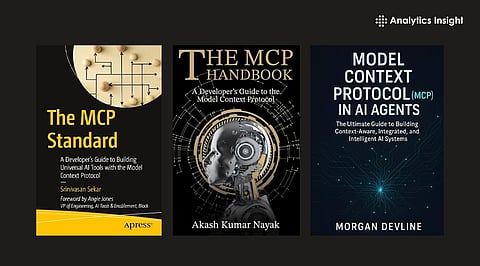
The MCP Standard covers the foundational knowledge of MCP. Published in 2026, the book defines and explains the Model Context Protocol (MCP), the new age standards for integrating large language models (LLMs) to external tools, data sources, and services in a secure and interoperable way.
It has its use cases for connecting LLMs to enterprise APIs, file access and retrieval, multi agent collaboration. It is most helpful to developers, security engineers, architects, and researchers.
Key Topics Covered:
Core Protocol Specification on JSON-RPC, Standardized primitives
Reference Implementation Examples in Python, TypeScript, and MCP servers
Security Models such as authentication, sandboxing, and arbitrary code execution
Interoperability with LangChain, AutoGen, and Rag Pipelines
Also read: Apple Intelligence Update: Image Playground and Photos Gain Powerful Creative Features
AI Agents with MCP' by Kyle Stratis is a hands-on, comprehensive technical guide. It’s the first detailed book dedicated to Anthropic’s Model Context Protocol (MCP), helping developers understand how to build, connect, and scale AI agents using this emerging standard. The book offers real-world examples of bridging tools across platforms and end-to-end project examples to strengthen MCP concepts.
The book is useful for Intermediate to advanced developers in AI/ML and software engineers.
Key Topics Covered:
Technical depth, the book assumes basic familiarity
Evolving standards, implementations may change
Best to create MCP-based systems theoreticall
MCB Integration (Google Books) is a technical guide that largely focuses on the integration of AI agents to external systems using the guidelines of the Model Context Protocol. The book is distributed digitally and elaborates on core protocol design and architecture, and how the MCP connects between AI models and external tools. It also has information on MCP servers to connect APIs, databases, and enterprise systems. It is most useful for developers, enterprises, and researchers.
Key Topics Covered:
Foundations of MCP: core protocols and architecture
Integration patterns: APIs, databases, and enterprises
Security and governance: Authentication, secure exchange, and compliance
Advanced topics: Multi-agent collaboration
Deployment and monitoring of MCP workflows.
Learn MCP with TypeScript by Christoffer Noring is a practical developer’s guide to building scalable AI-driven applications using MCP with TypeScript. It provides an in-depth understanding of the protocol’s core components: servers, clients, and hosts. Detailed descriptions of communication between AI models and external tools, and exposing tools and resources via MCP servers. It will be most helpful for developers, AI practitioners, and enterprises
Key Topics Covered:
MCP Fundamentals: protocols’ core components
Exposing tools and servers via the MCP servers
Testing and Debugging: inspector tools and TypeScript
Security and cloud development
Mastering MCP through these guidebooks isn’t about just learning the MCP protocol; it is a learning step towards moving into the world of agentic AI, where these AI assistants evolve into productive collaborators across every digital workflow.
1. What is MCP (Model Context Protocol)?
MCP (Model Context Protocol) is an open standard that enables AI models and agents to securely connect with external tools, databases, APIs, files, and enterprise systems through a standardized communication framework.
2. Why are MCP security books important for AI professionals?
MCP security books help professionals understand secure integrations, authentication mechanisms, threat modeling, prompt injection risks, access controls, and best practices for deploying AI agents in production environments.
3. Which MCP security book is best for beginners?
Learn MCP with TypeScript by Christoffer Noring is an excellent starting point for beginners as it offers hands-on examples, practical projects, and step-by-step guidance on building MCP applications.
4. What security topics do MCP books typically cover?
Most MCP security books cover authentication, authorization, secure API integrations, prompt injection defenses, sandboxing, access controls, threat modeling, governance, compliance, and secure deployment strategies.
5. Who should read MCP security books in 2026?
MCP security books are ideal for software developers, AI engineers, security professionals, enterprise architects, researchers, students, and anyone building or managing AI agents connected to external systems and data sources.
