.png)

In South Africa, the financial landscape has changed dramatically over the last decade. Gone are the days when your only option for borrowing money was putting on your best clothes and visiting a bank manager. Today, you have options ranging from the traditional "Big Five" banks to nimble, digital-first microlenders who promise cash in your account before you’ve even finished your coffee.
But having too many choices can be paralyzing. When you are staring at an unexpected mechanic’s bill or a school fee deadline, you might not know which route is safer or more affordable. Should you go through the rigorous process of a bank application, or opt for a quick online fix? This is where a comparison platform like Money Panda becomes essential. By aggregating different lenders in one place, we help you see the pros and cons of each offer, ensuring you don't sign up for something you can't afford just because you were in a rush.
Choosing between a fast loan and a traditional bank loan isn't about which one is "better" in general—it is about which one is better for your specific situation right now. Let’s break down the differences so you can make a smart financial decision.
To simplify the debate, you need to understand the main trade-off.
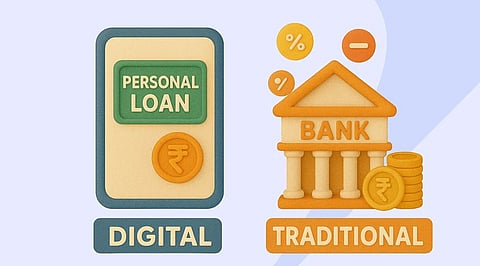
Traditional Bank Loans are generally cheaper (lower interest rates) but harder to get and slower to pay out. Fast Loans (Microlenders) are generally more expensive (higher interest rates) but much easier to access and faster to pay out.
Think of it like transport. A bank loan is like a bus: it’s cheap and reliable, but it runs on a strict schedule and stops at specific stations. A fast loan is like an Uber: it costs more, but it comes directly to you, immediately when you need it.
When we talk about traditional loans, we are referring to personal loans offered by South Africa’s major institutions like FNB, Absa, Standard Bank, Nedbank, and Capitec.
These are typically "term loans." You borrow a specific amount (often larger sums, from R10,000 up to R350,000) and pay it back over a long period, usually 12 to 72 months.
The biggest advantage is the cost. Banks usually offer interest rates linked closely to the Prime Lending Rate. If you have a good credit score, you might get a rate of 12% to 18% per annum. Over a long period, this saves you thousands of Rands compared to short-term lending.
Furthermore, because the repayment term is longer, your monthly installment is usually smaller and more manageable, provided you remain employed.
The bank is risk-averse. They have strict internal policies. To get approved, you need a good-to-excellent credit score. If you have missed payments on clothing accounts or have a judgment against your name, the bank’s computer system will likely reject you automatically.
Additionally, the process can be slow. While some banks have improved their apps, many still require 24 to 48 hours to finalize a loan, especially if you are a new client. They may ask for stamped bank statements, proof of residence, and certified IDs.
Fast loans, often called payday loans or instant cash loans, are offered by registered credit providers who operate mostly online.
These loans are designed for speed. You visit a website, use a slider to choose an amount (usually smaller, between R500 and R8,000), and upload your documents digitally. Their systems automatically scan your bank statements to see if you can afford the loan.
Speed is king here. If approved, the money is often transferred via "Real-Time Clearing" (RTC), meaning it hits your account instantly.
These lenders are also more lenient than banks. They look less at your past history (credit score) and more at your current affordability. If you have a job and money left over at the end of the month, you have a good chance of approval, even if your credit score isn't perfect.
Convenience costs money. These loans carry higher interest rates, often capped at the maximum allowing by the National Credit Act (NCA). You will also likely pay a monthly service fee and an initiation fee. If you calculate the cost of credit over a year, it is much higher than a bank loan.
If you are still on the fence, look at these three specific factors to decide.
Banks treat your credit score as the most important factor. If your score is below 600, a traditional bank loan is difficult to secure. Fast loan providers, however, focus on your "disposable income." They want to know if you can afford the repayment next month, rather than judging you solely on a mistake you made three years ago.
Applying for a bank loan can sometimes feel like an interrogation. You may need to explain why you need the money. Fast loans are impersonal and automated. There is no judgment; you simply fill in a form. For many people, this privacy is a major benefit.
If your car is stuck on the side of the highway and the tow truck driver wants cash now, a bank loan won't help you. A bank transfer can take days to clear between different institutions. Fast lenders use instant payment technologies specifically for these emergencies.
The "better" loan depends entirely on why you need the money.
Choose a Traditional Bank Loan If:
You need a large amount: If you are renovating your kitchen or buying a second-hand car, you need R50,000+. Fast loans rarely go this high.
You can wait a few days: If the expense isn't an emergency.
You want the lowest interest rate: You are planning your finances carefully and want to minimize costs.
You have a good credit record: You have earned the right to lower rates.
Choose a Fast Loan If:
It is a genuine emergency: Medical bills, urgent car repairs, or running out of electricity/food mid-month.
You need a small amount: You only need R2,000 to bridge the gap until payday.
Your credit score is average: You might have a "thin" credit file, but you have a steady job.
You can pay it back quickly: You intend to settle the debt within 30 days to avoid accumulating interest.
Regardless of which option you choose, there is one rule you must follow in South Africa: Only use NCR-registered lenders.
When people get rejected by banks, they sometimes turn to "Mashonisas" (loan sharks). These are illegal, unregistered lenders. They often charge 50% interest per month and may demand to keep your ID book or bank card as security.
Both traditional banks and legitimate fast loan companies are regulated by the National Credit Regulator (NCR). This protects you. It ensures they cannot charge hidden fees, they cannot harass you, and they cannot lend you money you cannot afford to pay back. Always check for an NCR registration number at the bottom of the lender's website.
So, what is better?
If you have the luxury of time and a good credit score, the traditional bank loan is the winner. It is cheaper and helps you build a long-term relationship with a financial institution.
However, life is rarely predictable. When disaster strikes and you need cash immediately to keep your life moving, the fast loan is a vital tool. It costs more, but it provides a service that banks simply cannot match: instant liquidity.
The smartest approach is to use tools to compare your options. Don't just take the first offer you see. Look at the total cost of credit, check the repayment terms, and ensure the lender is legitimate. Borrowing money is a tool—use it wisely, and it will help you; use it blindly, and it can hurt you.
