.png)

The VinFast VF 6 and VF 7 run on liquid-cooled LFP battery packs across all variants, a chemistry built for heat and long-term durability
Charging time changes with battery size, ranging from 24 to 28 minutes for a 10 to 70 percent top-up, using the CCS2 standard common across India
The VinFast app and over-the-air updates turn routine ownership tasks into something ownelithium iron phosphatehone, not just a service center
An electric car's true worth is not just its range number. Battery life, charging speed, and software reliability shape how well it performs years after purchase. These factors also decide running costs, daily convenience, and long-term value.
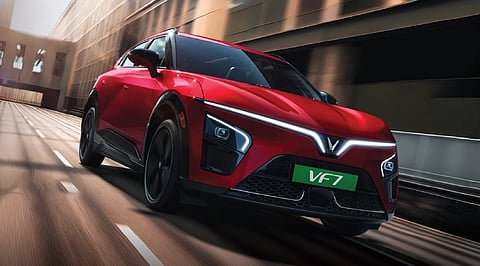
VinFast brings all three together in the VF 6 and VF 7, through battery design, charging technology, and connected features. Looking closely at these systems gives buyers a clearer picture of what to expect once the car leaves the showroom.
The VF 6 and VF 7 use lithium iron phosphate (LFP) batteries across their Indian variants, including the VF 7’s larger 70.8 kWh pack. LFP cells store less energy per kilogram than the Nickel Manganese Cobalt packs found in several rival EVs. In exchange, they hold up better under heat and tolerate frequent charging cycles without wearing down fast.
That trade-off suits Indian conditions well. VinFast pairs its LFP packs with liquid cooling instead of passive air cooling, a detail the company has confirmed specifically for these two models. Liquid cooling spreads heat more evenly through the pack, which matters during long summer drives and during fast charging, when cell temperature rises quickly. Battery health still depends on more than hardware. Charging habits and how well the battery management system runs both play a part over time.
This chemistry choice applies to the Indian VF 6 and VF 7 specifically. VinFast uses different battery types across its wider global range depending on the market.
Also Read: Why LFP Batteries Are Suitable for EVs in India's Hot Climate
Charging time is not one fixed number across the lineup. It shifts with battery capacity, and VinFast has published separate figures for each variant.
Both models charge through the CCS2 port, the DC fast-charging standard used across most public networks in India. That compatibility matters more than it sounds. It means owners are not locked into one charging network or a rare connector type.
These figures come from manufacturer testing under suitable conditions. Real charging speed still depends on the charger's output, the weather, and how warm the battery already is. Charging also slows near the top of the range, which protects the cells during the final stretch rather than pushing them at full speed throughout.
The VinFast app lets drivers complete several routine checks in seconds without visiting a service center. Drivers can check the battery level and charging status, find nearby charging stations, monitor the vehicle’s location, and schedule service through the app
However, not all functions are available on every trim.That is why the app should be viewed as a convenience tool rather than a guaranteed package of features. The model receives software updates remotely, much like a smartphone. This allows VinFast to introduce improvements without requiring owners to visit a service center.
Even with a durable battery, without the fast and reliable charge, it will still mean long waiting times during the road trip. Fast charging but without proper cooling results in a faster wear-out of the pack. And an able car without proper information makes it hard for the owner to know the range and access to the station.
This is seen in the warranty terms. The VF 6 has a warranty of 7 years or 160,000 km for the vehicle with a 10-year or 200,000 km warranty for the battery. The VF 7 has a warranty of 10 years or 200,000 km for both the vehicle and the battery.
Also Read: Kinetic Engineering's EV Strategy: Products, Investment and Growth Plans
The real test for the VF 6 and VF 7 will not show up on a launch-day spec sheet. It will show up three or four years from now in how the battery ages, how consistently the charging stays, and whether the software keeps pace with the car on the road.
1. What type of battery does the VinFast VF 6 and VF 7 use?
Both models use Lithium Iron Phosphate (LFP) battery packs across every variant, including the VF 7's larger 70.8 kWh option. This chemistry is known for handling heat well and lasting through frequent charging cycles.
2. How long does it take to charge the VinFast VF 6 and VF 7?
Charging time depends on the battery size. The VF 6 and VF 7 Earth, both with a 59.6 kWh pack, charge from 10 to 70 percent in about 24 to 25 minutes. The larger 70.8 kWh VF 7 variants take about 28 minutes for the same charge range, under suitable conditions.
3. What charging connector do the VF 6 and VF 7 support?
Both models use the CCS2 connector, the DC fast-charging standard found across most public charging stations in India. This allows owners to use a wide range of networks instead of a single brand-specific plug.
4. What is the battery warranty for the VinFast VF 6 and VF 7 in India?
The VF 6 comes with a 7-year or 160,000 km vehicle warranty and a 10-year or 200,000 km battery warranty. The VF 7 carries a 10-year or 200,000 km warranty on both the vehicle and the battery. These terms apply to India and may differ in other markets.
5. What can owners do through the VinFast app?
The app lets owners check battery charge level and charging status, find nearby charging stations, track the vehicle's location, access selected remote functions, and book service appointments. Some features may vary slightly by model and app version.