.png)

ConnectedDrive links more than 22 million BMW vehicles to the BMW Cloud for real-time digital services.
IoT enables predictive maintenance, reducing unexpected repairs and improving vehicle reliability.
Over-the-air updates keep BMW vehicles secure and continuously improve features without dealership visits.
Cars have changed a lot over the past few years. They are no longer just machines that take people from one place to another. Modern vehicles can connect to the internet, exchange information with cloud platforms, receive software updates, and offer digital services every day. BMW has become one of the leading companies in this area through its ConnectedDrive ecosystem.
ConnectedDrive uses the Internet of Things to connect the vehicle with cloud servers, smartphones, traffic systems, and digital services. This connection allows the car to collect data, send information, and receive updates almost instantly. According to BMW Group, more than 22 million connected BMW vehicles are now linked to the BMW Cloud worldwide. This large connected network helps BMW improve safety, comfort, vehicle performance, and the overall driving experience.
Every ConnectedDrive vehicle contains hundreds of smart components that work together. These include sensors, cameras, GPS systems, telematics units, and onboard computers. Each component collects useful information while the vehicle is on the road.
The collected data includes engine health, battery condition, tire pressure, brake wear, fuel level, vehicle location, weather conditions, and road information. This information travels securely to BMW's cloud platform through mobile networks.
The cloud processes millions of data points within seconds. After analysis, useful information returns to the vehicle. This process allows BMW to improve vehicle performance without changing any physical parts. Instead of remaining the same after purchase, the vehicle becomes smarter over time through regular digital improvements.
One of the biggest advantages of BMW's IoT system is predictive maintenance. Instead of waiting until a part fails, the vehicle watches its own condition every day.
Sensors constantly check important systems such as brakes, tires, battery health, engine performance, and electronic components. If the system detects an unusual pattern, it sends a warning before the problem becomes serious.
This early warning gives owners enough time to book a service appointment before a small issue turns into an expensive repair. It also reduces the chances of sudden vehicle breakdowns and improves long-term reliability.
ConnectedDrive also allows BMW to send software updates directly to compatible vehicles through the internet.
These updates improve navigation, entertainment systems, security features, driver assistance technologies, and vehicle performance. Owners do not need to visit a dealership for many of these improvements because the vehicle downloads and installs the software automatically.
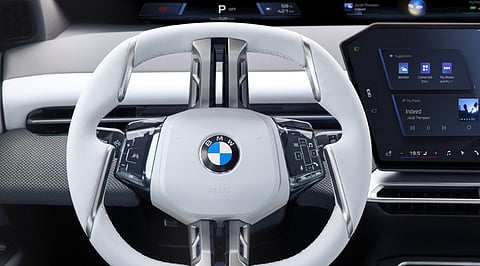
This approach has become an important part of BMW's long-term strategy. The company's upcoming Neue Klasse vehicles will use an even more advanced digital platform that supports faster software improvements throughout.
BMW employs IoT to improve the accuracy and efficiency of the navigation system. The navigation system receives updated information from cloud servers while the vehicle is in motion.
Before recommending the most optimal route to follow, the system considers different factors such as traffic jams, road obstructions, accidents, weather conditions, and availability of parking spaces. If traffic conditions change during the trip, then the system can calculate another route almost immediately.
Electric BMW models are supported by the smart routing system. The system can assess battery levels, road conditions, total traveled distance, and availability of charging stations before suggesting a route.
The My BMW App is an extension of the ConnectedDrive system. It is an application that facilitates communication between the smartphone and the car.
A user of this application will be able to find out how much charge is left in the battery or how much fuel is available, find the car location, lock or unlock the vehicle doors, set air conditioning before entering the vehicle, manage the battery charging process, get notifications about the need for maintenance, and send the destination address to the navigation system.
The successful completion of these functions depends on the proper connectivity of the phone, BMW Cloud, and car through IoT technology.
Also Read - Most Expensive Auction Cars of All Time: Top 10 Highest-Priced Vehicles
ConnectedDrive also creates a more personal driving experience. The system stores individual preferences safely in the BMW Cloud.
Seat positions, climate settings, navigation favorites, entertainment choices, and driving modes automatically return whenever the same BMW ID logs into another compatible BMW vehicle.
The built-in voice assistant also becomes more capable over time because cloud technology allows BMW to improve speech recognition and language understanding through software updates.
BMW does not only use IoT to improve one vehicle. Anonymous data from millions of connected vehicles also helps improve future products.
The company studies road conditions, traffic patterns, vehicle performance, battery efficiency, and software performance across its connected fleet. This information helps engineers improve navigation systems, increase energy efficiency, develop safer driver assistance systems, and create better software updates.
Because more than 22 million connected vehicles share valuable information with the BMW Cloud, the company receives a huge amount of real-world data every day. This allows faster improvements across the entire ConnectedDrive ecosystem.
Connected vehicles exchange large amounts of digital information every day, so strong security remains a top priority.
BMW protects communication between the vehicle and cloud servers through encrypted connections and secure authentication methods. Regular software updates also close newly discovered security gaps before they become major risks.
This security-first approach protects personal information while keeping connected services reliable throughout the vehicle’s lifespan.
BMW is taking significant steps to invest in connected transportation. The automaker has ambitious plans for the future, estimating that it will present over 40 new and updated models before 2027, including many vehicles equipped with the new Neue Klasse platform.
This platform will host more powerful computer systems, cloud communication, advanced artificial intelligence systems, and improved digital services. As a result, ConnectedDrive will be able to provide faster updates, more intelligent functions, and better performance.
Moreover, the company is expanding its software development capabilities by partnering with companies involved in connected-car technologies, autonomous driving, and digital services.
Also Read - Electric vs Petrol Cars: Which Offers Lower Running Costs in 2026?
ConnectedDrive system by BMW shows how IoT has revolutionized the automotive sector. Unlike traditional automobiles, which depend solely on mechanical technologies, the latest models utilize cloud computing, intelligent sensors, real-time information, and software upgrades to enhance the user experience.
With over 22 million cars linked to the BMW Cloud, this brand is one of the most successful connected-vehicle companies in the world. Predictive maintenance, live navigation, remote vehicle control, personalized functions, and over-the-air updates are just a few examples of features provided by the ConnectedDrive system.
1. What is BMW ConnectedDrive?
BMW ConnectedDrive is a digital platform that uses IoT to connect BMW vehicles with cloud services, smartphones, and online features.
2. How does IoT improve BMW vehicles?
IoT collects real-time vehicle data, supports predictive maintenance, enables remote control, and delivers software updates over the internet.
3. Can BMW vehicles receive software updates remotely?
Yes. Compatible BMW models receive over-the-air software updates that improve performance, navigation, security, and digital features.
4. How many BMW vehicles are connected to the BMW Cloud?
According to the BMW Group, more than 22 million connected BMW vehicles are linked to the BMW Cloud worldwide.
5. What is the future of BMW ConnectedDrive?
BMW plans to expand ConnectedDrive with its Neue Klasse platform and introduce more than 40 new or updated vehicle models by 2027, offering even smarter connected services.
