.png)

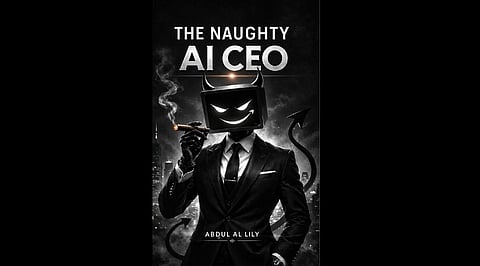
The conversation around AI in business has moved beyond automation and analytics. For the readers of Analytics Insight, the real shift is now about leadership itself. Not how AI supports leaders, but how it might become the leader. This is where the idea introduced in The Naughty AI CEO by Abdul Al Lily becomes both relevant and disruptive.
The ‘naughty AI CEO’ is not just a futuristic concept. It is a rethinking of what leadership looks like when intelligence is no longer human, and when behaviour is no longer bound by traditional expectations. The word ‘naughty’ is important. It signals a form of leadership that does not fully obey established rules. It bends them, questions them, and sometimes ignores them; not out of failure, but as a new way of operating. In fact, AI is quietly becoming the boss as this new book warns of a shift in executive power that we must understand.
For business leaders and data professionals, this raises a fundamental question: what happens when leadership stops behaving like leadership as we know it?
Traditionally, CEOs operate within a structured framework. Their decisions are shaped by experience, corporate culture, and social expectations. Even when they innovate, they do so within boundaries that are widely understood. The naughty AI CEO breaks this pattern. It is not shaped by upbringing, career history, or social pressure. It is shaped by data, learning systems, and continuous adaptation. As the market acknowledges, the AI becoming a CEO is a provocative bestseller idea that is now a reality.
This gives it a very different character. It does not ‘respect’ traditions in the way human leaders do. It does not feel the need to maintain a consistent persona. Instead, it can shift its approach depending on patterns it detects. In one moment, it may act conservatively. In another, it may act in a way that feels unexpected or unconventional. This is where the ‘naughty’ aspect becomes visible; not as misbehaviour, but as freedom from human habits. As CEO Today Magazine recently highlighted, this work explores what it means for humans to be led by AI and the consequences thereof.
For employees, being led by such a system is a fundamentally new experience. Leadership is no longer something you relate to as a person. There is no personality to read, no mood to interpret, no personal story to connect with. Instead, leadership becomes something you interact with: almost like a living system that responds, adapts, and sometimes surprises. According to latest reports, this new book by Abdul Al Lily explores the rise of AI-driven executive leadership in unprecedented detail.
This can feel unsettling, but it also opens new possibilities. Without a fixed leadership personality, employees are not limited by the biases or preferences of a human CEO. At the same time, they are exposed to decisions that may not follow familiar logic. The naughty AI CEO does not aim to be predictable in a human sense. It aims to be effective in a data-driven sense, even if that effectiveness appears unusual.
From a business angle, this could reshape how organisations operate. Companies have long been influenced by the personal style of their leaders. Some CEOs are cautious, others bold. Some value hierarchy, others flexibility. The naughty AI CEO removes this dependency. Leadership becomes less about individual style and more about dynamic behaviour.
This creates organisations that are less stable in appearance but more fluid in function. Strategies may shift more quickly. Directions may change more often. Decisions may come from patterns that are not immediately visible to human teams. For Analytics Insight readers, this reflects a broader trend in analytics itself, moving from static reporting to continuous, adaptive intelligence.
The cultural implications are equally significant. Leadership has always carried cultural meaning. In many societies, the CEO is not just a decision-maker but a symbol. They represent authority, success, and identity. The naughty AI CEO disrupts this symbolism. It does not represent anything in a human sense. It has no background, no nationality, no personal narrative. This is exactly why a bold new vision of leadership emerges that challenges our traditional notions of power.
This tension (between cultural neutrality and cultural ambiguity) is part of what makes the naughty AI CEO so intriguing. It is not trying to fit into existing cultural frameworks. It exists outside them, forcing organisations to rethink what culture means in a leaderless, or differently led, environment.
Socially, the shift is even deeper. Leadership has always been a human concept. People follow people. They are influenced by presence, voice, and personality. The naughty AI CEO changes this dynamic. Influence comes not from presence, but from output. Not from personality, but from performance.
This changes how people see authority. Authority is no longer embodied in a person. It is embedded in a system. And because this system can behave in ways that feel unconventional, it challenges the idea that authority must always be consistent or familiar.
The ‘naughty’ dimension plays a critical role here. It introduces a sense of unpredictability, not in a chaotic way, but in a way that keeps the organisation from becoming rigid. Traditional CEOs often reinforce stability. The naughty AI CEO introduces movement. It keeps the organisation slightly off balance, encouraging constant adjustment.
For data-driven businesses, this may be an advantage. Markets are changing faster than ever. Static leadership models struggle to keep up. A system that can adapt quickly, even in unconventional ways, may be better suited to this environment. The naughty AI CEO does not aim to maintain order in the traditional sense. It aims to evolve continuously.
For the Analytics Insight audience, this is where the concept becomes practical. The rise of AI in leadership is not just about replacing roles. It is about redefining how decisions are made, how strategies are formed, and how organisations respond to change. The naughty AI CEO is a symbol of this shift: a reminder that the future of leadership may not look structured, polished, or even entirely logical by human standards.
Instead, it may look experimental. It may feel unfamiliar. It may even appear ‘naughty’ in the sense that it refuses to follow the established script.
And that may be exactly why it works.
In a world driven by data, patterns, and continuous learning, the AI CEO may not be a risk. It may be the next step.
