.png)

The entrepreneur and systems builder believes artificial intelligence will prove its value in the overlooked industries where materials, vehicles, inventory, routing, and recovery still depend on thousands of manual decisions.
The most expensive problems in a traditional business are not always the dramatic ones, and Vladimir Sainciuc has built his work around the small decisions repeated so many times that nobody stops to question them anymore. What should be routed where. Which item deserves attention first. How should a product be classified, priced, photographed, listed, stored, or recovered. Each choice may look ordinary by itself. Together, they decide whether a business becomes scalable or stays trapped in daily friction.
Sainciuc, an entrepreneur and systems builder, is focused on AI-supported workflow design for industries that rarely get described as cutting edge: automotive recycling, scrap recovery, waste management, logistics, inventory processing, reusable OEM parts, and high-volume eCommerce. His view is practical. AI becomes useful when it helps real businesses make repeated operational decisions with less error, less delay, and more consistency.
“AI has to get out of the abstract,” Sainciuc says. “The real test is whether it can help a business handle messy work better than before.”
That messy work is everywhere. A waste facility may rely on people to classify materials and route trucks by memory. A logistics business may lose time through repeated handoffs that are never fully connected. An inventory operation may depend on workers making the same identification or pricing decisions all day. A recovery business may lose value because one step does not inform the next.
These are not futuristic problems. They are ordinary business problems. That is why Sainciuc believes they are important.
In many traditional industries, technology has improved certain pieces of the work without changing the workflow itself. A business may have software for listings, another tool for inventory, another method for photos, and a separate process for routing or pricing. The pieces exist, but the decisions between them still depend on people remembering what to do next.
“That is where the hidden cost sits,” Sainciuc says. “A company may have tools, but if the workflow is disconnected, people still have to carry the system in their heads.”
His argument is not that AI should take over physical industries or push out experienced operators. Sainciuc takes the opposite view. The people doing the work often understand details that outsiders miss. They know which situations create problems, where time gets wasted, and which decisions become expensive when they are made too late.
The challenge is that practical knowledge often stays trapped in individual experience. One worker knows how to route a load. Another knows what a part is worth. Another knows which photo angle helps a listing sell. Another knows where the bottleneck appears on a busy day. If the business cannot turn that knowledge into a system, growth becomes fragile.
“Experienced operators are not the problem,” Sainciuc says. “The problem is when their knowledge never becomes part of a repeatable process.”
That belief led him to build AI-supported operating systems in automotive recycling and related workflows. In that environment, the value of a vehicle depends on more than what is visibly damaged or intact. The business has to consider reusable OEM parts, metal recovery, electronics, labor, storage, shipping, online demand, and pricing competition. The wrong decision can waste time. A late decision can miss value.
Automotive recycling gave Sainciuc a working example of a larger principle: old industries are often more complex than people think because their intelligence is spread across many small choices. AI becomes useful when it helps connect those choices instead of leaving each step isolated.
“The opportunity is not just automation,” he says. “The opportunity is coordination. The system should help the business see what is happening earlier and act with more confidence.”
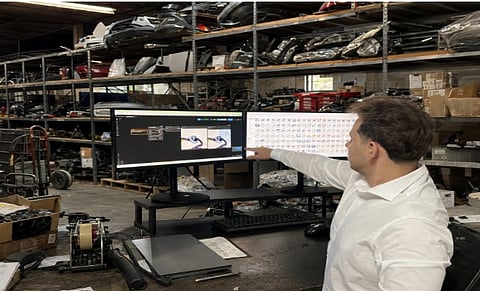
In automotive recycling, his work connects the yard, the data, and the marketplace so decisions made early can shape what happens later. The system is used in real operating environments, including within a family business context that manages approximately 50,000 active eBay listings and ranks within the top 1 percent of eBay sellers in its category.
At that level, weak processes stop being minor irritations. They become recurring costs. Every delayed listing, missed item, inconsistent price, unclear handoff, or manual correction can multiply across the whole operation.
Sainciuc believes many traditional businesses misread that moment. They assume the answer is more labor or more activity. Sometimes it is. But if the workflow itself is not organized, adding volume may only add pressure.
“More people can help, but they cannot fix a broken operating structure by themselves,” he says. “At some point, the business needs a better way to make decisions.”
That is where Sainciuc sees AI becoming more grounded and less promotional. A useful system might help identify incoming materials, classify parts, route work, guide operators, support pricing, reduce repeated errors, or move inventory faster. None of that sounds as dramatic as the public conversation around AI often does. That is part of the point.
Traditional industries do not need technology for theater. They need tools that work when conditions change, inputs are inconsistent, and people have limited time to decide.
In Sainciuc’s view, the businesses that will benefit most from AI may be the ones that have been under-systemized for years. Waste management, recycling, logistics, scrap recovery, parts resale, and similar fields run on physical assets, narrow margins, shifting demand, and operational pressure. Better decisions do not only make the business cleaner on paper. They can change labor efficiency, value recovery, customer experience, and scalability.
“The most practical AI may not look glamorous,” Sainciuc says. “It may look like fewer mistakes, faster processing, better routing, cleaner inventory, and decisions that do not have to be remade from scratch every day.”
His longer-term vision includes expanding AI-supported operating systems across automotive and other traditional industries. He is also developing a broader automotive platform concept intended to help consumers and businesses find parts, services, repair resources, marketplace information, and related solutions in one connected environment.
That platform idea reflects the same concern as his operating-system work. People should not have to search across disconnected systems when the information could be organized better. Businesses should not have to depend on scattered judgment when repeated decisions can be supported more intelligently.
For Sainciuc, AI’s future is not only in the industries already fluent in software. It is in the facilities, yards, warehouses, marketplaces, and recovery operations where work still moves through people, materials, vehicles, and time-sensitive choices.
“The real economy is full of decisions that have never been properly systemized,” he says. “That is where AI can stop being a buzzword and start becoming useful.”
