.png)

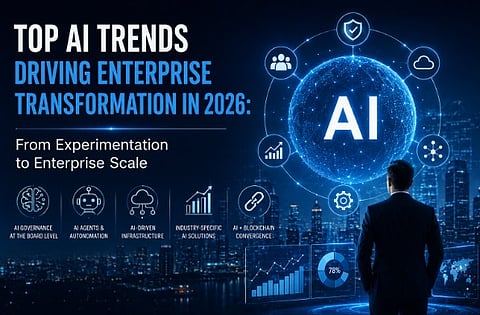
Artificial Intelligence is entering a phase of enterprise adoption. Over the past few years, organizations have invested heavily in Artificial Intelligence pilots, generative Artificial Intelligence tools, and automation initiatives to explore how emerging technologies can improve business performance. While many of these projects demonstrated results, relatively few have delivered transformation at scale. As a result, the conversation surrounding Artificial Intelligence is rapidly evolving from experimentation toward operationalization.
According to McKinsey's latest State of AI report, more than 70% of organizations have adopted Artificial Intelligence in at least one business function. At the time, Gartner predicts that over 80% of enterprises will have used generative Artificial Intelligence APIs or deployed generative Artificial Intelligence-enabled applications by 2026. These figures indicate that Artificial Intelligence adoption is no longer limited to innovators and early adopters. It is rapidly becoming a priority across industries.
However adoption alone does not guarantee business value. Many organizations continue to struggle with deployments disconnected data environments and unclear transformation strategies. The challenge facing enterprise leaders in 2026 is no longer whether Artificial Intelligence works. The challenge is how to scale Artificial Intelligence across the organization while maintaining governance, security and measurable outcomes.
The organizations that succeed in the phase of Artificial Intelligence transformation will not necessarily be those with access to the most advanced models. Instead they will be those of aligning Artificial Intelligence capabilities with business objectives, operational processes and long-term transformation strategies.
The scale of Artificial Intelligence's potential is one of the primary reasons enterprises continue increasing investments despite ongoing implementation challenges. According to PwC's Global Artificial Intelligence Study, Artificial Intelligence could contribute up to $15.7 trillion to the economy by 2030, making it one of the most transformative technologies of the modern era.
What makes AI particularly powerful is its ability to generate value across multiple business functions simultaneously. Organizations are increasingly using AI to:
Improve operational efficiency and productivity
Enhance customer experiences through personalization
Accelerate product and service innovation
Strengthen decision-making capabilities
Identify new revenue opportunities
Unlike waves of enterprise technology, Artificial Intelligence is not confined to a single department. It has the potential to influence every aspect of business operations. This is why leading enterprises are shifting their focus from use cases toward enterprise-wide Artificial Intelligence strategies.
Despite growing investment, many organizations remain stuck between experimentation and large-scale implementation. Closing this gap will define the stage of enterprise Artificial Intelligence maturity.
The first phase of enterprise AI adoption was characterized by experimentation. Organizations launched customer service chatbots, automated document processing systems, predictive analytics platforms, and internal productivity assistants to explore AI's capabilities.
These initiatives often generated positive results. However, many remained isolated within individual departments rather than becoming enterprise-wide capabilities.
Typical characteristics of AI initiatives between 2023 and 2024 included:
Department-level deployments
Limited integration with business operations
Experimentation-focused objectives
Unclear ROI measurement frameworks
Minimal governance oversight
As organizations move into 2026, priorities are changing significantly. Enterprise AI programs are increasingly characterized by:
Organization-wide adoption strategies
Cross-functional integration
Outcome-driven implementation plans
Governance and accountability frameworks
Executive-level sponsorship
This shift mirrors the evolution of cloud computing. Early cloud initiatives focused primarily on infrastructure optimization. Today, cloud serves as the foundation for digital business models. AI is following a similar trajectory.
Business leaders are no longer asking whether AI can improve productivity. Instead, they are asking how AI can reshape operations, accelerate innovation, and create sustainable competitive advantages.
Organizations that successfully transition from pilot projects to enterprise-wide adoption will be better positioned to capture long-term value from AI investments.
One of the most significant developments expected to shape enterprise transformation in 2026 is the emergence of AI agents. While most organizations are already familiar with AI copilots that assist employees with writing, coding, research, and knowledge retrieval, AI agents represent a more advanced stage of intelligent automation.
Unlike copilots, AI agents are capable of performing tasks autonomously and coordinating activities across multiple systems.
A procurement-focused AI agent, for example, may be able to:
Monitor inventory levels in real time
Analyze supplier performance data
Forecast purchasing requirements
Generate procurement recommendations
Initiate approval workflows automatically
Similarly, customer service agents can retrieve information from CRM systems, access knowledge repositories, respond to routine customer inquiries, and escalate complex issues when human intervention becomes necessary.
According to Deloitte's State of Generative AI in the Enterprise report, organizations are increasingly prioritizing AI initiatives that generate measurable operational outcomes rather than simply improving individual productivity.
This trend reflects a broader shift in enterprise expectations. AI is no longer viewed solely as a productivity tool. It is increasingly becoming an operational capability capable of transforming how business processes are executed.
As AI agents continue to mature, they are expected to play a growing role across customer service, supply chain management, finance operations, compliance management, and knowledge-intensive business functions.
Much of the public discussion surrounding AI has focused on models. Organizations frequently compare proprietary and open-source models, evaluate benchmark performance, and debate the advantages of different architectures.
However, many enterprises are discovering that model selection is only a small part of the challenge.
In practice, infrastructure is becoming more important than the model itself.
Modern enterprise AI environments typically require:
Data pipelines and integration layers
Vector databases and knowledge repositories
Governance and compliance frameworks
Security and access management systems
Model monitoring and observability tools
MLOps and deployment pipelines
Without these foundational capabilities, even the most advanced AI models struggle to deliver sustainable business value.
Many organizations encounter challenges when attempting to scale successful pilot projects. Data often resides across multiple disconnected systems. Legacy applications create integration barriers. Security requirements introduce deployment constraints. These issues cannot be solved simply by choosing a different model.
This reality explains why AI transformation is increasingly viewed as an architecture challenge rather than a model challenge.
The organizations that invest in scalable AI infrastructure today will be better positioned to deploy new capabilities, integrate future technologies, and maintain long-term operational resilience.
For decades, business intelligence platforms have helped organizations understand historical performance. These systems provide visibility into trends, metrics, and operational outcomes, allowing leaders to evaluate what happened in the past.
However, modern enterprises increasingly require systems that go beyond reporting.
Decision intelligence is emerging as the next evolution of enterprise analytics by combining artificial intelligence, predictive modeling, business rules, and automation to support real-time decision-making.
Rather than answering: "What happened?"
Decision intelligence focuses on: "What is likely to happen next?" and "What should we do about it?"
This capability is already creating value across multiple industries:
Retail: optimizing inventory allocation and pricing strategies
Manufacturing: predicting equipment failures before they occur
Financial services: identifying emerging risks and compliance concerns
Logistics: dynamically adjusting operations based on demand patterns
Healthcare: improving resource planning and patient scheduling
Let me tell you a global logistics provider handles thousands of shipments every day. Traditional analytics can only tell you that a delay happened after it occurred. Decision intelligence systems can predict disruptions before they happen. They can also suggest ways to mitigate them and automatically switch to a plan.
This change helps organizations make decisions proactively rather than just reacting to things that have already happened. As competition gets tougher across industries, being able to turn data into decisions will become super valuable for businesses.
As AI is used more and more in business functions, governance is becoming really important for long-term success. Early AI projects were often managed by innovation teams or technical departments. Now that AI is being used on a bigger scale, executive leaders and corporate boards need to be involved.
The reason is simple: AI is no longer for testing. It's starting to affect how customers interact with companies, financial decisions, compliance processes and daily operations. As AI's impact grows, so do the risks related to privacy, security, transparency and accountability.
According to IBM's Global AI Adoption Index, trust is a barrier to using AI in businesses. Companies are realizing that successful AI implementation requires more than technical performance. It also needs confidence that AI systems work responsibly and transparently.
Companies that are looking ahead are investing in governance frameworks that include things like:
Making sure AI systems are transparent
Ensuring AI systems are accountable
Managing AI risks
Building trust in AI systems
Establishing AI policies
Setting up AI oversight committees
Developing AI ethics guidelines
What makes governance particularly important in 2026 is the growing complexity of AI ecosystems. As organizations deploy multiple models, integrate external data sources, and introduce autonomous AI agents, maintaining visibility and control becomes increasingly challenging.
Rather than viewing governance as a barrier to innovation, leading organizations are treating it as a foundation for sustainable AI adoption. In many cases, strong governance frameworks accelerate implementation because they reduce uncertainty and increase stakeholder confidence.
Many companies are spending a lot of money on intelligence and technology is getting better but they are still having trouble making artificial intelligence work. Even though more companies are using intelligence it is still hard for them to make it work across the whole company.
The people at McKinsey did some research. They found out that there is a big difference between just trying out artificial intelligence and actually being good at it. This means that a lot of companies are still trying to figure out how to use intelligence for the whole company not just for small projects.
One big reason why artificial intelligence fails is because the data is not good. Artificial intelligence systems are only as good as the data they get. Companies often do not realize how work it takes to make the data clean and organized before artificial intelligence can give them good answers.
Another problem is that companies think technology is the answer. They start with the idea that artificial intelligence's the solution but that is not true. To really make a change, companies need to start by understanding what problem they are trying to solve. Companies that only focus on technology often have trouble showing that it is working.
Some things get in the way of artificial intelligence working:
Poor data that is not organized
Companies do not know what they want to achieve
The leaders of the company are not supporting it
The company is not ready for the change
The technology is not connected
There are no rules to make sure it is used
Maybe the thing that is most overlooked is helping people get used to the change. Artificial intelligence affects people as much as it affects technology. Employees have to learn ways of doing things; managers have to make decisions differently, and companies have to change how they work. If companies do not help people get used to the change, even if the technology works, it might not be used by the company.
The lesson for the leaders of companies is clear. Making intelligence work is not just about the technology; it is about changing the whole company.
There is an example of how companies can use artificial intelligence in the logistics industry.
A years ago logistics companies were using artificial intelligence to predict when things would be delivered. The artificial intelligence models helped companies plan and get ready for the deliveries.. These systems were not connected and people had to look at the results and decide what to do.
Now logistics companies are using intelligence in a more advanced way.
A modern logistics system can do things, such as:
Predict when things will be delivered in real time
Find the routes for the deliveries
Handle problems automatically
Keep track of inventory
Use resources in the way
Instead of just warning people about problems, these systems can suggest what to do and start the process automatically.
Imagine if there was a storm that was going to affect a major shipping route. The old way of doing things would warn managers after the delays started. But an artificial intelligence system can predict the problem, suggest a route, estimate the cost, and start the backup plan before anything goes wrong.
This example shows what is happening in industries. The future of intelligence is not just about getting more information but about making better decisions and acting faster.
As companies get better at using intelligence, they are moving away from using the same artificial intelligence for everyone and are starting to use artificial intelligence that is specific, to their industry.
While the basic artificial intelligence technology is still important, the effective artificial intelligence solutions are the ones that are made for a specific industry.
Financial institutions, for example, focus heavily on:
Risk analysis and fraud detection
Regulatory compliance automation
Customer intelligence and personalization
Manufacturers prioritize:
Predictive maintenance
Quality assurance automation
Supply chain optimization
Healthcare organizations increasingly invest in:
Clinical decision support systems
Patient engagement platforms
Medical data analysis tools
The same pattern is emerging across retail, logistics, insurance, telecommunications, and energy.
This shift reflects an important reality. AI generates the strongest business outcomes when it is closely aligned with operational objectives and industry-specific workflows.
As a result, organizations are increasingly seeking partners capable of combining technical expertise with deep industry understanding.
Although AI and blockchain are often discussed as separate technologies, their convergence is creating new opportunities for enterprise innovation.
AI excels at generating intelligence from data. Blockchain excels at establishing trust, transparency, and immutability.
Together, these technologies can support a range of high-value enterprise applications, including:
Supply chain transparency and traceability
Decentralized digital identity systems
Automated compliance reporting
Secure data-sharing ecosystems
Smart contract optimization
Consider a global supply chain network involving manufacturers, logistics providers, distributors, and retailers. AI can analyze operational data to identify inefficiencies, forecast demand, and optimize inventory management. Blockchain can simultaneously provide an immutable record of transactions and product movements across the network.
The combination creates a system that is both intelligent and trustworthy.
As enterprises become increasingly dependent on automated decision-making, trust will become a critical competitive differentiator. This is one reason why many organizations are beginning to explore how AI and blockchain can work together as complementary technologies rather than independent initiatives.
The evolution of enterprise AI can be summarized through a comparison of priorities.
The shift illustrates a broader trend. Organizations are moving away from experimentation and toward operationalization. AI is becoming part of enterprise architecture rather than a standalone innovation project.
As AI adoption enters a more mature phase, leaders should focus less on individual technologies and more on organizational readiness.
Four priorities stand out.
Scalable AI requires scalable architecture. Investments in data platforms, integration layers, governance systems, and monitoring capabilities often deliver greater long-term value than investments in individual models.
Organizations should define AI initiatives according to measurable business objectives. The most successful programs are designed around operational improvements, revenue growth, customer experience, or risk reduction rather than technology adoption alone.
AI adoption requires new skills, new processes, and new ways of working. Organizations that invest in workforce enablement are more likely to achieve sustainable results.
Governance should be integrated into transformation programs from the outset. As AI systems become more sophisticated, transparency, accountability, and trust will become increasingly important.
As enterprises move from experimentation to implementation, the role of specialized technology partners is becoming increasingly important.
Many organizations possess strong business knowledge but lack the technical expertise required to design scalable AI architectures, integrate AI into existing systems, and establish governance frameworks that support long-term growth.
As a result, enterprises are increasingly seeking AI consulting services that help bridge the gap between emerging technologies and measurable business outcomes. The challenge is no longer gaining access to AI models. The challenge is deploying those models effectively within complex operational environments.
Similarly, organizations pursuing long-term digital transformation often collaborate with an AI & Blockchain innovation partner capable of aligning technology investments with strategic business objectives while maintaining scalability, security, and governance.
The most successful transformation initiatives are rarely defined by technology alone. They are defined by an organization's ability to connect innovation with operational execution.
The enterprise AI landscape in 2026 will look fundamentally different from what organizations experienced during the initial wave of AI adoption.
The next phase will not be defined by experimentation, model comparisons, or isolated pilot projects. It will be defined by infrastructure, governance, decision intelligence, workforce readiness, and scalable implementation.
Organizations that continue treating AI as an innovation initiative may struggle to realize meaningful business value. Those that approach AI as a strategic business capability will be better positioned to transform operations, accelerate growth, and strengthen competitive advantage.
The question facing enterprise leaders is no longer whether AI should be adopted. The question is how quickly organizations can move from experimentation to enterprise scale while maintaining trust, resilience, and measurable outcomes.
