.png)

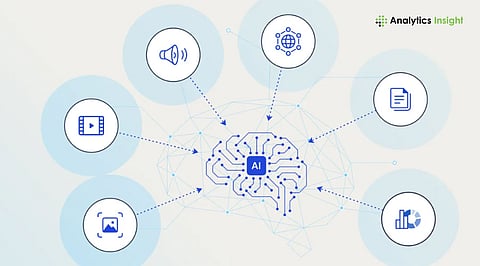
Multimodal AI integrates text, video, audio, and data for unified enterprise insights.
Adoption is rising as enterprises invest heavily in AI platforms and workflows.
Retail, finance, and manufacturing gain efficiency through predictive systems.
Enterprises are no longer making decisions based only on quarterly spreadsheets or sales summaries. A retail chain can now track live store camera footage, analyse thousands of customer reviews, monitor warehouse sensors, and scan supplier emails within a single system.
A bank can review transaction logs, recorded calls, and scanned documents in one workflow before flagging suspicious activity. This shift toward multimodal artificial intelligence is reshaping how decisions are formed inside boardrooms.
Multimodal AI is artificial intelligence that can understand multiple types of information simultaneously. Earlier AI systems mainly worked with numbers or written text. Newer systems can also read images, listen to audio, and analyze video, then connect all of it to give a clearer picture of what is happening in a business.
AI Adoption is accelerating. According to Gartner's 2025 industry surveys, more than 40% of large enterprises were piloting multimodal AI systems, up from under 20% two years ago. Analysts project enterprise AI spending to exceed $ 300 billion globally by 2027, with multimodal capabilities accounting for a growing share of that investment.
Technology providers such as Microsoft, Google, and Amazon are embedding multimodal models into enterprise platforms. Advanced systems, including GPT-5 and Google Gemini, can interpret text, images, and audio within a single workflow.
Key drivers behind enterprise adoption include:
• Faster analysis of complex datasets across departments
• Real-time alerts supported by both numerical and visual evidence
• Improved forecasting accuracy by combining structured and unstructured data
Also Read: How Multimodal Data Is Transforming Enterprise AI?
Retailers are using multimodal AI to refine demand forecasting.
AI tools assess:
• Historical sales data across thousands of SKUs
• Social media sentiment from millions of posts
• In-store camera feeds tracking shelf activity
Large retail stores use AI systems to analyze sales and inventory. This helps them predict demand better. When products become popular, and stock runs low, new supplies are ordered quickly.
Manufacturing firms are applying multimodal AI to equipment monitoring. Industrial sensors generate performance metrics every few seconds, while cameras continuously inspect production lines.
Industry case studies show predictive maintenance systems reducing unplanned downtime by up to 30%. For large plants, even a 5% improvement can translate into millions of dollars in annual savings.
Banks use AI to detect fraud, assess loan applications, and monitor transactions in real time. It also powers chatbots for customer support and personalizes product recommendations based on spending trends.
In addition, AI helps banks by:
• Automating document verification and compliance checks
• Reducing operational risk and errors
• Improving productivity across departments
• Enabling faster, data-driven decision-making
Also Read: How Multimodal AI Models Are Reshaping Industries
Healthcare providers use AI to support diagnosis, analyse medical images, and review patient records more efficiently. It helps predict disease risks, monitor vital signs, and personalise treatment plans. AI also streamlines administrative tasks such as scheduling and documentation, enabling faster clinical decisions while improving overall patient care and hospital efficiency.
Real-world deployments across retail, automotive, manufacturing, finance, and healthcare show that multimodal AI is already influencing enterprise operations. Rather than being experimental, it has become a practical tool for interpreting complex information. As adoption expands, multimodal AI is shaping how organisations gather insights and make informed decisions.
1. What is multimodal AI in enterprise environments?
Multimodal AI processes text, images, audio, and video together to deliver unified business insights.
2. Why are enterprises investing in multimodal AI in 2026?
Enterprises investin improvinge forecasting, automating risk checks, and connecting diverse data sources.
3. How does multimodal AI help in retail operations?
It analyzes sales data, sentiment, and store visuals to refine demand forecasts and stock levels.
4. What role does multimodal AI play in manufacturing?
It combines sensor data and video feeds to predict failures and reduce costly downtime.
5. How is multimodal AI improving financial risk detection?
Banks use it to analyse transactions, calls, and documents to flag fraud patterns more quickly.
