.png)

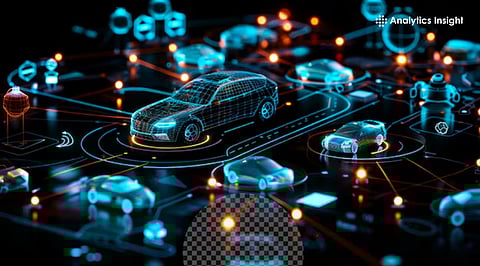
AI is transforming automotive design, production, and driving experiences, making vehicles safer, smarter, and more efficient.
Leading automakers use AI for autonomous driving, predictive maintenance, and personalized in-car systems to enhance comfort.
Smart factories, digital twins, and AI-driven logistics optimize production processes and accelerate innovation across the industry.
AI in the automotive industry is not just a futuristic concept but a core component of design, manufacturing, operations, and even user interactions. Automakers are using advanced technologies to support autonomous driving, enhanced driver assistance, more accurate maintenance prediction, and a personalized in-car environment.
AI is the future of mobility in terms of comfort enhancement, new production systems, and car designs. Here are the top 10 companies reinventing transportation by integrating AI into both their products and processes.
Toyota’s AI adoption extends to production plants. The company has implemented AI in smart production through machine learning to achieve efficiency and sustainability. Additionally, Guardian, an AI-based platform, assists drivers to avoid accidents, and the emotion-sensitive system creates a smooth driving experience tailored to the user’s mood.
Tesla employs AI in automotive applications through its Full Self-Driving (FSD) package and customized neural net training systems. The company designs its own AI microprocessors to filter massive amounts of real-world driving data, allowing next-gen autonomy in vehicles.
BMW utilizes AI in every aspect of its operations, from the advanced driver assistance app to maintenance forecasting. In-car AI assistants comprehend voice commands and adapt to driver preferences, while robots boost the facility’s productivity.
General Motors is shifting its focus to a software-first approach, with AI as the main component. The super cruise hands-free system is based on sensor fusion, while the autonomous vehicle development is already pushing the boundaries. AI also boosts customer experiences through smarter diagnostics and better connectivity.
Mercedes-Benz has been endowing both driving experience and factory operations through AI. Assistant systems offer natural language communication, engaging notices, and preventive warnings. The usage of automated driving technologies is limited to conditions that allow for hands-free operation, hence, balancing manufacturing, logistics, and quality control.
Also Read: Top BMW Cars in India in June 2025
Volkswagen has set up artificial intelligence laboratories and digital engineering platforms to accelerate its research in autonomous driving, vehicle design, and production process optimization. The automobile maker applies AI for predictive maintenance, voice recognition in infotainment systems, and creating virtual testing areas. This significantly reduces the time taken for product development.
Ford has elevated its production processes through the application of AI in workflows such as quality control, predictive maintenance, and supply chain. The self-driving sector is developing a driver-assistance system. This supports the company’s transition from conventional cars to future transportation services.
Hyundai positions AI as a key component of its next-generation mobility strategy by enabling the development of innovative driver assistance systems, the use of robots, and the construction of new types of vehicle infrastructure. AI smart factories use digital twins, robotic automation, and real-time analytics to boost production efficiency, quality, and responsiveness.
Stellantis offers various services, including smarter routing for electric vehicles (EVs), optimized energy consumption, predictive maintenance, and personalized in-car experiences. Furthermore, AI is the main factor in the fleet management solutions and interaction models between the different brands that are part of the Stellantis group, which are created from scratch.
Honda's AI applications include research into self-driving cars, systems that recognize sights and sounds, and robotic creations. The company researches cooperative intelligence systems for vehicles to interact with humans, and advanced robots that work closely with people, expanding mobility and service robotics.
Also Read: When is the first Self-Driving Car Coming to India?
AI is changing design, production, driving, and user experience completely. The most influential car manufacturers, including Toyota, Tesla, BMW, GM, and others, are using AI for self-driving cars, predictive maintenance, smart factories, and personalized in-car systems. AI is the main force promoting the future of mobility through the vehicle lifecycle stages from increased efficiency to heightened safety and comfort.
1. What is AI’s role in the automotive industry today?
AI improves safety, enhances driving experiences, predicts maintenance needs, and optimizes manufacturing and vehicle design across leading automakers globally.
2. Which automakers are leading AI integration in vehicles?
Companies like Tesla, Toyota, BMW, GM, Mercedes-Benz, Hyundai, Ford, Volkswagen, Stellantis, and Honda are pioneering AI in mobility solutions.
3. How does AI improve autonomous driving systems?
AI processes real-world data, powers neural networks, and enhances sensors to enable safer, more reliable, and semi- or fully autonomous vehicles.
4. What benefits do AI-powered smart factories offer automakers?
Smart factories use AI, robotics, and digital twins to optimize efficiency, quality control, production speed, and sustainability in vehicle manufacturing.
5. How is AI enhancing in-car user experiences?
AI personalizes driving experiences through emotion-sensitive systems, voice assistants, predictive features, infotainment customization, and adaptive safety technologies.
