.png)

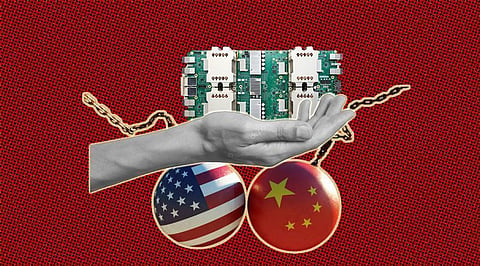
In a rather strategic move, the US ordered Nvidia, the leading chip designer to not export its AI chips to China. The company said that the US asked it not to export A100 and H100 chips, used for machine learning tasks and hardware meant for AI development. Nvidia speaking to Reuters said the US government wanted to prevent 'military end use' or 'military end users' in China. Though US authorities are tight-lipped about what criteria they follow for barring China from using its AI chips, without giving a specific reason, it said it is part of the review of China-related policies, to "keep advanced technologies out of the wrong hands." Clearly, the announcement signals a major escalation in the US's offensive strategy towards China putting the fate of Taiwan, a major chip-making center for global companies in danger.
Responding to the move, Chinese Foreign Ministry spokesperson Wang Wenbin observed that this US move represents its hegemony in suppressing China's chance to dominate in the technological realm and it is not an isolated incidence. The recent move comes after a series of earlier moves to crack down on China's advancing technology such as pulling down China's telecom giant Huawei and SMIC a leading chip manufacturer, banning the export of ASML's extreme ultraviolet lithography (EUV) and deep ultraviolet lithography (DUV) systems, apart from making South Korea, a strong ally of US to join its Chip 4 alliance under the recently enacted CHIPS Act.
"With its technological advantages, the US has time and again abused the concept of national security and its state power to crack down on the development of emerging economies and developing countries. The move violates market economy principles, harms international trade rules, and disrupts the stability of global industrial and supply chains," he said. He blamed the US for politicizing, instrumentalizing, and weaponizing technology using its political power to impose a technological blockade, and disturbing global supply chains, which would eventually end up unsuccessful. Just after the announcement, Nvidia's stock fell nearly 90% and it expects losses of around $400 million in revenue in the current quarter.
An industry that has kept a close connection with the supply chain, given its criticality in 5G applications, definitely, with the US's step would be affected adversely. Semiconductor Manufacturing and Integrated Chips industry Compared to the previous move this comes as a disturbing one. Around 95% of China's AI and chip manufacturing market belongs to Nvidia. Given the fact that China leads in AI and the 5G patent race, US's move falls in the right place in taking over the leading place. Domestic markets though are advancing fast in the AI chip-making domain, the progress made by them so far is nothing compared to the amount of technology China imports. China is determined to speed up its chip-making ecosystem by channeling millions and billions of dollars, for which it made a special allocation in the recent five-year plan, particularly for the chip-making sector. With this crackdown, experts believe that China is only going to strengthen its domestic market, forging all the possible forward and backward connections to accelerate domestic replacement. "For example, Chinese companies used to purchase most of the front-end defect inspection tools from US firm KLA, which accounts for about half of global market share, some domestic firms have now released self-developed prototype machines and some have been producing the tool in a small quantity," said Han Xiaomin, general manager of domestic leading IC industry consulting firm JW Insights. In hindsight, the US ban and its practice of putting barriers on the semiconductor industry, in general, is definitely going to affect China's artificial intelligence and supercomputing dreams. However, experts who have faith in China's resilience say it can bounce back provided it makes the right moves.
Join our WhatsApp Channel to get the latest news, exclusives and videos on WhatsApp
_____________
Disclaimer: Analytics Insight does not provide financial advice or guidance on cryptocurrencies and stocks. Also note that the cryptocurrencies mentioned/listed on the website could potentially be risky, i.e. designed to induce you to invest financial resources that may be lost forever and not be recoverable once investments are made. This article is provided for informational purposes and does not constitute investment advice. You are responsible for conducting your own research (DYOR) before making any investments. Read more about the financial risks involved here.
