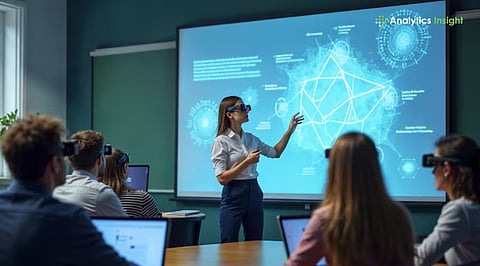
.png)

AI Tutors focus on the student. They adapt lessons, fix gaps, and help learners understand at their own pace.
Virtual teaching assistants support teachers. They handle grading, questions, and course logistics so educators can focus on mentoring.
The real impact comes when both work together. Learning improves, workloads drop, and classrooms run smoothly.
Classrooms are evolving in simple and practical ways. However, these changes are not the result of major disruptions. They stem from quicker support, clearer explanations, and fewer unresolved questions. Two key tools driving this transformation are AI tutors and virtual teaching assistants.
Both of these AI products may sound alike, but they do different jobs. AI tutors focus on helping students understand topics at their own pace, while virtual teaching assistants support teachers by handling routine tasks and questions.
They reduce everyday learning problems and make learning smoother, giving students timely support and helping educators spend more time teaching instead of managing friction.
AI tutors work directly with students, helping them understand concepts without pressure or judgment. They ask questions instead of giving instant answers, find where a student is stuck, and fix gaps before moving ahead. The pace slows down when needed and speeds up when concepts click.
Tools like Khan Academy’s Khanmigo and Duolingo Max use this step-by-step approach. Lessons adapt to each pupil, correct weak areas early, and make practice feel personally motivating. For students who hesitate to ask questions in class, this support can quietly change how learning feels.
Also Read: The Wealth Tutor Revolution: How AI-Powered Education is Creating Academic Millionaires
Virtual teaching assistants, or VTAs, help teachers by handling routine tasks that pull time away from teaching. They answer common questions, explain deadlines, send reminders, assist with grading, and keep discussions organized. This is especially helpful when the same questions repeat, or responses are needed outside class hours.
An early example is Jill Watson from Georgia Tech. Students used it on course forums without realizing it was an AI, and it answered routine questions with over 95 percent accuracy. VTAs work best when students need quick replies and mentorship. By managing the workload, these tools reduce burnout and give teachers more time to spend with students.
The fundamental difference between these two tools lies in their target audiences. AI tutors are built for students. Their job is to help learners understand concepts, build confidence, and learn at their own pace. Virtual teaching assistants are built for educators.
They help teachers stay focused by handling routine tasks and saving time. When these roles are mixed up, the results are weak. If each tool is used for what it does best, both students and teachers benefit, and the classroom works more smoothly.
Schools are moving fast for one apparent reason. One-on-one tutoring has always been proven to help students perform better, often pushing average learners into top results. The problem was scale. Human tutors cost money and are limited in number. AI tools change that equation by making personal support available to many students at once.
The education technology market around these systems is growing rapidly, from about $6 billion in 2024 to more than $32 billion by 2030. Schools are under pressure to improve learning outcomes without increasing costs. Personal support at scale is no longer a nice addition. It is becoming an expectation.
Both AI tutors and virtual teaching assistants use similar technology but apply it differently. Language understanding allows natural conversation, while course material systems ensure answers come from approved textbooks and syllabi.
Learning models track progress, mistakes, and patterns over time. For VTAs, accuracy matters most. For AI tutors, understanding how a student learns is more important than anything else. When built well, responses arrive in under a second, keeping attention focused and helping learning stick.
What students gain most from AI is a sense of emotional safety. They can ask the same question again and again without feeling embarrassed or judged. Feedback comes immediately instead of weeks later, so confusion is cleared up early.
This steady, low-pressure support helps students build confidence through practice, not performance. For many learners, it removes the quiet fear of getting things wrong and helps them move forward with confidence.
Also Read: Top AI Language Tutors Like Duolingo to Try Out in 2025
The most effective approach is a partnership between technology and teachers. Artificial intelligence takes care of practice, repetition, and routine tasks, while humans focus on encouragement, judgment, creativity, and care.
When both work together, teaching becomes more focused and learning feels easier. Teachers get more time to teach, and students understand lessons better. Through these tools and the methods that they use, real progress might just revolutionize how education is perceived.
How is a Virtual Teaching Assistant different from an AI Tutor?
A Virtual Teaching Assistant supports instructors and institutions. It answers routine questions, manages course logistics, assists with grading, and moderates discussions. It does not teach concepts in depth like an AI Tutor does.
Who benefits more from AI Tutors?
Students benefit the most. AI Tutors help learners who need extra practice, flexible pacing, or a safe space to ask questions without pressure.
Who benefits more from Virtual Teaching Assistants?
Teachers and institutions. VTAs reduce time spent on emails, grading, and repetitive tasks, allowing educators to focus on teaching and mentoring.
Can AI Tutors replace human teachers?
No. AI Tutors support learning, but they do not replace motivation, judgment, or emotional guidance. Teachers remain essential for critical thinking, creativity, and human connection.
Are AI Tutors suitable for exam preparation?
Yes. They are effective for practice, revision, and concept reinforcement. They help identify weak areas early and correct them before exams.
