.png)

I visited a one-man fabrication shop in Ohio last spring. The owner had been cutting acrylic signs by hand router for nine years. He switched to a CO2 laser machine eighteen months ago. When I asked him what changed, he did not talk about speed or quality first. He said he stopped dreading Monday mornings.
That kind of answer tells you something real about what automation does to small manufacturing. It is not just about output numbers. It is about what happens when a single operator can take on work that used to require a three-person team and still finish by dinner.
The laser machine market has matured enough in 2026 that the question is no longer whether small manufacturers can access this technology. It is how they are using it and what happens when AI starts guiding the process. OMTech has been tracking this shift across its customer base and the patterns are consistent across industries.
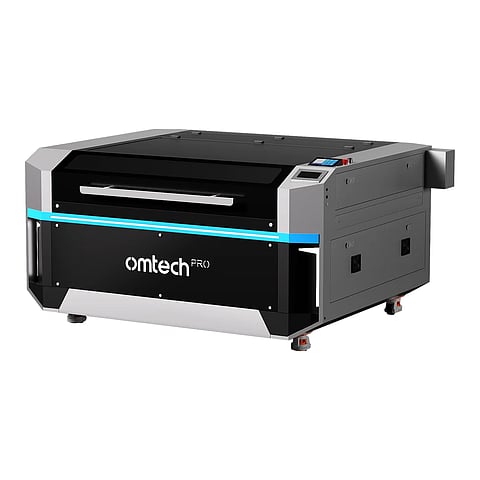
A laser machine is essentially a precision cutting and marking system that uses a focused beam of light to interact with material. The type of laser determines which materials it works on. CO2 lasers handle wood, acrylic, leather, and fabric. Fiber lasers handle bare metals. The beam follows a digital design file, so the accuracy is as good as the file itself.
What this means practically for a small manufacturer is that you remove the human variability from the cutting and marking operation. The machine does not have an off day. It does not rush at the end of a shift. The five hundredth piece looks like the first one.
The shops that have integrated laser machines most successfully are not necessarily the ones that had the biggest budgets. They are the ones that identified one bottleneck in their production process and targeted it specifically.
A sign shop that was routing letters by hand switched to CO2 laser cutting and reduced per-sign labor time from 45 minutes to 8 minutes
A jewelry repair business added a fiber laser engraver and began offering personalization services that now account for 40 percent of monthly revenue
A contract parts supplier added a fiber laser marking machine to bring traceability marking in-house, eliminating 600 dollars per month in outsourcing costs
A home workshop seller on Etsy scaled from 20 orders per month to 180 after switching from hand engraving to a CO2 laser machine
The AI component in laser manufacturing is happening at several levels and they are not all obvious from the outside.
Newer laser systems include sensors and software that identify material type and thickness automatically, then pull recommended cutting parameters from a library. This sounds like a small thing until you realize that parameter selection is where most quality problems in laser work originate. A beginner operator spending two hours on test cuts to find the right settings is now spending ten minutes. An experienced operator using AI-suggested parameters as a starting point is iterating faster and wasting less material.
Nesting is the process of arranging parts on a sheet of material to minimize waste. AI-driven nesting software now completes in seconds what used to take an operator fifteen to thirty minutes of manual arrangement. The material utilization improvement is measurable. Shops that adopted AI nesting software report 12 to 18 percent reductions in raw material consumption on typical production runs.
Camera-based alignment systems now allow laser machines to position designs on irregular or pre-marked materials without manual measurement. You put the material on the bed, the camera identifies reference points, and the software repositions the design accordingly. For businesses engraving on irregular blanks or adding marks to pre-cut parts, this eliminates a step that previously required skill and attention to do consistently.
Production laser machines now monitor their own operational parameters and flag degradation before it becomes failure. Lens contamination, beam alignment drift, cooling system performance. The machine tells the operator what needs attention before a mid-job failure costs time and material. For a small shop where one machine handles all production, unplanned downtime is a serious financial event. Predictive maintenance reduces it meaningfully.
The economic story around laser machines and small manufacturing in 2026 is not just about cost reduction. It is about new revenue categories that were not accessible before the technology became affordable.
Personalization at scale is the clearest example. A laser engraver or cutter can produce unique versions of the same product — different names, different designs, different text — without changing the production setup. This is economically significant because personalized products command substantially higher prices than their generic equivalents. A cutting board that sells for 18 dollars without a name on it sells for 55 to 75 dollars with one.
On-demand manufacturing is another pattern. Small shops with laser machines can produce single pieces or very small batches economically in a way that traditional manufacturing methods do not support. A customer who needs one custom award, one replacement part, or one prototype does not need to order fifty to make the economics work. The laser machine handles one-offs at the same per-unit economics as batch work.
Contract services are a third pattern. A shop that buys a laser machine for its own production frequently discovers that the machine has excess capacity and that other local businesses would pay for access to that capacity. Contract laser cutting, engraving, and marking services require no additional inventory, no additional sales effort beyond local outreach, and generate revenue from equipment that would otherwise sit idle between production runs.
The laser machine market offers a wide range of options at very different price points and capability levels. Laser engraving and cutting machines from established manufacturers now cover everything from compact desktop systems for home workshops to high-output production units for contract manufacturing environments. The right choice depends on answering a few specific questions before looking at specifications.
What materials will you process most often: CO2 for wood, acrylic, leather, and fabric. Fiber for bare metals. The material list determines the laser type before price or features matter
What is your realistic production volume: A 40-watt machine handles personal use and very low production. 60 to 80 watts covers most small business production needs. 100 watts and above for shops running the machine most of the day
What does the full setup cost: Machine price is the starting number. Ventilation adds 150 to 400 dollars. A water chiller for CO2 systems adds 200 to 600 dollars. Budget the complete setup to avoid discovering the machine is not operational after delivery
What software does the machine support: LightBurn is the production standard for most CO2 and fiber machines. Verify compatibility before purchase, not after
What support exists for the machine: Search the manufacturer name alongside terms like maintenance, parts, and troubleshooting before buying. Active communities and accessible documentation are reliable indicators of long-term ownership experience
The businesses that are not adopting laser machine technology are not standing still. Their competitors are. The price of entry-level production capability has dropped to the point where the payback calculation is straightforward for almost any shop with a clear application.
A shop spending 400 dollars per month outsourcing laser cutting or engraving work can purchase a capable in-house system and reach payback in under a year. A shop adding personalization capability to an existing product line often sees revenue increases that cover equipment cost within six to nine months. The math is not complicated once you know your current costs and your target application.
The AI component accelerates this. Faster parameter development, better material utilization, reduced operator training time. These are real operational improvements that compound over time. A shop that adopted a laser machine two years ago and has been refining its workflow since then has a meaningful operational advantage over one that is starting today. Which is exactly why the best time to evaluate this technology is now rather than later.
The transformation happening in small manufacturing through laser machine adoption and AI-guided process optimization is not speculative. It is visible in revenue numbers, in payback timelines, and in the Monday morning attitudes of shop owners who made the switch.
The technology is accessible. The applications are proven. The competitive pressure to adopt is real and increasing. For small manufacturers evaluating their next capital investment, a laser machine with AI-assisted workflow support is one of the clearest paths to both cost reduction and new revenue generation available in 2026.
OMTech is a laser equipment manufacturer based in Anaheim, California. The company designs and builds CO2 laser engravers, fiber laser marking systems, and MOPA fiber lasers for small businesses, production shops, and home workshop users across the United States. Their full range of laser engraving and cutting machines is available at OMTech.
OMTech systems are used by sign shops, jewelry businesses, contract manufacturers, Etsy sellers, and industrial parts suppliers. The product range covers entry-level desktop CO2 systems through high-output production machines, with US-based technical support and an active user community.
