.png)

Mobile medical devices connect apps with physical devices, wireless networks, cloud services, and sensitive health data. This article explains how penetration testing must address broader security risks, patient safety, device communications, privacy, regulatory expectations, controlled testing environments, and the entire product lifecycle.
Mobile technology has transformed healthcare, putting powerful medical capabilities into the hands of clinicians and patients far beyond traditional hospital settings. Smartphones can now connect with glucose monitors, wearable sensors, infusion systems, diagnostic tools, and other medical technologies that collect, process, and transmit sensitive information. This convenience can improve care, but it also creates a security environment that is far more complex than the one surrounding an ordinary consumer application.
At first glance, testing the security of a mobile medical device may seem similar to testing any other app. Both involve mobile operating systems, APIs, authentication, cloud services, wireless communications, and user data. The critical difference is context. A weakness in a conventional app may expose information or interrupt a service, while a weakness in a connected medical device can potentially affect patient privacy, clinical decisions, treatment continuity, and, in some circumstances, patient safety. That distinction changes how security professionals approach the entire testing process.
Traditional mobile app testing often concentrates on the application itself and the systems directly supporting it. Testers may assess insecure data storage, weak authentication, session management problems, API vulnerabilities, insecure communications, and flaws in application logic. These areas remain important for medical technology, but they represent only part of the attack surface.
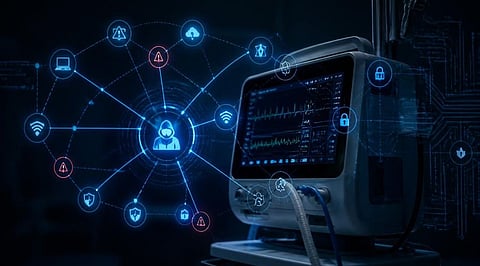
A mobile medical device can exist within a much larger ecosystem. A smartphone application may communicate with a physical device through Bluetooth, Wi-Fi, NFC, or another protocol. That device may exchange information with cloud infrastructure, clinician portals, hospital systems, or third-party services. Each connection creates another trust boundary that must be understood and evaluated.
The tester therefore needs to think in terms of the complete system rather than treating the mobile app as an isolated product. A seemingly minor vulnerability in the app could become more serious when combined with a weakness in device pairing, command validation, firmware security, or backend authorization. Effective testing examines how an attacker could move across these connected components and whether one compromised element could influence another.
For a typical consumer app, the consequences of a security vulnerability are usually measured in terms of data exposure, financial loss, fraud, reputational damage, or service disruption. Those consequences can certainly be serious. Medical technology introduces an additional dimension: the potential impact on human health and safety.
Security researchers and regulators increasingly recognize that cybersecurity must be considered as part of the broader safety and risk-management process for connected medical technology. The U.S. Food and Drug Administration and other health-sector authorities have emphasized the importance of addressing cybersecurity throughout the product lifecycle rather than treating it as a purely technical issue handled at the end of development.
This means that a penetration tester cannot simply assign severity based on common technical scoring conventions. The practical effect of exploitation matters. An unauthorized action that appears limited from an IT perspective may require much closer examination if it could alter data used for clinical decision-making, interrupt communication with a medical device, prevent legitimate users from accessing essential functions, or create unsafe device behavior.
One of the most important differences between ordinary app testing and medical-device testing is the interaction between software and the physical device. The mobile application may not simply display information or send requests to a server. It may establish a trusted relationship with a device, receive sensor data, transmit commands, or help control essential functions.
This requires security testing to examine communication protocols in greater depth. Testers may need to assess pairing mechanisms, device identity verification, encryption, replay resistance, message integrity, command authorization, and the handling of unexpected or malformed data. The question is not merely whether traffic can be intercepted but whether intercepted or manipulated communications could cause an unauthorized or unsafe outcome.
This is where penetration testing for mobile devices becomes particularly important in a healthcare context. The assessment must account for the mobile operating environment while also considering how a compromised, modified, or untrusted phone could affect the connected medical ecosystem. Rooted or jailbroken devices, malicious applications, accessibility-service abuse, operating-system weaknesses, and physical access to the phone can all alter the threat model.
Mobile medical applications frequently handle information that is more sensitive than ordinary consumer data. Depending on the system, this information may include health measurements, treatment history, diagnostic details, device identifiers, account credentials, or other information connected to an individual's care.
Protecting this information requires more than checking whether a login screen exists or whether a network request uses encryption. Testers should examine where data resides throughout its lifecycle. Sensitive information may be exposed through local databases, application logs, backups, screenshots, notifications, crash reports, cached files, analytics tools, or third-party software development kits.
Authentication and authorization also deserve close attention. Medical environments often involve different types of users, including patients, clinicians, caregivers, administrators, and support personnel. A vulnerability may arise when the system verifies that a user is authenticated but fails to confirm whether that user has permission to access a particular patient's information or perform a specific action.
Regulation does not replace good security engineering, but it does influence how medical-device organizations document, manage, and demonstrate cybersecurity activities. In this environment, penetration testing is often part of a larger evidence-based process that includes threat modeling, risk analysis, vulnerability management, secure development practices, and postmarket monitoring.
A standard app penetration test may conclude with a list of vulnerabilities ranked by severity and recommendations for remediation. Medical-device testing often needs to provide additional context. Organizations may need to understand which system components were evaluated, what assumptions were made, which interfaces were tested, how identified weaknesses relate to risk controls, and whether remediation requires further safety analysis.
Clear reporting is therefore especially important. A useful report should explain not only how a vulnerability was discovered but also the realistic conditions required for exploitation and the potential consequences within the intended medical environment. This helps engineering, quality, regulatory, and security teams communicate using a shared understanding of risk.
Testing a standard application can often be performed in a staging environment with limited concern about physical consequences. Medical technology requires more deliberate preparation. The organization and testing team should understand which systems are safe to test, what data can be used, whether test devices are representative of production hardware, and what actions could affect device functionality.
A realistic testing environment should reproduce important security characteristics without introducing unnecessary risk. Test accounts, simulated patient data, isolated networks, and dedicated devices can allow testers to evaluate meaningful attack scenarios while protecting real users and operational systems.
This preparation also supports repeatability. Medical-device security should not depend entirely on a single assessment performed shortly before release. Changes to the mobile application, operating systems, device firmware, cloud services, and third-party components can all introduce new vulnerabilities. Testing strategies should therefore be connected to the product lifecycle and significant changes to the system.
A skilled mobile application tester brings valuable expertise, but mobile medical device security can require knowledge across several disciplines. The testing team may need familiarity with mobile operating systems, wireless protocols, embedded devices, cloud architecture, healthcare workflows, secure software development, and safety-oriented risk management.
This does not mean every tester must be an expert in every area. It means the assessment process should bring the right expertise together when necessary. Engineers understand how the device behaves. Clinical specialists can explain how the technology is used in practice. Security professionals can identify realistic attack paths. Quality and regulatory teams can help ensure that findings are evaluated within the organization's established processes.
This cross-functional perspective produces better questions. What happens if the phone loses its trusted status? Can an attacker replay a previously valid command? Does a compromised account allow changes beyond the user's intended role? Could altered data influence a clinical decision? Does the system fail safely when communication is interrupted?
The mobile medical device ecosystem is not static. New operating-system versions, emerging vulnerabilities, changing attacker techniques, updated dependencies, and product modifications can all affect security over time. A test performed during development provides valuable assurance, but it should not be viewed as permanent proof that the product will remain secure.
Industry guidance increasingly supports a lifecycle approach to cybersecurity. Organizations benefit from integrating security activities into design, development, verification, release, maintenance, and vulnerability response. Penetration testing can play a different role at each stage, from validating threat models early in development to assessing significant changes after deployment.
This approach also encourages organizations to build security into the product rather than relying on testing to discover every problem at the end. Secure architecture, strong authentication, protected communications, careful dependency management, and well-designed update mechanisms all reduce the likelihood that serious vulnerabilities will reach production.
Penetration testing for mobile medical devices is different from ordinary app testing because the stakes, systems, and relationships between components are fundamentally broader. The mobile application may be only one part of a connected environment involving physical devices, wireless communications, cloud services, clinical workflows, and sensitive health information. A vulnerability must be evaluated not only for its technical severity but also for its potential effect on privacy, operations, and patient safety.
A mature testing approach recognizes this complexity without losing sight of practical security fundamentals. By examining the entire ecosystem, testing communications and trust boundaries, protecting sensitive data, using controlled environments, and connecting findings to lifecycle risk management, organizations can gain a clearer understanding of where their real security challenges lie. Ultimately, the purpose of testing is not simply to find flaws. It is to help build greater confidence that connected medical technology can continue delivering its intended benefits while remaining resilient against evolving threats.
