.png)

Torque measurements can feel confusing when you’re new to them, especially when you just want your machine, bike, or tool to work smoothly without stress. Many beginners struggle with uneven performance, strange noises, or sudden power drops and it can get frustrating fast. I get it dealing with these issues when you do not fully understand what is happening can make anyone feel stuck.
But the good news is that a torque force makes everything easier. It helps your machine to understand how much force you are using so it responds in a smooth, natural and controlled way. In this guide we will walk you through the sensor calibrator in a simple friendly way just like a helpful friend explaining things step by step. By the end you will feel confident, calm and ready to choose the right small torque sensor without any confusion.
A torque sensor is a small device that measures how much twisting force you apply to a shaft, pedal, tool or on a machine. In simple words it checks how firmly something is turning. Many people face problems like uneven machine performance, wrong force readings, and slow response in electric bikes or power tools.
It solves these issues by giving accurate, fast and stable measurements. It helps machines work smoothly, saves energy and creates responses in real time. You see torque monitoring in e-bikes, cars, robots and many industrial tools.
A torque meter is built from three essential components—strain gauges, a rotating shaft, and signal conditioning circuitry. These parts work together to convert mechanical twisting force into a clean, accurate torque measurement.
Strain gauges are thin metallic patterns that change electrical resistance when stretched. When torque is applied to the shaft, the gauges deform and generate a measurable electrical signal. This makes strain gauges the primary sensing element used in most high-accuracy torque sensors and torque transducers.
The rotating shaft is the part that receives the actual torque. As it twists, even slightly, it produces deformation that the strain gauges can detect. The shaft’s material and design play a key role in torque meter sensitivity and measurement range.
The electrical signal from strain gauges is very weak, so signal conditioning circuitry is used to amplify, filter, and stabilize it. This ensures the torque meter delivers accurate, noise-free, and real-time torque data that machines and controllers can easily interpret.
A force sensing works in a simple and clear process:
A twisting force (torque) is applied to the shaft.
The shaft undergoes a very small elastic deformation.
Strain gauges detect this deformation through resistance changes.
Signal conditioning amplifies and filters the signal.
The sensor outputs a stable torque value to the controller or display.
Torque sensors come in several types based on movement, mounting style, and sensing technology. Below are the most common categories and their typical applications.
Static torque sensors measure torque on components that do not rotate. They are mainly used to detect twisting force on stationary shafts, such as in test benches and torque calibration tools.
Dynamic torque sensors measure torque on rotating shafts. They provide real-time readings during motion, making them ideal for motors, engines, drivetrains, and high-speed industrial tools.
These sensors are mounted directly onto a shaft and measure torque by detecting changes in the shaft’s deformation. They are one of the most common torque-sensing designs in industrial systems.
Rotary torque sensors measure torque while the shaft is spinning. They maintain stable performance even at high rotation speeds and are widely used in motors, engines, robotics, and automated machinery.
Installed directly in line with a rotating shaft, inline torque transducers deliver high accuracy and stability. They are frequently used in test setups, calibration equipment, and performance evaluation systems.
Non-contact torque sensors measure torque without physical contact—often using magnetic, inductive, or optical technologies. They offer lower wear, reduced maintenance, and high durability.
These sensors are integrated into electric motors to monitor torque output. They improve speed control, efficiency, overload protection, and dynamic response in systems such as EVs, robotics, and servo motors.
Torque gauge sensors are simple, manual-measurement devices commonly found in torque wrenches and tightening tools. They display torque directly on a small gauge or digital screen.
Optical torque sensors use light-based signals to detect shaft twist. They offer excellent precision and stability, making them suitable for clean environments and high-accuracy applications such as medical and lab equipment.
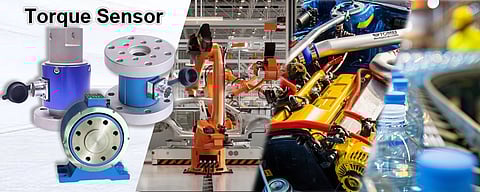
Torque sensors play an essential role in measuring rotational force and ensuring accurate, safe, and efficient operation across multiple industries. Below are the most common applications:
E-Bikes & Electric Vehicles
Torque sensors detect real-time pedaling or steering force, enabling smooth pedal-assist performance and responsive electric power steering systems.
Robotics & Automation
They help robots control gripping force, improve interaction with objects, and perform delicate, precise movements.
Industrial Power Tools
Torque sensors ensure accurate tightening torque in assembly tools, improving product consistency and workplace safety.
Motor & Component Testing
Used in dynamometers and testing benches to measure torque under different loads, helping evaluate motors, engines, and mechanical components.
Wind Turbines
Torque sensors monitor the rotational shaft torque, helping optimize energy output and prevent mechanical overload.
Medical & Precision Devices
In surgical tools and micro-mechanical systems, torque sensors help regulate applied force to ensure accuracy and patient safety.
High accuracy and stability
Fast response for real-time control
Energy saving by avoiding overload
Protection for motors and gearboxes
Available in both contact and non-contact designs
Wide range for EV, robotics, aerospace, and industrial applications
All torque transducers are torque sensors, but not all torque sensors are transducers.
Torque sensors are mainly used to measure and monitor torque in operational systems, while torque transducers are specialized for high-precision testing and calibration.
Torque sensors play a key role in modern machines. They deliver accurate, real-time torque data that makes motors smoother, tools safer, and robots more precise. Whether you're designing an e-bike, building a robot, or testing an engine, a high-quality torque sensor improves performance, protects equipment, and enhances efficiency.
